
Prestonsburg, Kentucky bus crash
On the morning of February 28, 1958, twenty-seven Floyd County families sent their children to school as they did every morning. Forty-eight children boarded the bus that rolled out of Lancer and Emma and Auxier and through the river bottoms toward the high school in Prestonsburg. By midmorning, twenty-six of those children would be dead. So would their driver. The bus had skidded into the back of a wrecker truck on U.S. Route 23, lurched off the embankment, and plunged into the icy, rain-swollen Levisa Fork of the Big Sandy River. Fifty-three hours passed before Navy divers from Norfolk found the bus, submerged and swept downstream. It remains, sixty-eight years later, the third-deadliest bus crash in American history.
The Morning
It had rained for days. The Levisa Fork was running fast and brown, well above its banks, swallowing the river-bottom roads. The temperature was a few degrees above freezing. John Alex DeRossett, the driver, was running his usual Bus 27 route, picking up elementary and high school children from the small communities of Lancer, Emma, and Auxier. Forty-eight students were aboard - some quite young, some nearly grown. Anna Laura Goble was nine years old, from Emma. James Edison Carey was also nine, also from Emma. John Harlan Hughes Jr. was thirteen, from Lancer. James Thomas Ousley was fifteen, also from Lancer. They had names. They had hometowns measured by post office boxes and creek crossings. They were riding to school.
The Crash
What happened on U.S. 23 took only seconds. The bus came up behind a wrecker truck and clipped its rear. The wrecker drove on, the driver apparently unaware of the contact. The bus, knocked off course, rolled down the embankment and into the river. The Levisa Fork was deep, fast, and cold. The current took the bus and carried it downstream. Twenty-two children escaped the sinking bus in the first minutes, pulled from the river by people running from nearby homes. The rest could not get out. Most of the children were thought to have survived the initial impact. They drowned in the dark, submerged interior, swept along by floodwater. By the time emergency responders reached the riverbank, most of the bus was already gone.
Fifty-three Hours
The recovery operation that followed became the largest in Kentucky's peacetime history. Governor Happy Chandler called up five hundred National Guardsmen from nine cities. Divers from the United States Navy were flown in from Norfolk. Local volunteers - miners, farmers, anyone who could swim or carry - searched the swollen river for miles downstream. The bus was finally located fifty-three hours after it went in. When it was lifted from the river, the truth of what had happened became unbearable. Most of the children were still inside. Twenty-two students had escaped in those first desperate minutes; they were the only ones who made it out. Twenty-six students had died, along with John DeRossett, the driver, who had stayed at his wheel. The Floyd County Emergency and Rescue Squad was founded by volunteers two months later, on April 27, 1958, born directly from what they had seen along the river. It remains an all-volunteer agency today.
What the Songs Remembered
Within months, two recordings appeared. The Stanley Brothers, the Appalachian bluegrass duo from just over the Virginia line, released No School Bus in Heaven. Ralph Bowman cut The Tragedy of Bus 27. Neither charted nationally, but both got regional airplay across the coalfields. In a country that had a hard time finding words, the music came forward to do what music does in Appalachia when nothing else will work. Thirty years later, in 1988, another Kentucky school bus - this one returning from a church youth trip to Carrollton - was struck by a drunk driver and burned, killing twenty-seven. The two crashes are tied for third-deadliest in American history. Both happened in Kentucky. Both involved children who had survived the initial collision but could not escape the bus. After Carrollton, Kentucky changed its requirements: every public school bus in the state now carries nine emergency exits, the most of any state or Canadian province. That standard exists, in part, because of what the Levisa Fork did to Bus 27 and what came after.
The Sign by the Guardrail
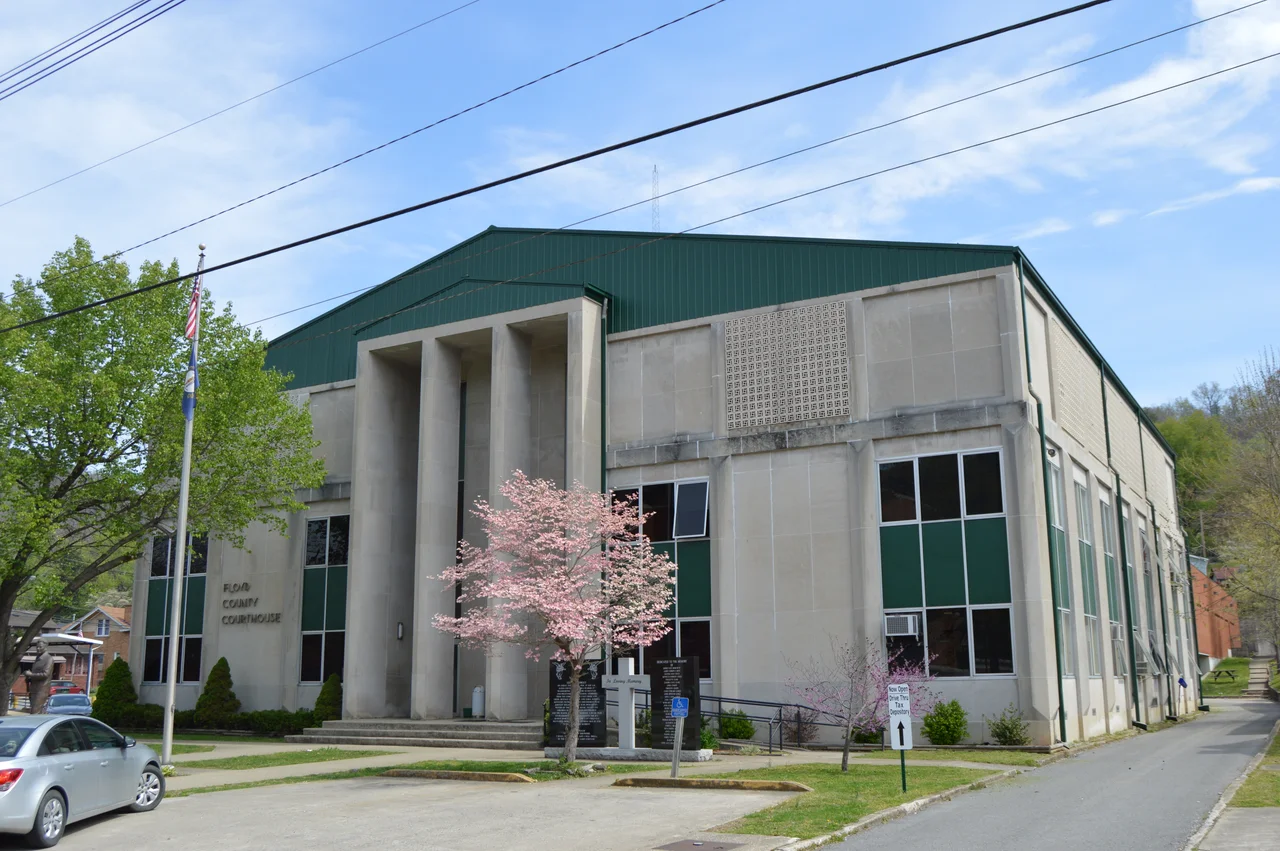
On Route 1428, the old alignment of U.S. 23, six tenths of a mile east of the Route 302 intersection, a sign stands by the guardrail. It shows the shadow of a school bus with the names of the children and the driver overlaid on it - twenty-seven names that should not be there. A wreath of plastic flowers usually rests against the guardrail in front of it. Two documentary films - The Very Worst Thing and A Life of Its Own - have been made about what happened. The memorial in front of the old Floyd County courthouse in Prestonsburg lists the same names. Sixty-eight years later, in the small Kentucky communities along the Big Sandy, those names are still spoken. The river still runs along U.S. 23. The school buses still cross the bridge. And the country that lost its children on a cold February morning in 1958 remembers, because there is nothing else to do.
From the Air
The crash site sits at approximately 37.67 degrees north, 82.72 degrees west along the Levisa Fork of the Big Sandy River in Floyd County, Kentucky, on the old alignment of U.S. 23 east of Prestonsburg. Best viewed quietly. Nearest airport is Big Sandy Regional (K0I8) about 15 nm north in adjacent Martin County. Tri-State Airport (KHTS) is the nearest commercial field, roughly 50 nm to the north. The river valley follows U.S. 23 north-south through eastern Kentucky's coal country.
Nearby Stories
- Kentucky Appalachians 4 km away
- Mingo County, West Virginia 11 km away
- Alice Lloyd College 14 km away
- 2002 Appalachian School of Law shooting 24 km away
- Hobet Coal Mine 28 km away
- The Kentucky Meat Shower: When Flesh Fell From a Clear Sky 41 km away
- Cumberland Gap 99 km away
- Battle of Blue Licks 100 km away