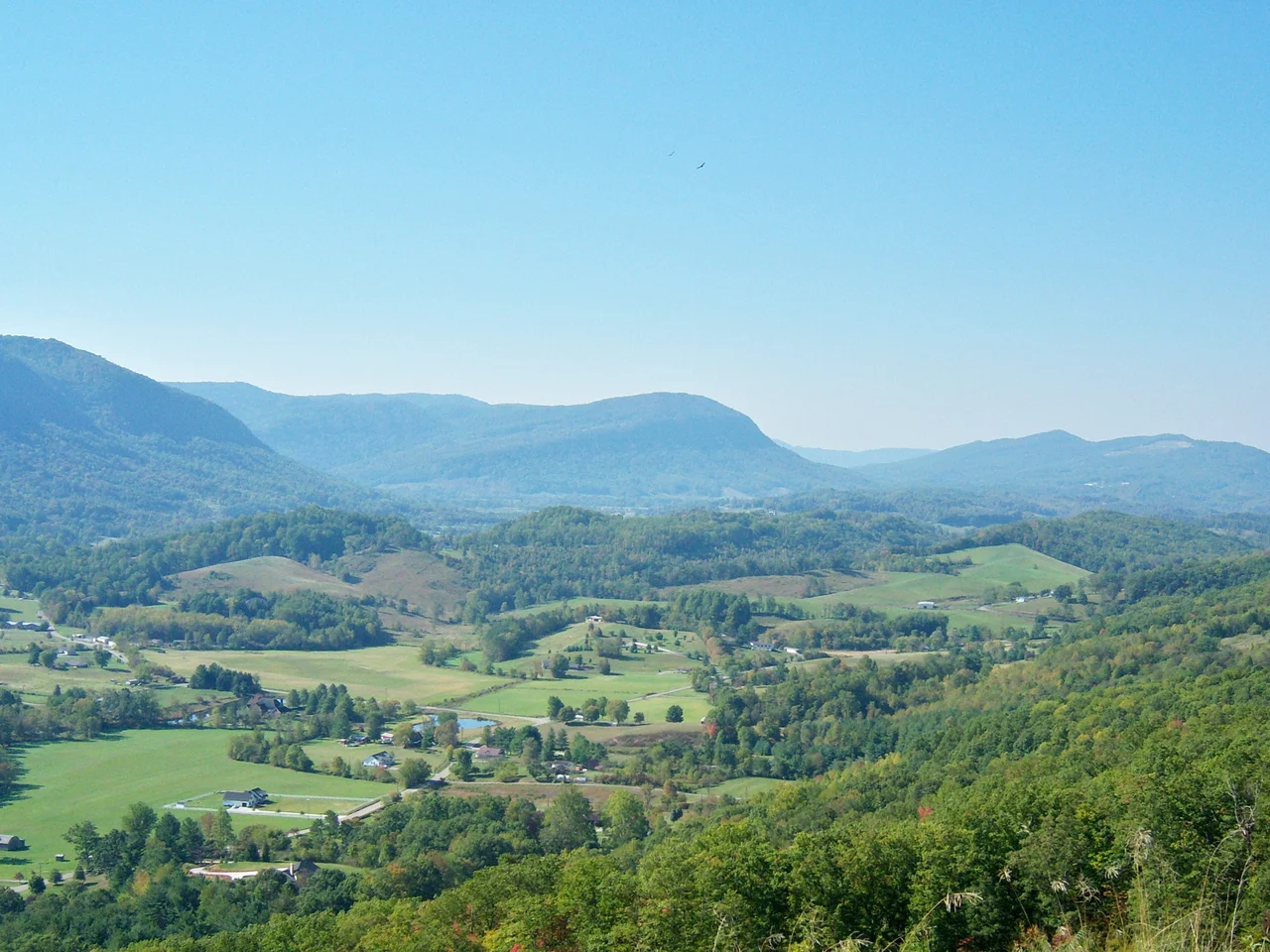

Wise County, Virginia
Wise County is one of those places where everything happened. The actor George C. Scott was born here. So was Napoleon Hill, whose 1937 book Think and Grow Rich has sold tens of millions of copies. So was Ralph Stanley, the bluegrass tenor whose high lonesome voice carried the genre into the twenty-first century. So was John Fox Jr., whose 1908 novel The Trail of the Lonesome Pine made the southern mountains visible to American readers. So was Edith Maxwell, a schoolteacher whose 1935 conviction for killing her father set off one of the biggest media firestorms of the decade. The county is 405 square miles of Appalachian ridges in the southwestern corner of Virginia, formed in 1856 and named for Henry A. Wise, then the state's governor. Coal made it. The closure of coal is unmaking it. What comes next is still being worked out.
Before Coal
The Cherokee held this country, with Shawnee and Iroquois challenges, through the seventeenth and eighteenth centuries. In the summer of 1786, Cherokee and Shawnee hunting parties fought a two-day battle at the headwaters of the Clinch River - a Cherokee victory, with heavy losses on both sides. The first European explorers reached present-day Wise County in 1750: Thomas Walker and Christopher Gist, traveling separately, looking for land. Bob Benge, a leader the settlers called Chickamauga Cherokee, led the last major Native resistance in the area. He was killed in 1794, and after his death white settlement accelerated. By 1856 there were enough people in the upper reaches of the Clinch to justify breaking a new county off Lee, Scott, and Russell. They named it for Henry A. Wise.
The Coal Decades
Coal arrived in the 1880s and remade everything. The Stonega Coke and Coal Company organized in the town of Appalachia and built up the surrounding hollows with company houses, company stores, and rail lines. Labor came from far away - African American families moving north, and Irish, Polish, Italian, and Hungarian immigrants drawn by the wages. Towns like Stonega, Dunbar, Osaka, Tacoma, Glamorgan, and Derby grew up as coal camps with whole populations dependent on a single seam. At the peak the county had work for tens of thousands. Mining was dangerous, lung-blackening work, and union battles ran hot through the early twentieth century. The 1880s boom was the founding event in modern Wise County history. The slow decline that followed is the other.
Famous Sons and One Famous Daughter
George C. Scott grew up in Wise in the 1930s, watched coal trains as a boy, and became the actor who refused his Patton Oscar in 1971 because he found the awards system absurd. Napoleon Hill, born in 1883 in Pound, drew on the discipline of his hardscrabble childhood to write the self-help book that would shape Andrew Carnegie's ideas into the American gospel of personal achievement. Ralph Stanley, born in 1927 near the county line in Dickenson, learned mountain banjo from his mother and built a sound that would carry bluegrass into the O Brother, Where Art Thou? soundtrack and back into popular consciousness. John Fox Jr. wrote The Trail of the Lonesome Pine in nearby Big Stone Gap and put the southern mountains on America's literary map. Adriana Trigiani, also from Big Stone Gap, has continued that tradition. Edith Maxwell, convicted of killing her father in 1935 - a case that hinged on contested testimony and whose verdict was eventually commuted - became one of the most-covered defendants of her era.
Prisons, Power, and What Holds
Two of the highest-security prisons in Virginia opened in Wise County in the late 1990s, three years apart: Red Onion State Prison in 1998, Wallens Ridge State Prison in 1999. Both were built on coal-scarred ridges; both were seen, at first, as economic substitutes for the work that mining no longer provided. Both still operate, with reduced security classifications. In 2012, Dominion Energy fired up the Virginia City Hybrid Energy Center, a power plant burning about 80 percent coal and up to 20 percent biomass. In 2014 it was fined $47,651 for emissions violations. Mountain Empire Community College and the University of Virginia's College at Wise anchor the public-education economy. Each summer Big Stone Gap hosts the Trail of the Lonesome Pine outdoor drama; Norton holds the Dock Boggs Old-Time Music Festival in September; the High Knob lookout tower, at the peak of one of the highest mountains in Virginia, still draws hikers despite a 2007 fire. Wise County continues to produce. What it produces is no longer always coal.
From the Air
Centered near 36.97°N, 82.62°W in far southwestern Virginia, west of Dickenson County and north of Scott County. From cruising altitude Wise County appears as a series of high parallel ridges - Stone Mountain, Powell Mountain, Black Mountain - with the towns of Big Stone Gap, Wise, Appalachia, Norton, and Coeburn nestled in valleys between them. Strip-mining scars are visible on many ridges. Nearby airports: KLNP (Lonesome Pine, Wise) sits centrally in the county; KTRI (Tri-Cities, TN-VA) lies about 35 nm south. High Knob lookout tower marks the highest point. Recommended viewing altitude 5,000-10,000 ft AGL. Best appreciated in autumn for fall color or winter for visibility through bare trees.
Nearby Stories
- Alice Lloyd College 11 km away
- 2002 Appalachian School of Law shooting 15 km away
- Bristol, Virginia 16 km away
- Scott County, Virginia 17 km away
- Appalachian School of Law 34 km away
- Cumberland Gap 35 km away
- The Kentucky Meat Shower: When Flesh Fell From a Clear Sky 102 km away
- Fraterville Mine Disaster 118 km away