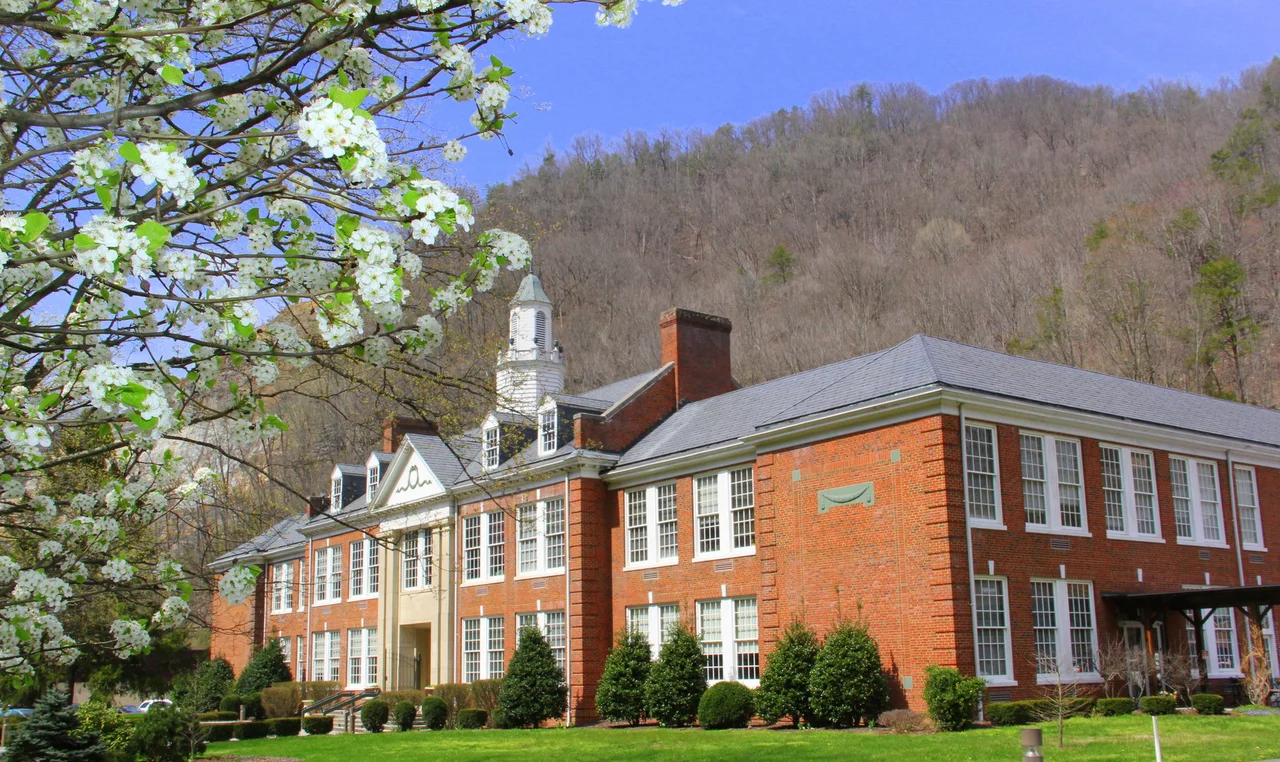

Appalachian School of Law
Ex petra veritatis justitia exsurgit. From the rock of truth, justice arises. The motto of the Appalachian School of Law was carved in Latin partly out of academic tradition and partly because the founders meant something specific by it: the rock in question was Buchanan County, Virginia - the actual sandstone of the Appalachian Plateau, the coal-bearing strata under the campus, the mountain country that built the town of Grundy and had been written off by most of the rest of the country. Justice, they thought, ought to arise from there too. In 1997, the school took in its first class of seventy-one students. The buildings that housed them had previously been a junior high school.
A Law School in a Coal Town
Grundy is the seat of Buchanan County, the only county in Virginia that borders both West Virginia and Kentucky - tucked into a fold of the Appalachian Plateau where the Levisa Fork cuts through the sandstone. By the early 1990s, the coal economy was contracting, the town's population was shrinking, and local leaders were looking for something that could anchor a future. The notion of a law school in a remote coal town was, by any conventional measure, implausible. But the area had no lawyers to spare and a county economy desperate for institutional investment. A million-dollar loan, eventually converted to a grant, paid for renovating the former Grundy Junior High School. The State Council of Higher Education in Virginia approved the school to enroll Juris Doctor students in 1997. The American Bar Association came along with provisional accreditation soon after.
The Founding Mission
ASL was created to train lawyers for places like the place it was built in. The curriculum emphasizes alternative dispute resolution and community service - both topics chosen with central Appalachia in mind, where civil disputes often involve neighbors and where access to formal legal services has historically been thin. Every student is required to perform community service hours. The school's small size - around 128 full-time students - was deliberate, allowing close mentorship from a faculty that included nationally recognized scholars who had chosen Grundy for the same reasons the school existed. The dean at the time of opening, and through the school's first formative years, was Anthony Sutin, who had served in the Clinton Justice Department before coming to Buchanan County to build something new.
January 16, 2002
On January 16, 2002, a former student named Peter Odighizuwa, who had been dismissed for academic reasons, returned to campus with a handgun. He killed Dean Anthony Sutin, Professor Thomas Blackwell, and first-year student Angela Dales, a single mother working her way through law school. Three other students were wounded. The shooting lasted minutes. Odighizuwa was subdued in the parking lot by other students and held until police arrived. He was eventually found mentally competent, pleaded guilty to avoid the death penalty, and is serving multiple life sentences at Red Onion State Prison. The school responded by planting memorial trees on its front lawn, renaming its student services office and scholarship program in Angela Dales's memory, and continuing the work. It has never closed in remembrance, but it has never forgotten.
A Sister School in Pharmacy
ASL's modest early success encouraged the same Buchanan County leaders to try the same trick again. The Appalachian College of Pharmacy - originally the University of Appalachia College of Pharmacy - was founded in nearby Oakwood in 2003, opening its doors in 2005. It occupies the buildings of the former Garden High School. Like the law school, it was designed to serve a region with chronic shortages of professional services and to give graduates a pathway into Appalachian communities that needed them. The two institutions, tucked into a corner of the country that most maps show only as elevation, train a steady stream of lawyers and pharmacists who go to work in towns that used to lose their best students permanently to the cities.
The Difficult Years
Like many small private law schools, ASL has faced hard years. Bar passage rates have wavered. Employment outcomes for graduates, particularly in the years following the 2008 recession, were difficult - the school's 2021 disclosure showed 31% of the Class of 2020 in full-time, JD-required work within nine months. The ABA placed accreditation pressure on the school in 2017, which was later lifted in 2020. The school has continued to operate, continued to graduate classes, continued to plant graduates into the courthouses and law offices of central Appalachia. The motto on the seal still reads Ex petra veritatis justitia exsurgit. The faculty fellowships still bear the names of Sutin and Blackwell. The road outside campus still bears the name of Angela Dales. From the rock of truth - and from the rock of remembered loss - the school continues to do what it was built to do.
From the Air
The Appalachian School of Law sits at 37.28 degrees north, 82.09 degrees west in Grundy, Virginia, in the narrow Levisa Fork valley of Buchanan County. The campus is small and tucked into former school buildings; not easily distinguished from altitude. Nearest airport is Pike County Airport (KPBX) about 20 nm west across the state line. Tri-State Airport (KHTS) is the nearest commercial field, 75 nm to the north. The surrounding terrain runs 1,500-2,500 feet AGL with significant ridge lines.
Nearby Stories
- Matewan Historic District 6.7 km away
- Prestonsburg, Kentucky bus crash 11 km away
- Wise County, Virginia 13 km away
- Alice Lloyd College 23 km away
- Tazewell County, Virginia 25 km away
- Upper Big Branch Mine Disaster 36 km away
- Appalachian League 39 km away
- Emory and Henry University 42 km away