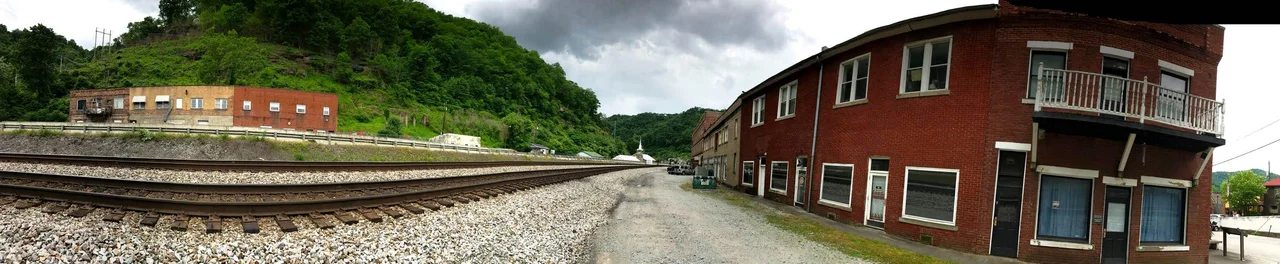

Matewan Historic District
Mayor Cabell Testerman was holding a warrant in his hand when Albert Felts shot him. It was about three in the afternoon on May 19, 1920, on Mate Street in Matewan, West Virginia, in front of the Chambers Hardware Store. Felts was a Baldwin-Felts detective. The warrant Testerman held was a forgery the detectives had brought to justify the day's evictions. Within seconds, Police Chief Sid Hatfield was firing back, miners on the rail platform across the street had opened up with rifles, and ten men were dying — seven detectives, two miners, and the mayor of a coal town who had refused to let the evictions go forward.
A Town You Can Still Walk
The Matewan Historic District is the small town center that witnessed the shooting. It sits on a narrow shelf of floodplain on the north bank of the Tug Fork, hemmed in by hills that rise steeply on every side and by Mate Creek to the east. Two main streets parallel the river: Mate Street, which is also West Virginia Highway 49, and Main Street. McCoy Alley runs between Main Street and the river. The buildings between the streets are mostly vernacular early twentieth-century commercial brick and frame, and most of them stood here on the day of the battle. The concrete bridge to the west is a later replacement. The railroad bed has been raised. The buildings — the bank, the hardware store fronts, the two-story commercial blocks — are the same.
Company Town, Company Detectives
Matewan in 1920 was a coal town. The mines that ringed it were essentially company kingdoms — operators controlled housing, stores, scrip, and the deputized force that kept order. When the United Mine Workers of America began signing up miners in Mingo County that spring, the Stone Mountain Coal Company answered by hiring Baldwin-Felts detectives to evict the families of union men from company houses. Sid Hatfield, the town's young police chief, was a coal miner himself and the son of coal miners. He told the detectives they had no authority inside Matewan's town limits. Mayor Cabell Testerman backed him. When Albert and Lee Felts arrived on the noon train with their crew and began clearing households at gunpoint, Hatfield and Testerman went down to the rail depot to stop them. The shootout that followed lasted only minutes.
The Dead and What Came After
Albert Felts and his brother Lee Felts both died. So did five other detectives, two striking miners, and Mayor Testerman. The Urias Hotel that had served as the detectives' headquarters is gone now, one of the few historic structures lost from the district. The event radicalized the West Virginia coalfields. Sid Hatfield was acquitted of the killings, but on August 1, 1921, Baldwin-Felts detectives shot him and his deputy Ed Chambers dead on the courthouse steps in Welch as their wives watched. Within weeks, ten thousand armed coal miners began marching toward Logan County in what became the Battle of Blair Mountain — the largest armed uprising in American labor history. The march ended only when federal troops intervened with the threat of aerial bombing.
What the District Preserves
Matewan was designated a National Historic Landmark in 1997. The West Virginia Mine Wars Museum, an independent institution on Mate Street, documents the events of 1920 and 1921 in the buildings where they happened. Bullet holes in the brick storefronts are still pointed out to visitors. John Sayles's 1987 film Matewan was filmed in the area and renewed national interest in a story that the coal industry had spent decades trying to forget. The town below those steep hills is small and quiet, and the river still bends the way it bent in 1920. The names of the men who died here are not abstractions. Cabell Testerman. Albert Felts. Lee Felts. The two miners whose stand in front of the hardware store helped change American labor history.
From the Air
Coordinates: 37.62N, 82.17W, elevation roughly 700 feet (210 m). Matewan sits on a tight bend of the Tug Fork, the river that forms the West Virginia-Kentucky border here. Recommended viewing altitude 4,500-6,000 feet MSL to clear the surrounding ridges. The Norfolk Southern rail line runs the length of the historic district between Mate Street and the river. Nearest airports: Williamson-Mingo (6L4) about 12 nm northwest, Mercer County (KBLF) about 35 nm east. The valley fogs in heavily at sunrise; clear sky usually arrives by 10am local.
Nearby Stories
- National Coal Heritage Area 6.5 km away
- Prestonsburg, Kentucky bus crash 9.7 km away
- Hobet Coal Mine 16 km away
- Yatesville Lake 17 km away
- 2002 Appalachian School of Law shooting 18 km away
- Alice Lloyd College 26 km away
- Upper Big Branch Mine Disaster 26 km away
- Bluefield, Virginia 33 km away