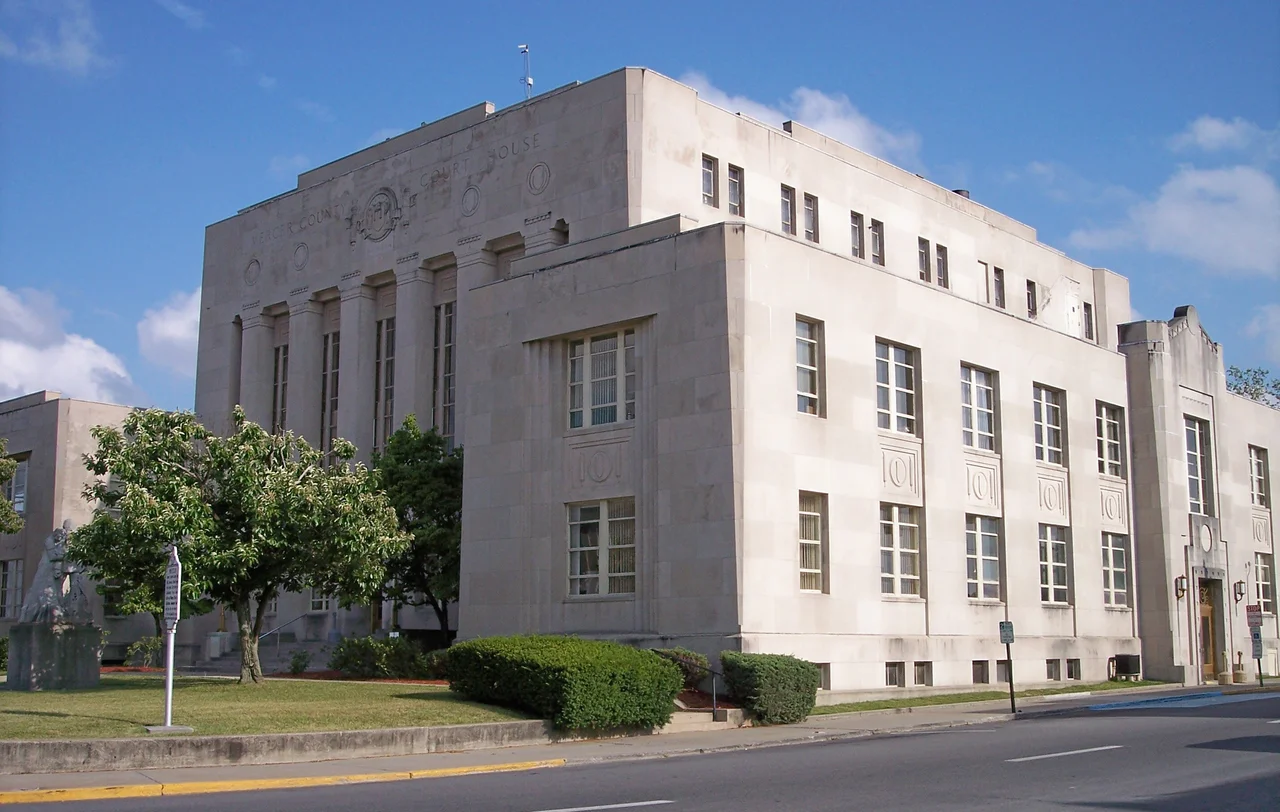

Princeton, West Virginia
Princeton was burned by its own side. On May 1, 1862, with Union troops advancing through Mercer County during the Civil War, Confederate Captain Walter Jenifer ordered the town torched to prevent the federal army from capturing the supplies stored there. According to local accounts, many Princeton residents lit their own homes themselves before walking away from the rubble. By the time the fire died down, almost no building was left standing. The Robert McNutt house survived - ironically, as the federal army then commandeered it for headquarters. After the war, residents shunned the new circuit judge, Nathaniel Harrison, for being a Confederate turncoat. Princeton would have to start over.
Reconstruction and the Long Wait
The new State of West Virginia was created in 1863, but Princeton and Mercer County had stayed loyal to the Confederacy, and they were not included in the original counties forming the new state. By the end of 1865 they were absorbed in anyway. Princeton slowly rebuilt during Reconstruction, but the real change was still decades away - and it arrived not by river but by rail. In Southern West Virginia, in the late 19th century, coal mining and railroads combined into a single, transformative industry. Most of the early action was elsewhere. Princeton sat east of the primary coalfields, and watched the trains run past for thirty years before its own moment came.
The Standard Oil Railroad
The story of how the Virginian Railway got built sounds like financial fiction. In 1896, an engineer named William Nelson Page started building the Loup Creek and Deepwater Railway - a tiny logging line connecting a sawmill to the C&O mainline on the Kanawha River. He renamed it the Deepwater Railway in 1898. Then in 1902 he enlisted a silent partner: Henry Huttleston Rogers, one of the senior partners of Standard Oil and one of the richest men in America. Together they planned to push the line 80 miles south to tap untapped bituminous coalfields. The Norfolk and Western and the C and O refused to give Page reasonable interchange rates - the established railroads expected the upstart to give up. They had no idea Standard Oil's fortune was behind him.
Tidewater, Deepwater, Victoria, Sewells Point
Instead of giving up, Page and Rogers expanded their plan. In Virginia, they incorporated a second railroad - the Tidewater Railway, officially based in Staunton on the C&O. But the Tidewater quietly surveyed and bought rights of way far from the C&O, paralleling the Norfolk and Western across southern Virginia, even through Roanoke where the N&W had its corporate headquarters. By the time the established railroads realized in 1906 that Deepwater and Tidewater were related, the route was secured. N&W president Lucius E. Johnson was famously hauled to 26 Broadway in New York - the Standard Oil Building - by Andrew Carnegie, to meet Rogers. The meeting reportedly took only a few minutes. In 1907, Deepwater and Tidewater merged to form the Virginian Railway, completing the line from Deepwater all the way to Sewells Point on Hampton Roads in 1909 - 443 miles, built to standards no other railroad of the era could match.
Princeton, Headquarters of the New River Division
Princeton was designated headquarters of the Virginian's New River Division. The town was incorporated on February 20, 1909, the same year the railroad opened. For the first half of the 20th century, the Virginian was an engineering marvel that ran on Standard Oil money - electrified through the Allegheny Mountains, equipped with the heaviest locomotives in the world, and remarkably profitable for both its shareholders and its workers. In 1959 the Virginian was absorbed into the Norfolk and Western. The shift from steam to diesel-electric power eliminated most of the shops jobs in Princeton. By the late 20th century, almost nothing remained. The VGN's coal piers at Sewells Point were closed and folded into Naval Station Norfolk - the largest navy base in the world. Most of the Princeton Shops were demolished by 2006.
The Replica Station and the Plateau Town
Princeton today is a city of about 5,872 people, the county seat of Mercer County, the heart of the Bluefield micropolitan area. The average altitude is 2,400 feet, with hills rising to 3,100 and dropping to 1,700 along the river valleys. Most strikingly, residents built a replica of the Virginian Railway's original two-story Princeton Passenger Station and Offices - the largest such effort in the entire state. The new Princeton Railroad Museum looks like the original from a century ago, and houses the town's railroading heritage. The town that was burned by its own side has, in the end, kept the memory of its own past alive on its own terms - one engineering marvel, one Standard Oil fortune, and one well-built replica at a time.
From the Air
Princeton sits at 37.368 N, 81.096 W in Mercer County, southern West Virginia, at about 2,400 feet average elevation. The town occupies a small plateau in the Bluefield micropolitan area, with surrounding ridges rising to 3,100 feet and river valleys dropping to 1,700. Look for the distinctive two-story replica of the Virginian Railway passenger station downtown - now the Princeton Railroad Museum. Interstate 77 passes the eastern edge of town at exit 9. Nearest commercial field: Mercer County (KBLF) in Bluefield, about 7 nm south-southwest. Beckley (KBKW) is about 30 nm north. Concord University in Athens lies 10 nm north.
Nearby Stories
- Appalachian League 8.2 km away
- Welch, West Virginia 9.4 km away
- Virginia Tech 16 km away
- Battle of Lewisburg 21 km away
- Floyd County, Virginia 21 km away
- Buffalo Creek Flood 22 km away
- Beckley, West Virginia 22 km away
- Emory and Henry University 43 km away