
Battle of Lewisburg
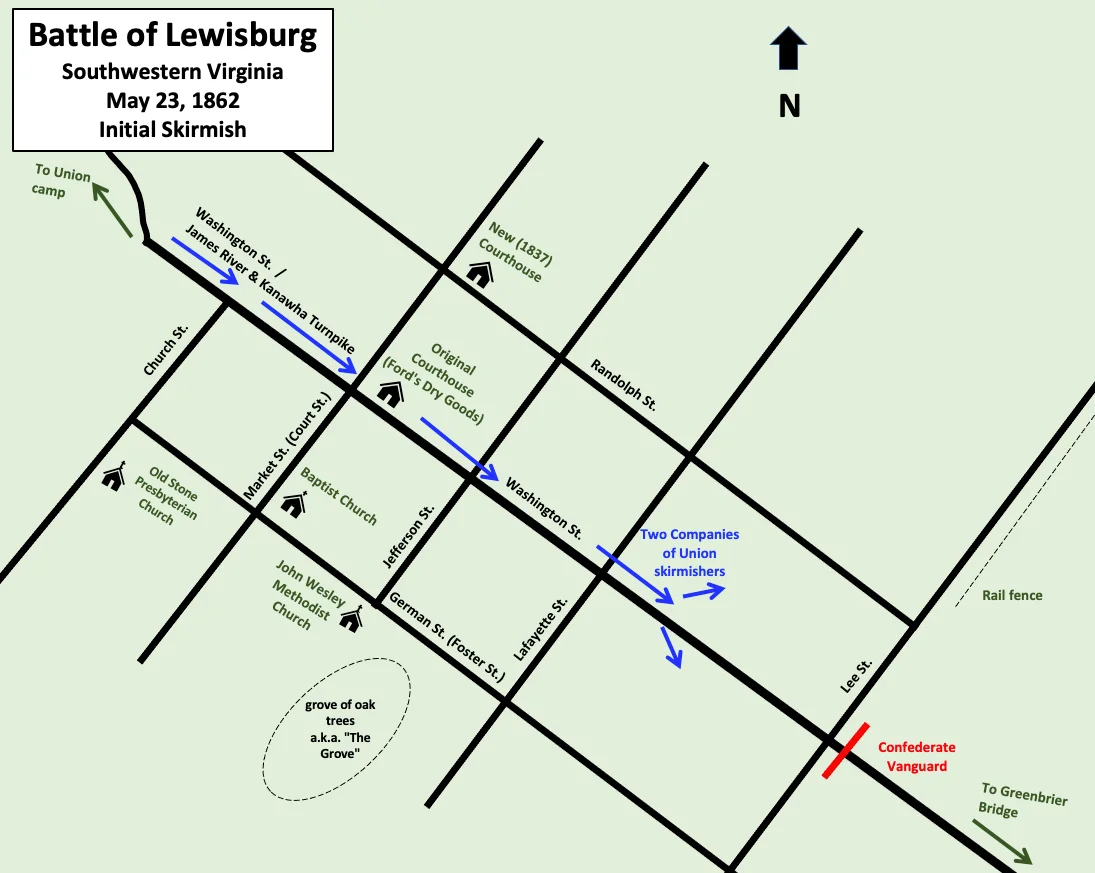
Just before sunrise on May 23, 1862, three Confederate regiments crested a ridge east of Lewisburg, West Virginia, and looked down at the sleeping Union camp below. They had marched fast through the night to surprise a numerically smaller Federal force - about 1,300 men of the Third Provisional Brigade, under a thirty-three-year-old West Point colonel named George Crook. The Confederates had artillery on the ridge and momentum on their side. What they did not have, as it turned out, was time. By the time the Lewisburg courthouse clock struck seven, the Confederate attack had collapsed in confusion through the town's streets, Crook's Ohio and Loyal Virginia regiments had captured four cannons, and the Battle of Lewisburg was over - a tidy Union victory that helped make Crook's career.
Two Armies, Two Problems
The campaign that brought Crook to Lewisburg began with John C. Fremont's Mountain Department plan to push south against Confederate forces in southwest Virginia. Crook's brigade, headquartered at Meadow Bluff in Greenbrier County, was the eastern arm of a two-prong advance. His three regiments included the 36th Ohio Infantry under Lieutenant Colonel Melvin Clarke, armed with Enfield rifled muskets; the 44th Ohio under Colonel Samuel Gilbert; and one battalion of the 2nd Loyal Virginia Cavalry (later the 2nd West Virginia Cavalry) under Major John J. Hoffman, carrying sabers, single-shot horse pistols, and shortened Enfields. Crook had occupied Lewisburg on May 12, scattering a small Confederate detachment. The Confederate response came together at Dublin Depot in southwest Virginia, where Major General William W. Loring's Department of Southwest Virginia ordered Brigadier General Henry Heth to march on Lewisburg with about 2,300 men - the so-called Army of New River, including the 22nd Virginia under Lieutenant Colonel George S. Patton (grandfather of the World War II general) and the 45th Virginia under Colonel William Henry Browne.
The Night March
Heth had numerical superiority and the element of surprise. He marched his men hard through the night of May 22-23, climbing the ridge east of Lewisburg in the darkness with four pieces of artillery. By dawn his line was forming on the high ground overlooking the town, the cannons unlimbering, the infantry dressing their lines for the descent. What he did not realize was that Crook had received intelligence of the approach the previous evening from local Unionist scouts. The Federal regiments stood to arms in the dark and moved out of camp before sunrise, taking up positions on the eastern edge of town. When Confederate artillery opened the fight around 5 a.m., the Union infantry was already in line. The 36th Ohio and the dismounted Loyal Virginia cavalrymen advanced up the slope into Heth's volley fire.
The Confederate Collapse
What happened over the next ninety minutes is the kind of small-unit confusion that decides battles when one side is inexperienced. The 45th Virginia, fighting its first engagement, took heavy fire from the Ohioans climbing the ridge. The 22nd Virginia, on Heth's other flank, became disordered in the broken terrain. Captain William H. Powell's cavalry, attached to the 2nd Loyal Virginia, worked around Heth's left and found a position from which they could enfilade the Confederate line. Patton's regiment broke first, falling back through the streets of Lewisburg in disorder. The 45th Virginia followed. Heth's cannons - four guns of the Western Artillery - were abandoned as the gunners fled. By 7 a.m., Heth had ordered a general retreat back across the Greenbrier River. The Federals captured 175 prisoners, four artillery pieces, and several hundred small arms. Union casualties were 13 killed and 53 wounded. Confederate casualties were 38 killed, 66 wounded, and 100 captured.
The Town That Stayed
Lewisburg's residents had spent the morning under fire from both sides. Civilians sheltered in cellars and behind stone walls as Confederate artillery shells flew over and Union infantry pushed through residential streets. The Old Stone Presbyterian Church, built in 1796 and still standing on Church Street, served as a field hospital for both sides after the battle - a familiar role for it, as it would also serve during later engagements. Confederate dead were buried in what became the Lewisburg Confederate Cemetery, a small plot at the corner of McElhenney and Randolph that today holds 95 unknown soldiers in a single mass grave. Crook's victory helped secure Greenbrier County for the Union for the immediate term, though the valley would change hands again before the war's end. For George Crook, the battle established a reputation for cool competence that carried him through the rest of the Civil War and, later, the Indian Wars on the western plains.
Aviator's Notes
The battle was fought at and around 37.80 N, 80.45 W in the streets of Lewisburg, Greenbrier County, West Virginia, at an elevation around 2,300 feet. The nearest commercial airport is Greenbrier Valley Regional (KLWB) at Lewisburg, just west of the historic district. From altitude the town reads as a compact grid in the broad Greenbrier Valley, with the Greenbrier River flowing on the south side of town and Interstate 64 just to the south. The historic Lewisburg district, including the Confederate Cemetery and the Old Stone Presbyterian Church, sits at the eastern edge of the modern downtown - the same ground over which the battle was fought.
From the Air
Located at 37.80 N, 80.45 W in Lewisburg, Greenbrier County, West Virginia, at approximately 2,300 feet elevation. Nearest airport: Greenbrier Valley Regional (KLWB), located just west of the historic district. Recommended viewing altitude 5,500-7,500 feet. The Greenbrier River runs on the south side of town as a useful landmark; I-64 runs east-west south of the town. Mountain weather brings winter icing and summer afternoon thunderstorms.
Nearby Stories
- Bath County Pumped Storage Station 7.2 km away
- Botetourt County, Virginia 7.5 km away
- Paint Bank, Virginia 8.2 km away
- Gauley River National Recreation Area 8.8 km away
- Seebert Lane Colored School 12 km away
- Babcock State Park 16 km away
- Garth Newel Music Center 16 km away
- Concord University 25 km away