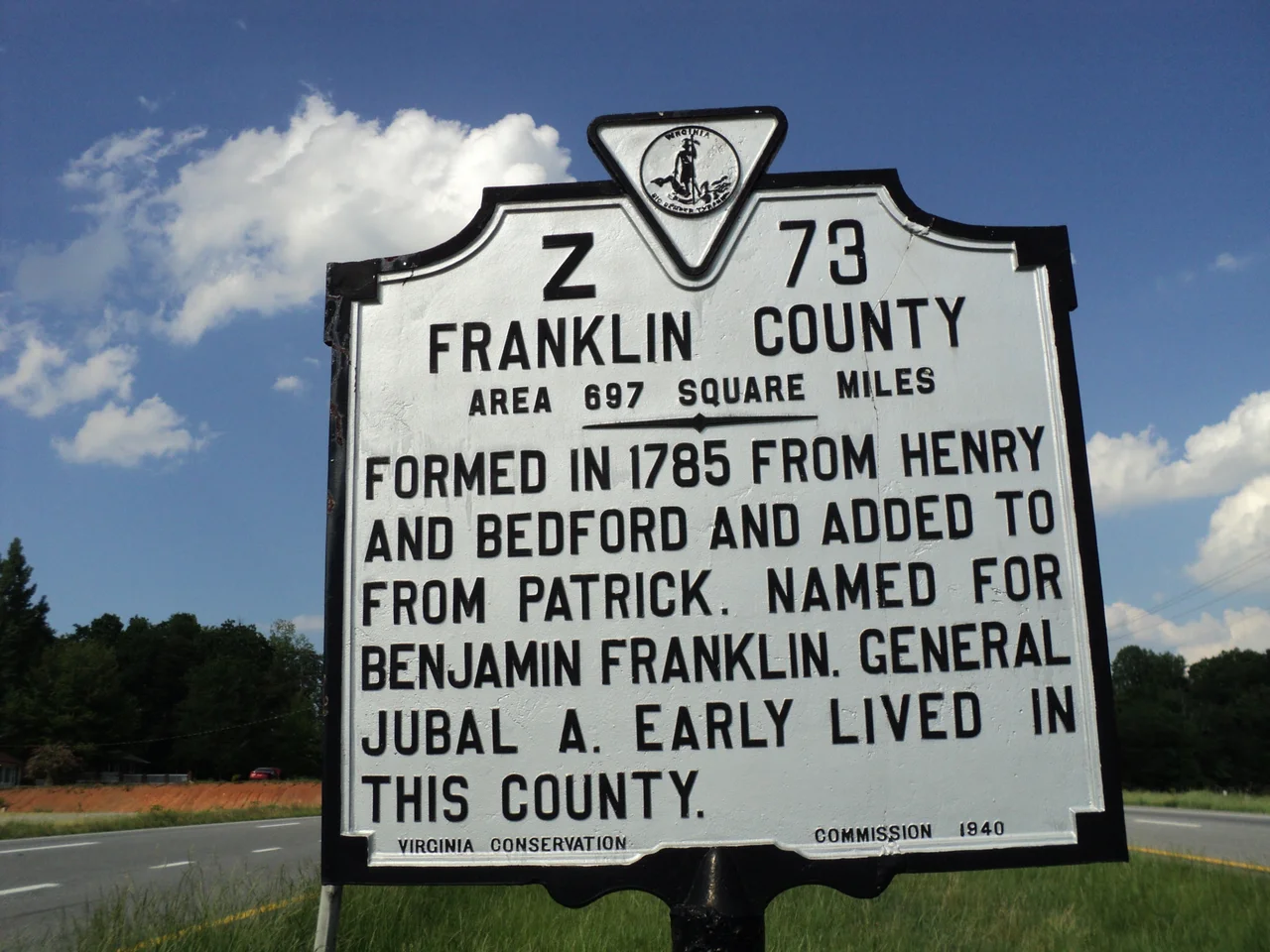

Franklin County, Virginia
Historians have estimated that during the 1920s, ninety-nine of every hundred residents of Franklin County, Virginia were in some way involved in the illegal liquor trade. The math is almost certainly an exaggeration - but only barely. Local stills ran day and night through Prohibition. The whiskey moved by truck through the Blue Ridge passes to Chicago, New York, and points in between. Between 1930 and 1935 alone, federal investigators estimated that Franklin County still operators sold a volume of whiskey that would have generated $5.5 million in 1920s excise taxes - a number adjusted for inflation that translates to many tens of millions today. The local chamber of commerce eventually adopted the title Moonshine Capital of the World as a tourism slogan. The bootleggers became local legends; one of them, Forrest Bondurant, became the subject of his grandson Matt Bondurant's novel The Wettest County in the World, adapted in 2012 as the film Lawless. The county that produced that liquor also produced Booker T. Washington, born enslaved on a tobacco farm near Hale's Ford in 1856. Today, with about 54,000 people on 712 square miles of Blue Ridge foothills, Franklin County is still working out what it wants to be remembered for.
Born on the Burroughs Farm
Booker Taliaferro Washington was born into slavery in 1856 on the Burroughs Tobacco Farm at Hale's Ford in Franklin County. He was nine years old when emancipation came. He walked, with his family, across the mountains to Malden, West Virginia, where his stepfather had found work in the salt mines. From those circumstances - a child of slavery in a country still arguing about what to do with him - Washington eventually walked himself into Hampton Institute, into the founding of Tuskegee Institute, into a complicated political role that historians still debate, and into the first autobiography by a Black American to become a national bestseller. The cabin where he was born is part of the Booker T. Washington National Monument today, preserved with a partial reconstruction of the Burroughs farm complex. A child born enslaved in this county became one of the most influential American educators of the nineteenth century. The cabin still stands.
Prohibition Country
When the Eighteenth Amendment took effect in 1920, Franklin County had several things going for it as a moonshine economy. Abundant clean water in mountain streams. Tucked-away hollers where federal revenue agents would never find a still. Tradition - Scots-Irish settlers had been distilling whiskey on this land for more than a century before Prohibition. And the right network of relationships between local farmers, distillers, and gangsters in Chicago and elsewhere who needed product. The bootleggers ran the operation up Highway 29 toward Washington and onward to the cities. Some local law enforcement officials were part of the criminal activity and helped kill competitors. The county's high participation rate was not a metaphor: ordinary farmers ran small stills as cash supplements; the larger commercial operations involved dozens of workers. The trade kept going after Prohibition ended in 1933, in smaller volumes but with continuing significance. Moonshine is still being made in the area, according to the county's own published history.
The Bondurant Brothers
Howard, Forrest, and Jack Bondurant were three of the brothers who ran a bootlegging operation out of the Snow Creek area of Franklin County during Prohibition. Their grandson Matt Bondurant turned their story into the historical novel The Wettest County in the World in 2008. The novel - centered on Forrest, who survived multiple violent encounters with rival distillers and corrupt law enforcement - became the basis for the 2012 film Lawless, directed by John Hillcoat from a screenplay by Nick Cave, starring Shia LaBeouf, Tom Hardy, and Jessica Chastain. Forrest Bondurant developed a local reputation for being almost impossible to kill: he reportedly survived a slashed throat that should have been fatal, by walking himself to the hospital. The film romanticized; the historical reality was rougher. Confederate General Jubal Anderson Early - the man who led the 1864 raid on Washington - was born in Franklin County as well. Two kinds of folk hero, one for each century.
Adam Clayton Powell Sr.
Adam Clayton Powell Sr. was born in 1865 in Franklin County to Sally Dunning, a free woman of color whose family had been free for at least three generations before the Civil War. The detail matters: Powell did not begin enslaved. His mother's family represented one of the small but meaningful communities of free Black Virginians who lived through the slavery era and out the other side. Powell worked his way through Wayland Seminary and Yale University and eventually became pastor of the Abyssinian Baptist Church in Harlem from 1908 to 1936, building it into the largest Protestant congregation in the United States at the time - more than 10,000 members. His son, Adam Clayton Powell Jr., would become one of the most consequential African American politicians of the twentieth century. Franklin County produced both Booker T. Washington and Adam Clayton Powell Sr. - two of the most important figures in Black American religious and educational history, born within a few decades and a few miles of each other.
Smith Mountain Lake and the New Economy
Since the 1980s the county's center of economic gravity has shifted toward Smith Mountain Lake - the 32-square-mile reservoir created in 1966 when Appalachian Power dammed the Roanoke River for hydroelectricity. The lake brought lake houses. Lake houses brought retirees and commuters from Roanoke, Lynchburg, Martinsville, and Danville. Smith Mountain Lake was the on-location setting for the 1991 Disney comedy What About Bob?, starring Bill Murray and Richard Dreyfuss - a film whose cast and crew lived in the same lakefront cottages whose owners now charge weekly rentals. The Blue Ridge Parkway passes through the southwest corner of the county; the Booker T. Washington National Monument anchors the northeast. Population is up. Median age is up. The hollers that once held stills now hold weekend homes. Some local distillers, going legitimate, now sell licensed moonshine at boutique distilleries to the same tourists who once would have been unwelcome on the property. The economy changes. The whiskey is still made here, with permits this time.
From the Air
Franklin County centers near 36.99 degrees north, 79.88 degrees west, in the Blue Ridge foothills of southern Virginia. The county seat Rocky Mount sits roughly 25 miles south of Roanoke. Smith Mountain Lake, a long irregular reservoir, dominates the eastern portion of the county and is the most visible landmark from cruising altitude. Roanoke-Blacksburg Regional (KROA) is the nearest commercial airport, about 25 miles north. The Blue Ridge Parkway crosses the southwest corner; the Booker T. Washington National Monument is near Hale's Ford. Ferrum College sits on a ridge in the west part of the county.
Nearby Stories
- Norwich Historic District 0.6 km away
- Martinsville, Virginia 12 km away
- Radford, Virginia 15 km away
- Wreck of the Old 97 17 km away
- Poplar Forest 19 km away
- Hargrave Military Academy 20 km away
- Draper's Meadow Massacre 23 km away
- Chang and Eng Bunker 33 km away