
Radford, Virginia
Before it was Radford, it was Lovely Mount. Before Lovely Mount, English Ferry. Before English Ferry, Ingle's Ferry. The succession of names reflects what this little patch of southwestern Virginia has always been: a crossing point. Travelers stopped at the New River here for fresh water on their way west. Then the Virginia and Tennessee Railroad arrived in 1854 and a depot went up at Lovely Mount, exactly halfway between Lynchburg and Bristol. Everything that has happened to Radford since flows from that one decision.
The Town That the Railroad Made
Once the depot opened, the population boomed. Ice plants, a creamery, milling and piping companies all set up shop along the tracks. The settlement grew up around the railroad and not the other way around, which is why the train station area became known as Central Depot and the town picked up the name Central City along the way. In 1891 it was finally renamed for Dr. John B. Radford, whose home Arnheim still stands and joined the National Register of Historic Places in 2002. By 1971, when passenger service ended, personal cars and the new interstate had made the trains less necessary. But Norfolk Southern still runs freight through Radford on the Roanoke-to-Bristol line - the same route the town was built to serve.
A College and an Arsenal
Two things changed Radford in the 20th century. In 1913, the state chose it as the site for the Radford State Normal School - a women's college that would become Radford University in 1979. Then in 1940-41, with war coming, the U.S. military picked Pulaski and Montgomery counties just outside the city for a gunpowder and ammunition plant. The Radford Army Ammunition Plant - the Arsenal - drew families in from across the region. Neighborhoods went up specifically to house arsenal workers: Monroe Terrace, Radford Village, Sunset Village. They are still Radford's main residential districts. Today, the university dominates the city's identity - the 2020 population was 16,070, and the age distribution skews young in ways only a college town can - but the arsenal still hums quietly outside the city limits.
The Bobcats and the Beamer Connection
For a city of fewer than 17,000 people, Radford has produced a surprising volume of state athletic titles - more than thirty across the decades, in everything from tennis to track to wrestling. The 1971 and 1972 Radford Bobcats high school football teams ran off 26 straight wins and back-to-back AA state titles, briefly counted among the best high school teams in the country. The assistant coach for that 1971 championship squad was a young man named Frank Beamer, who would go on to become one of college football's most beloved coaches at Virginia Tech. Beamer's mentor in Radford was Norman G. Lineburg, who coached the Bobcats from 1970 to 2006 and retired with 315 wins - second only to Hampton's Mike Smith in Virginia high school football history.
Margaret Skeete and a Cast of Others
Radford's list of notable people runs in unexpected directions. Margaret Skeete, born in Texas in 1878 and later a Radford resident, lived until 1994 and was for a time the oldest living American. Corrine Conley voiced Rudolph's mother in the Rankin/Bass Christmas special. John Ripley earned the Navy Cross as a Marine Corps colonel. The Gregory Brothers, the musicians who turned news clips into viral songs in the 2010s, came from Radford. So did former governor John Dalton, the porn actress Seka, the evangelist Paul Washer, and Virginia Tech's current men's basketball coach Mike Young. James Hoge Tyler, Virginia's governor in the late 1890s, lived here too - which is why Tyler Avenue runs through campus today.
Bisset Park and the Water Below
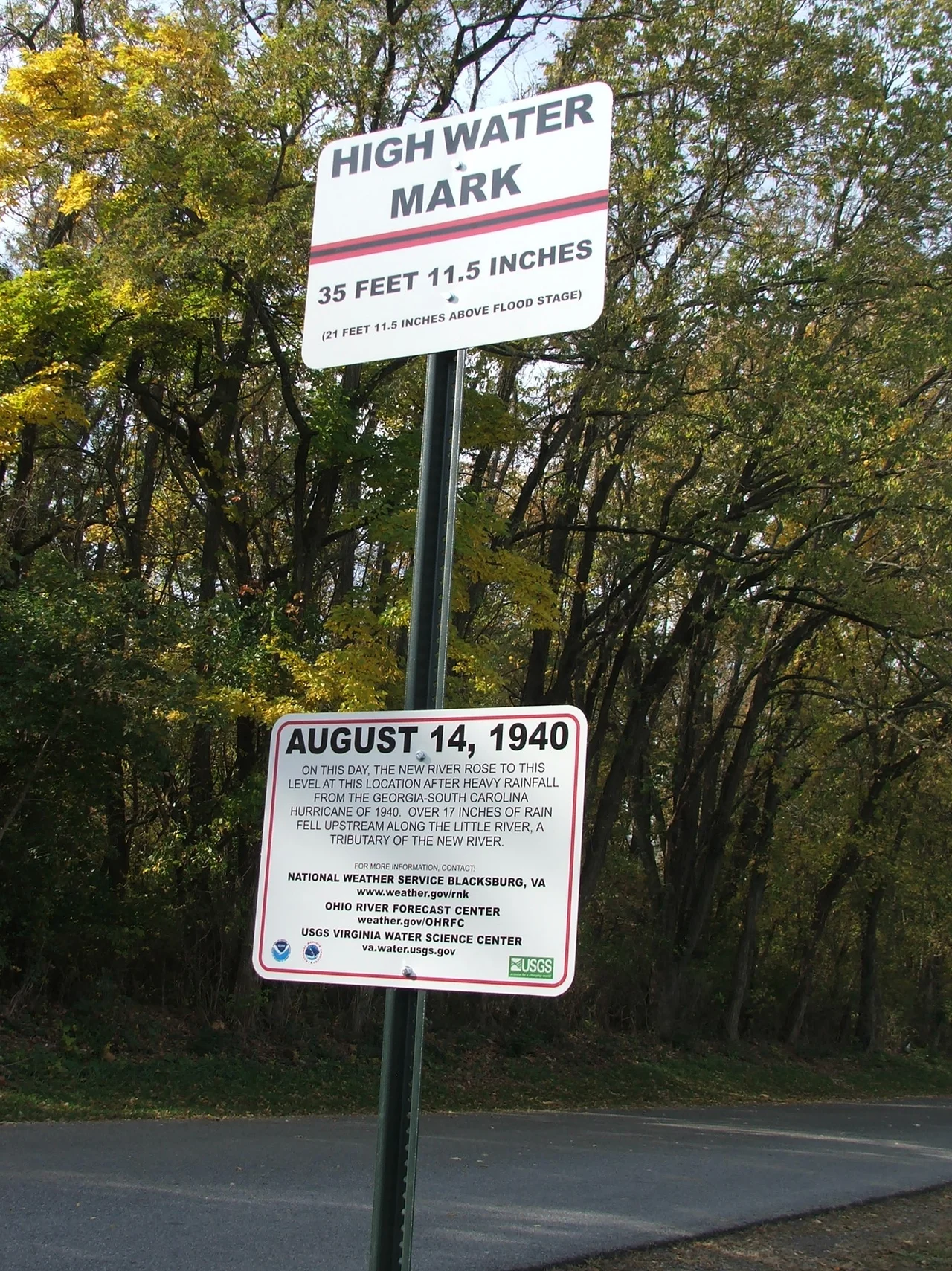
Bisset Park runs along the New River downtown - a strip of riverbank that floods often enough that the city has had to install high-water-mark signs. The river has shaped Radford's shape, its history, and its weather. The climate here is unusually mild for Appalachia, classified as marine west coast by the Koppen system - the kind of climate you find more often in the Pacific Northwest. The hills hold the rain in. The river takes a long, lazy bend through town. And the sun, when it shines, picks out the Norfolk Southern coal trains as they roll west, then east, then west again - still doing the work the town was built to do.
From the Air
Radford sits at 37.128 N, 80.570 W in the New River Valley, about 10 miles west of Blacksburg and Virginia Tech. Look for the broad double-bend of the New River with the city pressed into its inside curve, the Norfolk Southern tracks paralleling the water, and the university campus on the south bank. The Radford Army Ammunition Plant sprawls northwest of town along the river. Interstate 81 passes immediately to the south, exits 105 and 109. Nearest fields: New River Valley (KPSK) about 5 nm west near Dublin; Virginia Tech Montgomery Executive (KBCB) about 12 nm northeast.
Nearby Stories
- WDBJ 1.9 km away
- Mitchell Stadium 8.7 km away
- Monroe County, West Virginia 18 km away
- Botetourt County, Virginia 34 km away
- Galax, Virginia 35 km away
- Martinsville, Virginia 36 km away
- New River and Greenbrier Valleys 42 km away
- Emory and Henry University 58 km away