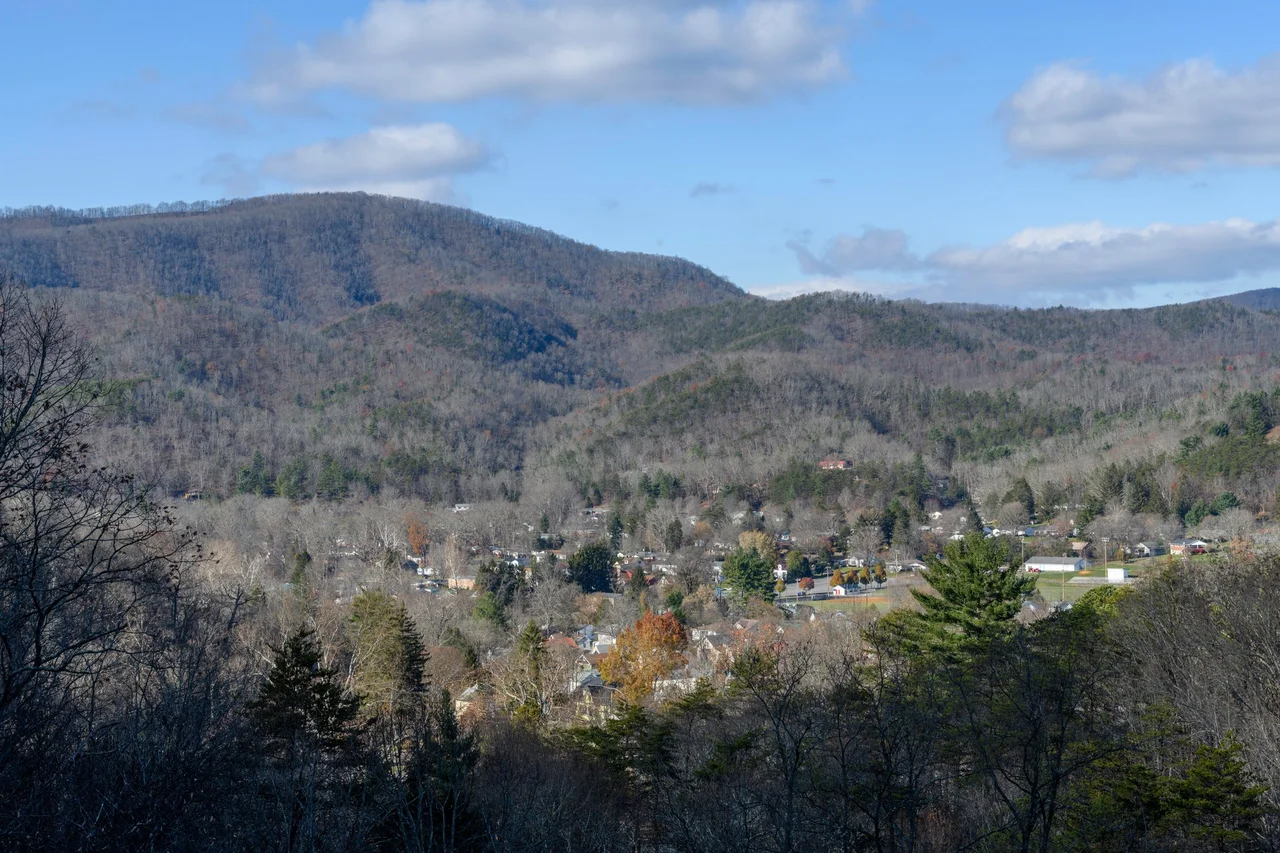

New River and Greenbrier Valleys
The New River is anything but new. Geologists rank it among the oldest rivers on Earth, a watercourse that was already running its present route when the Appalachians began to wrinkle up around it. The mountains rose; the river kept cutting. That stubborn geometry is why the New River Gorge exists at all - a deep slash of sandstone walls in the heart of southern West Virginia, now a national park. Just to the east, the gentler Greenbrier Valley rolls out in pasture and limestone hills, hiding caverns, a Cold War bunker, and a Civil War town that turned itself into a theater district. Two valleys, two moods, sharing one Appalachian heart.
A River Older Than the Mountains
Drop into the New River Gorge from any of the rim overlooks and the scale takes a moment to register. Sandstone cliffs drop away in stacked bands, the river coiling 800 feet below. Up top, spanning the chasm in a single steel arch, sits the New River Gorge Bridge - the longest single-arch steel bridge outside of China and, for one Saturday each October, the only place in the country where rappellers and BASE jumpers leap off a highway with the blessing of the state. The river itself is a paradox: ancient, north-flowing, indifferent to the mountains that grew up around it. Whitewater outfitters in Fayetteville run it daily through the summer, and climbers thread routes up the cliffs on either side. The park, established in 2020 as America's 63rd, layers natural drama over the ghost-towns of a coal-mining past that once filled the gorge with company houses, coke ovens, and trains.
The Greenbrier Side
Cross over the eastern ridge and the landscape exhales. The Greenbrier Valley opens into broad pastureland, limestone outcrops, and a river that meanders rather than races. Sandstone Falls thunders in the spring; the Greenbrier River Trail follows an old C&O rail bed for 78 miles, gentle enough for families on bikes. The valley's centerpiece is the Greenbrier Resort in White Sulphur Springs, a sprawling white-columned hotel that has welcomed presidents since Martin Van Buren. Beneath its west wing lies a 112,000-square-foot Cold War bunker, built secretly in the late 1950s to house Congress in case of nuclear attack and kept ready until a 1992 Washington Post story blew its cover. Today, the public can tour the steel blast doors, decontamination chambers, and the bare-bones congressional chamber where the House of Representatives was supposed to convene at the end of the world.
Lewisburg and the Limestone Country
Lewisburg sits at the valley's heart, a town of 4,000 that punches several weight classes above itself. Its historic district preserves 19th-century brick storefronts now filled with bookstores, galleries, and farm-to-table restaurants. The Greenbrier Valley Theatre - one of West Virginia's only year-round professional companies - draws audiences from across the region. Just outside town, Lost World Caverns opens into a hall the size of a cathedral, with a 28-foot column called the Goliath rising from the floor. The limestone that built the valley's prosperity also built its underworld: cave systems run for miles under the rolling pastures, used by Confederate saltpeter miners during the Civil War and now mapped by recreational cavers.
The Quieter Edges
Both valleys reward travelers who slow down. Babcock State Park's Glade Creek Grist Mill - reassembled from three older mills in 1976 - is the most photographed building in West Virginia, its overshot wheel turning beside a cascading creek. Hawks Nest State Park perches above the New River on a cliff once used by Civilian Conservation Corps crews; its tramway still drops visitors to the river below. Hatfield-McCoy ATV trails - named for the feuding families whose 1880s war played out one ridge to the south - stitch together hundreds of miles of old logging and mining tracks across the southern counties. Amtrak's Cardinal still rolls through Hinton, Alderson, and White Sulphur Springs three times a week, one of the few ways left to ride a passenger train through Appalachian high country.
Aviator's Notes
The region centers near 37.82 N, 81.24 W, stretching from Beckley and the gorge in the west to Lewisburg and White Sulphur Springs in the east. Raleigh County Memorial Airport (KBKW) at Beckley handles regional traffic, and Greenbrier Valley Airport (KLWB) at Lewisburg serves the resort. Look for the silver arc of the New River Gorge Bridge spanning a sharp green-walled cleft - it's the visual anchor for the whole region from altitude. Spring brings haze and afternoon thunderstorms; fall is reliably clear and spectacular, with hardwood color peaking in mid-October.
From the Air
Centered near 37.82 N, 81.24 W in southern West Virginia. Primary airports: Raleigh County Memorial (KBKW) at Beckley, Greenbrier Valley (KLWB) at Lewisburg, both with instrument approaches. Recommended viewing altitude 6,500-9,500 feet for best gorge perspective. Watch for the silver arch of the New River Gorge Bridge as a primary visual landmark. Mountain weather can change rapidly - check AIRMETs for icing and turbulence above the ridges, especially in winter.
Nearby Stories
- Logan County, West Virginia 6.1 km away
- Booker T. Washington High School 6.4 km away
- Summersville, West Virginia 16 km away
- Welch, West Virginia 26 km away
- Monroe County, West Virginia 29 km away
- 2020 Williamsburg Massacre 33 km away
- Morris Memorial Hospital for Crippled Children 35 km away
- Buchanan County, Virginia 40 km away