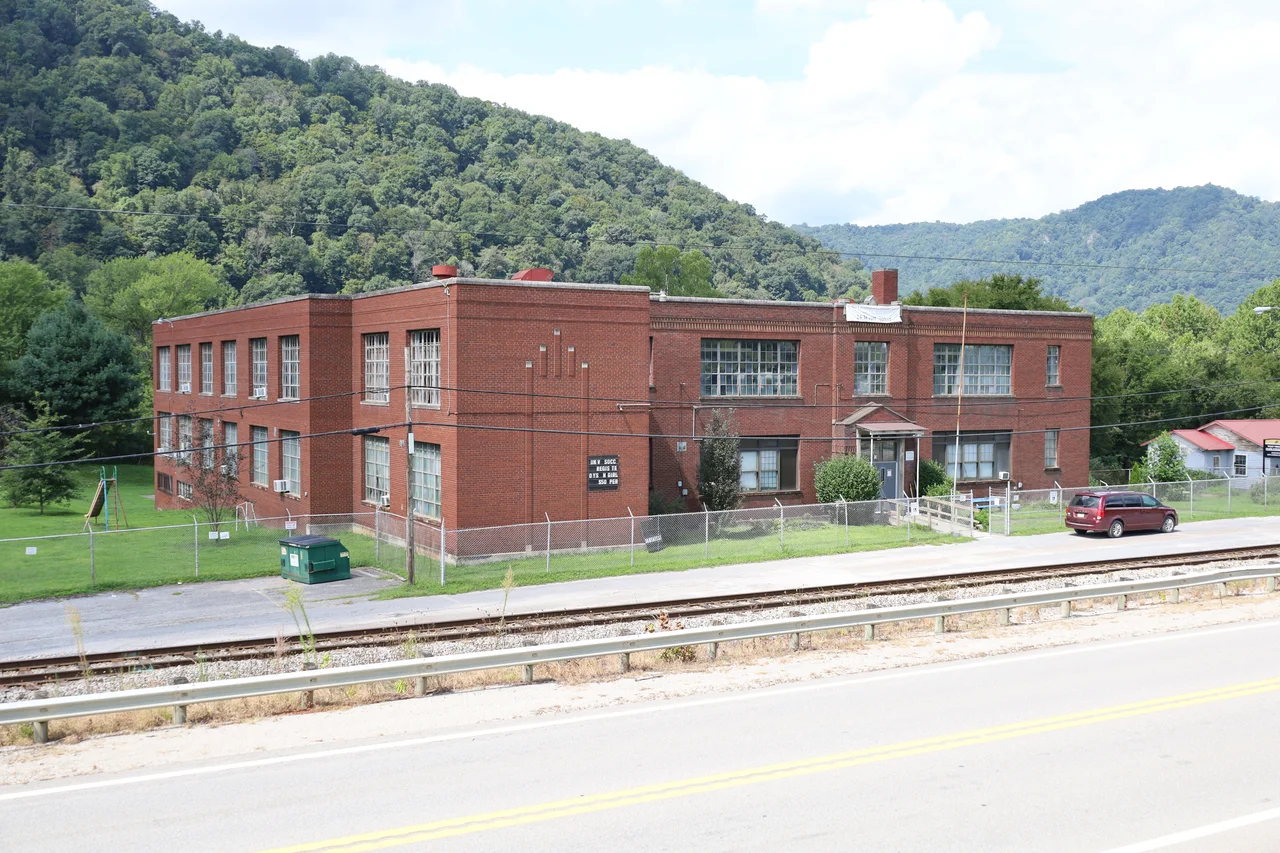

Booker T. Washington High School
When the brick was being laid in 1925, Black children in Kanawha County, West Virginia, had essentially two choices for high school: the school being built near London on the south bank of the Kanawha River, and Garnet High School in Charleston. The two schools - small for the population they served - were what the segregated system was prepared to offer. The new building near London, named for Booker T. Washington, who had been raised twelve miles upriver in Malden, was a two-story L-shaped wire-brick structure designed in a restrained Streamline Moderne style. It would serve as the Black high school for the eastern Kanawha Valley until 1956, when desegregation following Brown v. Board of Education ended its original purpose. The building outlived its function. It is still there, repurposed and standing, an artifact of a system that pretended to be separate but equal and was neither.
The School System That Required It
West Virginia's 1872 constitution and subsequent legislation mandated racially segregated schools - a system that lasted until 1956 in practice, two years after Brown v. Board ruled school segregation unconstitutional. By the 1920s, the Black population of Kanawha County had grown substantially with the coal and salt economies of the upper Kanawha Valley, and the existing facilities for Black secondary education were obviously inadequate. The Kanawha County Board of Education built two new Black high schools in the 1920s: Garnet in Charleston and Booker T. Washington near London. The investment was real but limited; per-pupil spending in West Virginia's Black schools remained well below per-pupil spending in white schools throughout the entire segregation era.
Streamline Moderne in the Coalfields
The building's architectural style - Streamline Moderne, characterized by horizontal lines, rounded corners, and a stripped-down industrial aesthetic - was unusual for a rural Kanawha County school in 1925. Most schools of the era were Colonial Revival or Tudor in style; Streamline Moderne would not become broadly popular for institutional buildings until the late 1930s. The L-shaped plan, the wire-brick exterior (a then-fashionable material with a hard glazed finish), and the tile-block rear section gave the school a distinctive presence in a landscape otherwise composed of wooden coal-camp houses and modest brick commercial buildings. It was a real school building, designed seriously, even within the constraints of the segregated system.
The Years It Served Its Original Purpose
From 1925 to 1956, the school educated Black students from the small towns and mining camps of the eastern Kanawha Valley - London, Cabin Creek, Ward, Eskdale, Cedar Grove. Students came from miles away, some boarding with families closer to the school. The curriculum mirrored white high schools' offerings within the resource limitations: English, mathematics, history, science, with industrial arts and home economics tracks. Athletic teams competed in the West Virginia Athletic Union, the segregated Black athletic conference. School plays, band concerts, and graduation exercises followed the same patterns as elsewhere. For three decades, the school functioned as the secondary education option for a substantial section of the valley's Black population - and as a community institution as much as an educational one.
After 1956
Brown v. Board was decided in 1954. West Virginia integrated its schools in 1956, two years after the ruling. The Booker T. Washington High School building no longer served as a high school; the students were absorbed into previously white facilities. The building was renamed Grant Junior High School, then Grant Elementary, and continued in those roles until June 1986, when the school closed for good. After 1986, the building stood empty for several years. It was added to the National Register of Historic Places in 1999. Today the building serves as the Booker T. Washington Community Center, run by local nonprofit organizations including the Upper Kanawha Valley Senior Activity Center. The same brick and tile-block walls that once housed segregated education now house community programs serving all residents of the area.
Flying Over the Valley
From the air, the Booker T. Washington school building sits on the south bank of the Kanawha River near the small community of London, between Charleston upstream and Cedar Grove downstream. The L-shaped plan distinguishes the building from the surrounding houses. The Kanawha River flows past to the north, with the New River Coalfield's tributary creeks coming in from the south. The terrain transitions here from the broad lower Kanawha Valley near Charleston into the narrower upper valley as the river bends toward its New River headwaters. Small coal-camp settlements line the riverbank. The school's presence and intact condition is a small visible remnant of a system that was meant to be permanent and was not.
From the Air
Located at 38.20°N, 81.37°W on the south bank of the Kanawha River near London, West Virginia, in eastern Kanawha County. The L-shaped brick building is the visible feature within the small community. Nearest airports: Yeager Airport (KCRW) at Charleston about 17 nm northwest, and Beckley/Raleigh County Memorial (KBKW) about 30 nm southeast. Best photographed from 2,500-4,000 feet AGL with the river bend and small community grid as orientation.
Nearby Stories
- Summersville, West Virginia 5.8 km away
- Westsylvania 13 km away
- Toyota Motor Manufacturing West Virginia 13 km away
- Upper Big Branch Mine Disaster 14 km away
- Logan County, West Virginia 16 km away
- Hobet Coal Mine 18 km away
- Robey Theatre 26 km away
- Greenbrier County, West Virginia 36 km away