.jpg)
Robey Theatre
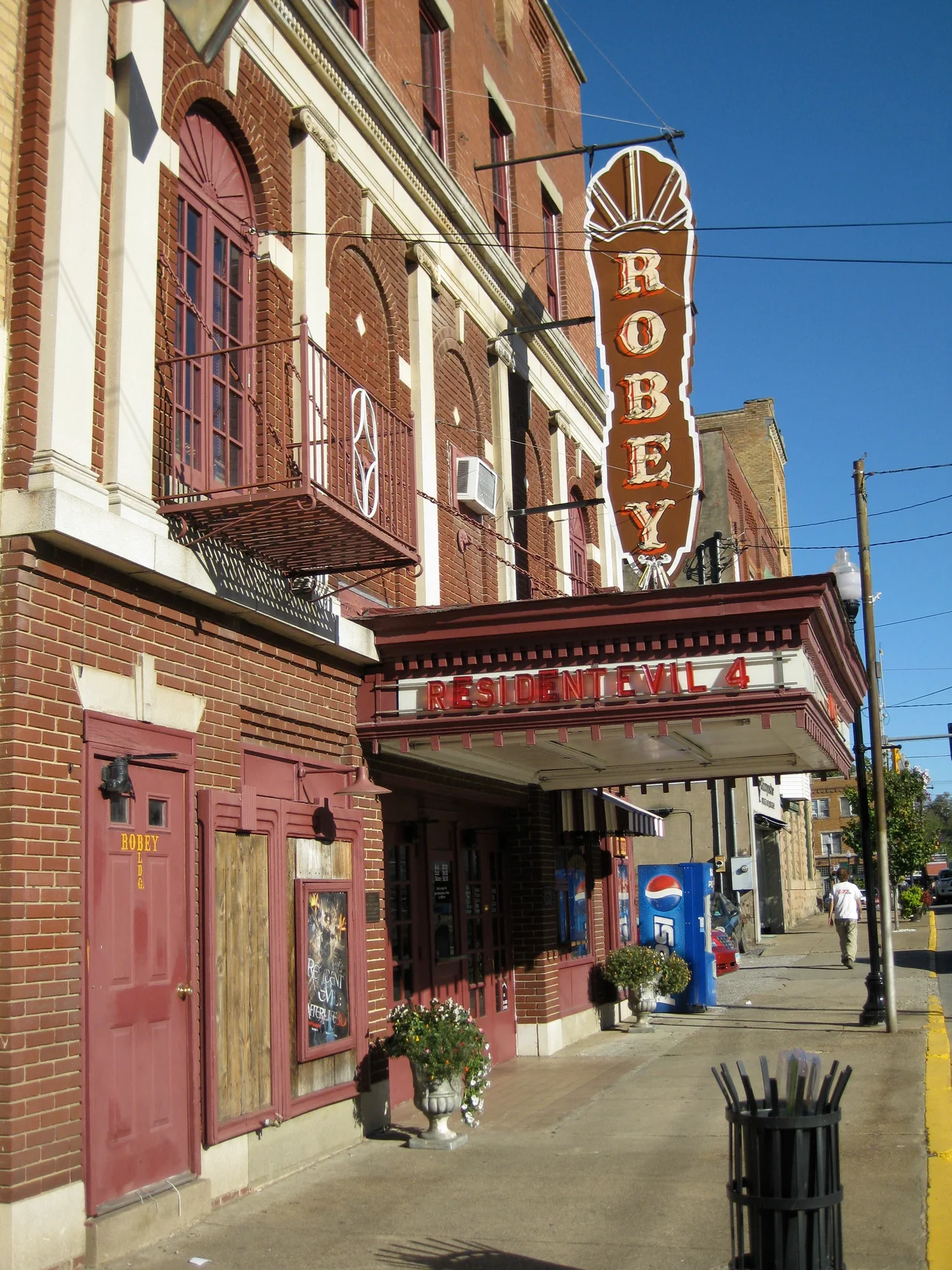
When the Robey Theatre opened its doors in Spencer, West Virginia in 1907, motion pictures were still a novelty. Sound films were two decades away. The Lumiere brothers had been showing flickering reels in Paris cafes for only twelve years. Movie theaters as a building type barely existed - most exhibitors ran their machines in storefronts or church halls or the corners of vaudeville stages. The Robey was built specifically for film, in a small town in Roane County, by people who were betting that this new medium would last. They were right. The Robey is still showing movies in 2026. It claims, with substantial documentation behind it, the title of oldest continuously operating movie theater in the United States.
The Building
The structure is three stories, five bays wide, in a Neoclassical/Italian Renaissance Revival idiom that was fashionable for small-town commercial buildings in the first decade of the 20th century. Brick facade. Cast-stone trim. Tall windows on the upper floors that originally lit office spaces or apartments above the auditorium. The central entrance bay has a ticket booth flanked by two sets of double doors. Above the entrance, a metal marquee hangs by chains from the second floor, with a neon sign mounted above it. The 1911 building was extensively remodeled in 1926 - the marquee and the current facade details mostly date from that work - but the bones of the original auditorium remain. It is the kind of small-town movie palace that thousands of American towns once had and almost none have kept.
Why It Survived
Most American movie theaters built before 1920 are gone. Television killed them in the 1950s. The multiplex killed the survivors in the 1980s and 1990s. The towns where the Robey's contemporaries once stood now have parking lots, drugstores, or vacant storefronts where the theaters used to be. The Robey survived because Spencer is small enough to be loyal and far enough from the nearest multiplex (in Charleston, roughly an hour away) to make the local theater the only practical option. The same isolation that has hurt rural towns in many ways has, in this case, protected a piece of architectural history. The Robey kept showing movies through the Depression, through World War II, through the television boom, through the multiplex consolidation. It is still showing them now.
The Continuous-Operation Claim
The phrase 'oldest continuously operating' contains a lot of fine print. Several older theater buildings exist - the Hippodrome in Baltimore opened in 1914 but originally featured vaudeville. The State Theatre in Washington, Iowa, often credited as the oldest in continuous operation, dates from 1897 for film but originated as the Graham Opera House in 1893 - making it a competing claimant on different grounds. The Robey's distinction is more specific: a building purpose-built for film exhibition that has shown movies, without interruption, since 1907. The various competing claims to be 'the oldest' theater in the United States rest on different definitions of opening date, continuous operation, and original purpose. The Robey's claim is sturdy enough that the National Register of Historic Places nomination accepted it in 1989.
Local Ownership
The Robey is currently owned by Aaron and Melissa Richardson - the latest in a line of local owners who have kept the lights on through the long quiet decades when running a single-screen small-town movie theater was not, by any conventional measure, a profitable enterprise. The math of operation is brutal in a town of fewer than 2,000 residents. The Richardsons sell tickets, popcorn, and the kind of community continuity that does not appear on any spreadsheet. The theater hosts first-run films, local events, school programs, and the occasional silent-film night with live piano accompaniment. The building also rents out for private events. The economics still do not pencil out the way they do at a 20-screen multiplex. The Richardsons keep going anyway.
Spencer
Spencer is the seat of Roane County, a small West Virginia town of about 2,200 people on the Spring Creek, in the rolling country between Charleston and Parkersburg. The town was founded in 1858 and incorporated in 1858 - the same year, give or take, that the first crude motion-picture experiments were happening in Europe. The historic Roane County Courthouse sits two blocks from the Robey. The Spencer State Hospital, a once-vast 19th-century mental institution, is also nearby, in various states of preservation and decay. The Robey is the architectural and cultural anchor of downtown Spencer in a way that few buildings of any kind can claim in any town of any size. The neon sign comes on at dusk. The films start at seven.
From the Air
Located at 38.73 degrees N, 81.35 degrees W in Spencer, Roane County, West Virginia. The Robey Theatre sits on Main Street in downtown Spencer. The town is about 45 nm northeast of Charleston. Yeager Airport (KCRW) in Charleston is the nearest tower-controlled field. Mid-Ohio Valley Regional Airport (KPKB) in Parkersburg is about 50 nm north. Recommended viewing altitude 3,500 to 5,500 feet MSL. Expect dissected plateau terrain throughout the area; valley fog common in the Spring Creek drainage mornings.
Nearby Stories
- Mound Cemetery Mound 10 km away
- Chief Cornstalk Wildlife Management Area 11 km away
- Sutton, West Virginia 17 km away
- Morris Memorial Hospital for Crippled Children 19 km away
- Mount Zion Baptist Church 20 km away
- Southwest Airlines Flight 2294 22 km away
- Nicholas County, West Virginia 24 km away
- Trans-Allegheny Lunatic Asylum 34 km away