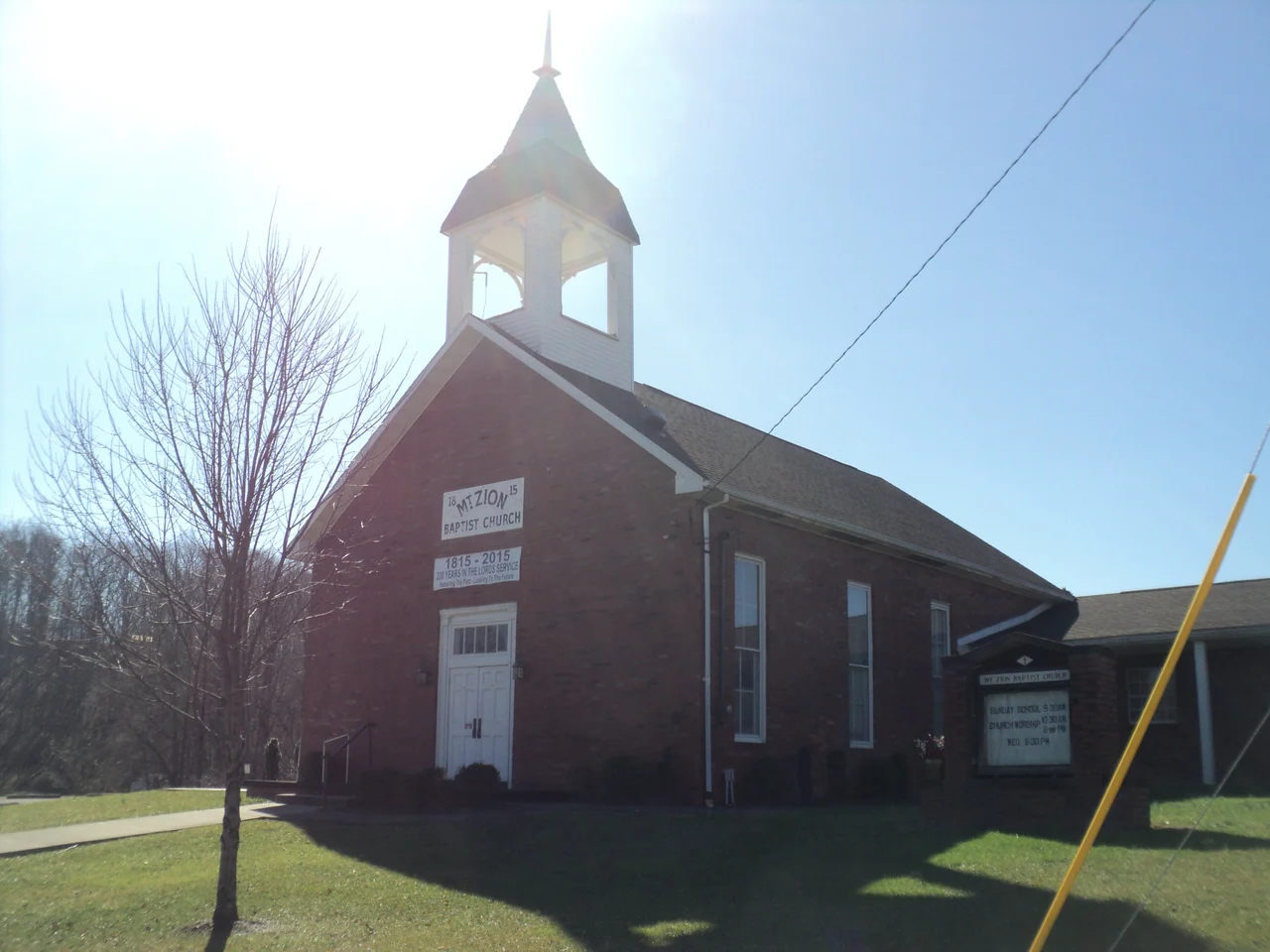

Mount Zion Baptist Church
On May 15, 1815, a frontier woman named Elizabeth Kettle opened her home in what was then called Butcher Bend, in the wilderness of what was then still western Virginia, and hosted the organizing meeting of a Baptist congregation. She had no church building. There was no town. There was barely a road. The first minister, the Reverend John Drake, arrived not long after - on foot, the way most missionaries traveled the Appalachian frontier in 1815, carrying a musket and a Bible. The musket was for bears and for the practical hazards of unfenced country. The Bible was for the work he had come to do. From that meeting, in Elizabeth Kettle's parlor, Mount Zion Baptist Church traces its 210-year continuous existence.
The Frontier Church
In 1815, the part of Wood County that would later become the small community of Mineral Wells was raw country. Settlers had been moving across the Allegheny ridges into the Ohio Valley for a generation, but the population was thin, the roads were primitive, and the religious infrastructure that the settled East took for granted - established congregations, trained ministers, printed hymnals, dedicated buildings - barely existed. Baptist congregations in particular operated on a low-overhead frontier model: a group of believers would organize themselves, call a preacher, meet wherever a roof could be found, and gradually build their way up to a permanent structure. Elizabeth Kettle's home served as the meeting house. Other early Baptist congregations in the region started the same way.
Rev. John Drake
The first minister came in the established tradition of the frontier missionary - a man whose ministry covered hundreds of square miles of thinly settled country, who traveled by horseback when he could and on foot when he had to, who preached at one settlement on Sunday and the next on Wednesday. The musket Drake carried is not mentioned in the historical record as having been used; it was the kind of thing a man traveling alone through Indian country and bear country and country with no organized law enforcement carried as a matter of course. The Bible was the working tool. Drake organized what was, in effect, a circuit. Mount Zion was one of several congregations he helped found in the area. He stayed long enough to set the church on its feet, then moved on.
From Logs to Brick
In 1819, four years after the founding meeting, the congregation built its first dedicated building - a log church under the direction of the Reverend James McAbbey, who had succeeded Drake. The log church served the community for more than six decades. By the 1880s, the population had grown, the congregation had grown with it, and the original log building was both too small and too worn for continued use. In 1883, the present building was constructed. It is a modest brick structure in the late-19th-century Gothic Revival vernacular that became standard for small American Protestant churches: a single nave, a steeple, pointed-arch windows, a small entry. The building has now served the congregation for more than 140 years.
The Mother Church
Mount Zion claims to be the mother church of at least seven other Baptist congregations in the area - meaning, in Baptist polity, that members of Mount Zion organized those new churches as the local population grew and as travel distances made it impractical for everyone to attend the same building. This pattern is characteristic of frontier and rural Baptist expansion across the United States in the 19th century. The original congregation does not lose membership when it spawns daughter congregations; it gains, in effect, a network of cooperative churches that share preachers, host joint revivals, and reinforce each other's existence. Mount Zion has been doing this for two centuries. Its daughter churches have done it for almost as long.
Continuity
A 210-year continuously operating institution is rare anywhere in the United States, and rarer in West Virginia, where economic upheaval, depopulation, and the closing of small communities have erased a great many earlier institutions. Mount Zion has outlasted the boom and bust of the oil industry in nearby Burning Springs, the rise and fall of the Pardee and Curtin Lumber Company, the construction of Interstate 77, and the gradual emptying of the rural countryside as families moved to Charleston, to Parkersburg, or out of state entirely. The church still holds Sunday services. The 1883 building, restored periodically by congregations that may someday qualify for National Register protection, still anchors the small community of Mineral Wells. Elizabeth Kettle's frontier meeting house, in its current architectural form, is still doing the work it was organized to do.
From the Air
Located at 39.17 degrees N, 81.51 degrees W in Wood County, West Virginia, in the small community of Mineral Wells on Route 14. The church sits in rural farmland southeast of Parkersburg. Mid-Ohio Valley Regional Airport (KPKB) in Parkersburg is the nearest tower-controlled field about 8 nm northwest. Recommended viewing altitude 3,000 to 4,500 feet MSL. Expect dissected plateau terrain throughout the area; the Ohio River drainage dominates the landscape to the west.
Nearby Stories
- Mound Cemetery Mound 0.8 km away
- Spencer, West Virginia 5.9 km away
- The Ohio River Museum 7 km away
- Chief Cornstalk Wildlife Management Area 16 km away
- Glenville State University 20 km away
- Flatwoods Monster 23 km away
- Hocking Hills State Park 54 km away
- West Virginia Penitentiary 62 km away