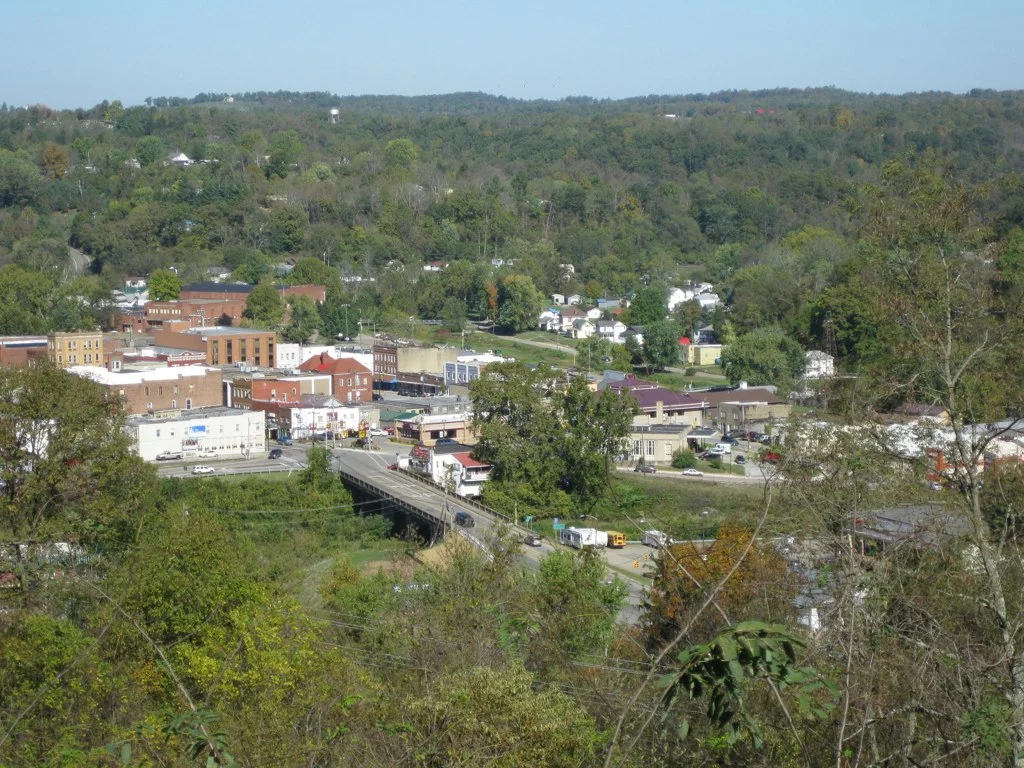

Spencer, West Virginia
Every October, the small West Virginia town of Spencer smells like pie - specifically, like black walnut pie. The West Virginia Black Walnut Festival, held annually since 1954, draws tens of thousands of visitors to a town of about 2,000 to eat pie, ice cream, fudge, and cake all made from the deeply flavored nutmeats of Juglans nigra. The festival is a serious affair. There are walnut-cracking contests. There are queens. There are parades. For four days in early October, Spencer becomes the unofficial capital of black walnut country, and the Roane County Courthouse square fills with people who came specifically to eat a nut that most of America has forgotten about.
Naming
Spencer was chartered in 1858, named for Spencer Roane, the Virginia jurist for whom the surrounding county was also named. Roane was a prominent figure of the early American republic - a Virginia state supreme court justice, an early advocate for states' rights, and a vigorous critic of John Marshall's federalist Supreme Court. He died in 1822, more than three decades before the West Virginia town that carries his first name was chartered. The choice of his first name rather than his surname for the town - which would have created the redundant Roane, Roane County, West Virginia - was a small piece of practical naming. Most of the people who founded Spencer would have struggled to pick Spencer Roane out of a portrait gallery. The name has outlived the politics it once carried.
The Walnut
Juglans nigra, the eastern black walnut, is native to the Ohio Valley and the Appalachian foothills. Its wood is prized for furniture - rich, dark, easily worked - and the trees are large and long-lived. The nuts are an entirely different proposition from the milder English walnut sold in supermarkets. Black walnuts have a thick green-black husk that stains everything it touches, and the nutmeats inside have a sharp, almost gamy flavor that bakes into pastries with extraordinary depth. The festival's origin in 1955 was a marketing effort: Hammons Products of Missouri was buying black walnuts by the truckload, and Spencer was at the heart of one of the best harvesting regions. Local people gathered nuts as a small autumn income. The festival celebrated that economy and its food.
The Robey
Two blocks from the courthouse, the Robey Theatre has been showing movies continuously since 1907. It claims, with backing from its National Register of Historic Places nomination, the title of oldest continuously operating movie theater in the United States. The marquee hangs by chains over the sidewalk. The neon sign comes on at dusk. The auditorium is single-screen, with the kind of acoustic ambiance that no multiplex can replicate. The Robey is what makes Spencer architecturally distinctive among small West Virginia towns - many have historic courthouses, but few have a working century-old movie palace.
The Asylum
On the edge of town, the Spencer State Hospital - originally the Second Hospital for the Insane, opened in 1893 - was once one of the largest state institutions in West Virginia. The vast Kirkbride-style main building, with its symmetrical wings designed to provide natural light and ventilation to patients in the 19th-century theory of moral treatment, dominated the local landscape for a century. The hospital closed in 1989. Most of the buildings have been demolished or have collapsed. A small portion is preserved. The site is a haunting reminder of the era when state-hospital towns - Spencer, Weston, Huntington - housed thousands of patients in conditions that ranged, depending on the decade and the administration, from genuinely therapeutic to genuinely awful.
Spring Creek
Spencer sits at the intersection of US-33 and US-119, in the rolling country between Charleston and Parkersburg. Spring Creek runs through the town. There is a Civil War park on a hill above the courthouse with a view of the surrounding hills - the war touched this country glancingly, in raids and skirmishes rather than major battles. La Finca Mexican Grill on Ripley Road feeds the long-haul drivers and the locals who got tired of cooking. The Chestnut Ridge Winery makes wine from local grapes. The town is the kind of small county seat that does not appear in tourist itineraries but quietly handles its centuries of business: the courthouse, the theater, the festival, the long memory of a state hospital, and the trees that drop walnuts every September.
From the Air
Located at 38.80 degrees N, 81.35 degrees W in Roane County, West Virginia. Spencer sits at the intersection of US-33 and US-119 in the dissected plateau country between Charleston and Parkersburg. Mid-Ohio Valley Regional Airport (KPKB) is about 45 nm north. Yeager Airport (KCRW) is about 50 nm southwest. Recommended viewing altitude 3,500 to 5,500 feet MSL. Expect dissected Allegheny Plateau terrain throughout the area; valley fog common in the Spring Creek drainage mornings.
Nearby Stories
- Mound Cemetery Mound 10 km away
- Chief Cornstalk Wildlife Management Area 11 km away
- Sutton, West Virginia 17 km away
- Morris Memorial Hospital for Crippled Children 19 km away
- Mount Zion Baptist Church 20 km away
- Southwest Airlines Flight 2294 22 km away
- Nicholas County, West Virginia 24 km away
- Trans-Allegheny Lunatic Asylum 34 km away