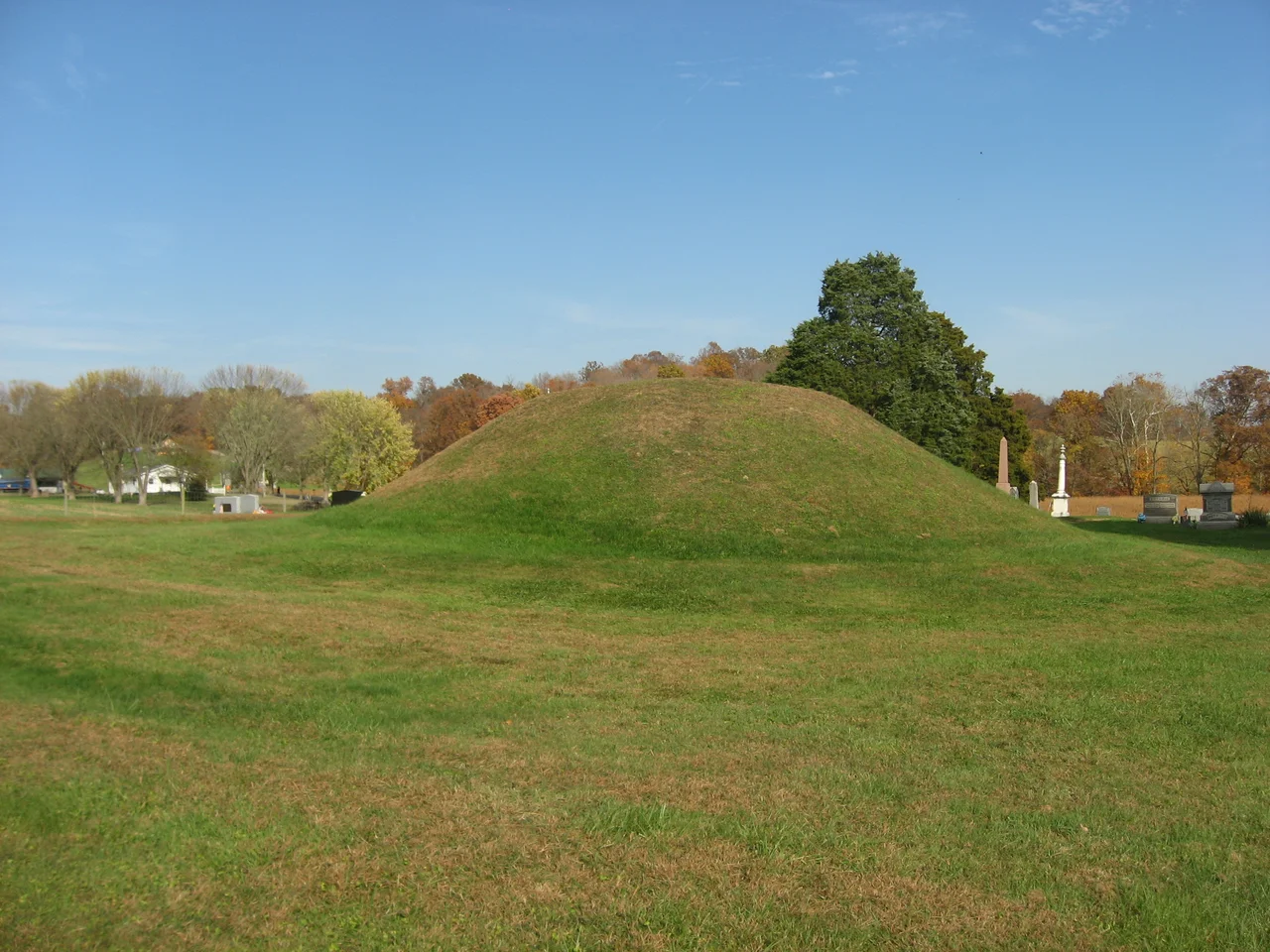

Mound Cemetery Mound
There used to be many of them. When white settlers arrived in what would become Meigs County, Ohio, in the late eighteenth century, they found dozens of conical earthen mounds dotting the high ground above the Ohio River and its tributaries - landmarks built two thousand years earlier by the people archaeologists now call the Adena culture. Most of those mounds are gone. Some were dug into by treasure hunters convinced they held silver or gold. Some were leveled by farmers who needed the land flat for plowing. A few survived for an accidental reason: settlers buried their own dead at their bases, and the cemeteries that grew up around them became, in effect, protective walls. The Mound Cemetery Mound near Chester, Ohio, is one of those accidental survivors.
The People Who Built It
The Adena culture flourished in the Ohio Valley roughly from 1000 BC to 200 AD - a thousand years of small communities that hunted, fished, gathered nuts and berries, and built earthworks. Their mounds typically covered burials, usually of high-status individuals, sometimes with grave goods of copper, mica, or carved stone. The mound near Chester is unexcavated, which means we know it from its shape rather than from its contents: a low conical rise of earth, modest in scale compared to the great Adena mounds at Grave Creek or Miamisburg, but unmistakably the same kind of structure. Whoever was buried inside lived in a society we know primarily through what they left in the ground - a few centuries before what archaeologists call the Hopewell tradition arose to incorporate Adena ideas into something more elaborate.
What the Settlers Did, and Did Not, Destroy
The pioneer-era account of Meigs County notes that many mounds existed when European Americans arrived, and many were destroyed. The two main destructive forces were treasure hunting - settlers digging into mounds in search of buried valuables, often finding instead stone tools, pottery sherds, and the bones of the people the mounds had been built to honor - and farming, which involved repeated plowing that gradually leveled smaller mounds back into the surrounding soil. The Mound Cemetery Mound escaped both fates. When local families established a burial ground at the site sometime in the nineteenth century, they built their own grave plots around the existing mound rather than across it. The result was a kind of two-thousand-year palimpsest: a Adena burial at the center, surrounded by graves of Ohio pioneers and their descendants.
The Second Mound
There is another mound nearby - the Reeves Mound - which was also added to the National Register of Historic Places in 1974, the same year as the Mound Cemetery Mound. Together they form a small cluster of preserved Adena-era earthworks in central Meigs County. Local accounts also describe additional earthworks in the vicinity that may have been mounds, now too disturbed to be certain. The pattern is consistent with what archaeologists know about Adena settlement: their communities often built groups of mounds, sometimes in alignment with one another, sometimes connected by low earthen embankments that the centuries of plowing have erased. The two surviving mounds here are likely the remnants of what was once a larger Adena landscape.
What It Means to Visit
Visiting the Mound Cemetery Mound today involves driving a quiet country road in rural Meigs County, parking at a small cemetery, and walking past a few rows of nineteenth- and twentieth-century gravestones to a low earthen rise covered in grass. It does not announce itself. There is no interpretive center, no path with switchbacks, no entrance fee. The mound is older than every other thing visible from the spot - older than the road, the cemetery, the surrounding farms, the village of Chester. The Adena people who carried baskets of earth to build it would have understood the impulse the later settlers acted on: this is a place where the dead are kept. The mound stayed because the people who came after, without quite meaning to, agreed with the people who came before about what the ground was for.
Flying Over the Quiet Ridge
From the air, the mound itself is too small to identify - a low rise a few feet high in a cemetery a few hundred feet across, hidden by trees in summer. The cemetery sits on slightly elevated ground north of Chester village, in the gently rolling country between the Ohio River to the south and the Hocking Hills to the north. Meigs County's landscape from cruising altitude reads as classic Ohio Valley uplands: woodlots, pastures, farm ponds, and small settlements tied together by gravel roads. Adena mounds occur all through this country if you know where to look, but most are invisible from any altitude. The Mound Cemetery Mound survives partly because it cannot be seen at a glance.
From the Air
Located at 39.11°N, 81.92°W in central Meigs County, Ohio, north of the small community of Chester in Chester Township. The mound is too small to identify directly from cruising altitude. Use the village of Chester and nearby country roads as orientation. Nearest airports: Athens-Albany (KUNI) about 25 nm north, Mid-Ohio Valley Regional (KPKB) about 30 nm east. Best appreciated as part of a broader survey of the upland country between the Ohio River and the Hocking Hills.
Nearby Stories
- Fort Randolph 3 km away
- Lake Katharine State Nature Preserve 5.8 km away
- Mount Zion Baptist Church 8.5 km away
- The Ohio River Museum 11 km away
- Spencer, West Virginia 19 km away
- Hardin Village Site 28 km away
- Hopewell Culture National Historical Park 34 km away
- Hocking Hills State Park 39 km away