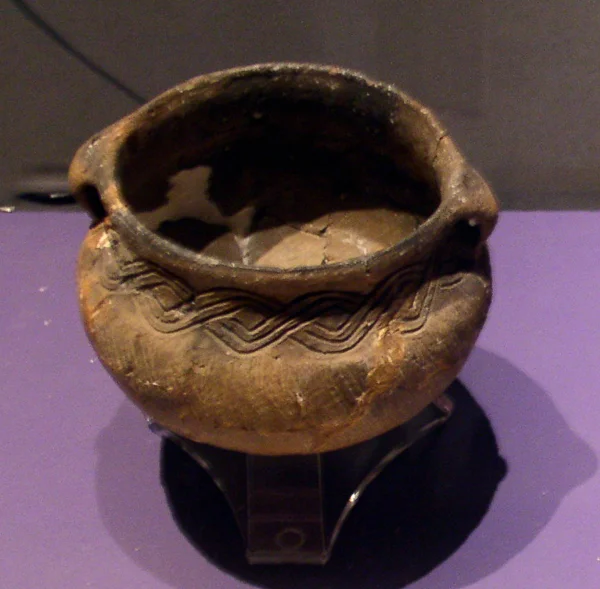

Hardin Village Site
By the time French and English explorers reached this stretch of the Ohio River, the people who had lived here were already gone. Hardin Village was occupied from sometime in the early 1500s and abandoned around 1625, a window of about a century. The villagers never met a European. But European trade goods did reach them - brass tubes, copper, fragments of metal that traveled overland through Mississippian trade networks faster than the people who made them. Archaeologists have found those metal beads in some of the graves at Hardin, evidence of a world that was already changing for people who would not live long enough to see who was changing it.
A Floodplain Town
Hardin Village (site 15GP22) sat on a wide, flat terrace of the Ohio River about 3 miles from present-day South Shore, Kentucky. The two-kilometer-wide floodplain offered exactly what Fort Ancient farmers needed: rich soil for maize, beans, and squash, and easy access to the river for fishing and travel. A wooden palisade ringed the village, signaling the kind of intermittent warfare that characterized the late Fort Ancient period. The layout was unusual for the culture. Most Fort Ancient towns arranged houses around a central oval plaza. Hardin's houses clustered instead, possibly because new homes were built atop old foundations as generations stacked up in the same spots.
Longhouses on the Ohio
The houses were rectangular, built single-set-post style with each support sunk into its own hole, then walled with bark, thatch, or hide. They resembled the Iroquoian longhouses farther east. The largest measured up to 9.1 by 21.5 meters, with interior posts holding up the roof and thin partitions splitting the space into multi-family dwellings. Storage pits ran along the inside walls for corn and dried squash. Each house had a single doorway, framed by two larger posts on the river-facing side. Average floor area ran about 133 square meters. Inside, families wove baskets, knapped stone, raised children, and ground mussel shell into temper for their pottery.
What the Burials Tell
Excavations in the late 1930s, 1966, and again in 2015 by University of Kentucky archaeologists have documented between 301 and 445 burials at Hardin - the largest Fort Ancient cemetery found in Kentucky. Most were extended burials, the body laid out straight. About half had grave goods. Adults typically received utilitarian items like pottery and stone tools. Children under four and adults over fifty more often received exotic objects, including engraved shell ornaments and the brass and copper that had reached the Ohio Valley through Mississippian trade with Spanish-era contacts in the southeast. The same burials reveal a darker story. Heavy reliance on maize had given the Fort Ancient people chronic malnutrition and niacin deficiency, producing high rates of arthritis, dental disease, treponematosis - a non-venereal cousin of syphilis - and short life expectancies.
Why They Left
Hardin Village was abandoned by about 1625, decades before sustained European contact. The cause is debated. Climate shifts of the Little Ice Age may have shortened growing seasons; epidemic disease may have traveled ahead of the colonists who introduced it; warfare with Iroquoian peoples pushing into the Ohio Valley may have made the floodplain untenable. Probably it was some combination. By the time French traders followed the river, the palisade had collapsed, the longhouses had rotted away, and the cornfields had returned to floodplain grass. The 445 burials still in the soil were the only continuous record of a community that had farmed this terrace for a century. The grave goods that came from people the villagers never met are now in archaeology labs, evidence of a contact that had reached them before it reached them in person.
From the Air
Located at 38.74 N, 82.91 W on the Ohio River floodplain in Greenup County, Kentucky, near South Shore. The site is on a wide flat terrace, the river curving north and east of it. Tri-State Airport (KHTS) is about 30 miles east. Best viewed at 3,000-5,000 feet on clear days, when the Ohio River corridor and adjacent farmland are clearly visible.
Nearby Stories
- Lake Tight 6.6 km away
- Greenbo Lake State Resort Park 6.9 km away
- Serpent Mound: The 1,400-Foot Snake Nobody Can Explain 9.5 km away
- Skatopia 12 km away
- Lake Katharine State Nature Preserve 12 km away
- Morris Memorial Hospital for Crippled Children 16 km away
- Serpent Mound 31 km away
- The Kentucky Meat Shower: When Flesh Fell From a Clear Sky 56 km away