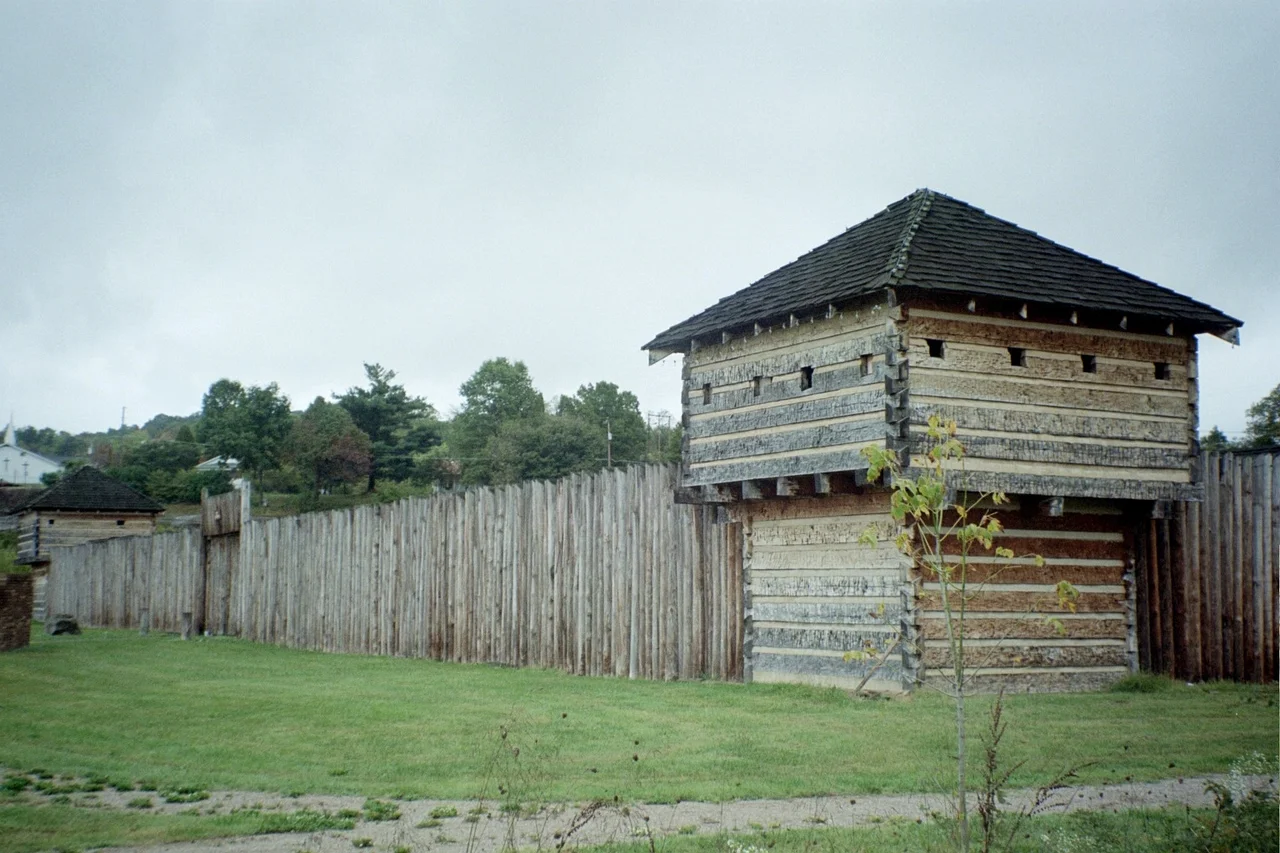

Fort Randolph
Cornstalk came to Fort Randolph in November 1777 carrying a warning. The Shawnee chief had told the Americans about a Virginia expedition rumored to be advancing into the Ohio Country. He explained that some Shawnee wanted to stay neutral but that he could not guarantee the loyalty of the younger warriors. Captain Matthew Arbuckle Sr., commanding the fort, listened carefully and then made a decision he probably did not yet know how to walk back from. He detained Cornstalk as a hostage. Days later, an American militiaman was killed outside the fort by an unrelated Native American party, and the militiaman's friends burst into the prisoners' cell. They killed Cornstalk and three other Shawnees, including Cornstalk's son. Virginia's governor Patrick Henry prosecuted the killers. The juries refused to convict. The chief who had come to the fort to keep the peace died because the soldiers inside it could not.
The Point and the Forts Before It
The triangle of land where the Kanawha River joins the Ohio had been strategic long before any fort stood there. The 1768 Treaty of Fort Stanwix transferred Iroquois claims to the land south of the Ohio to the British Crown, opening it nominally to colonial settlement. George Washington canoed down the Ohio in 1770 to inspect tracts around Point Pleasant. The Shawnee, whose hunting grounds these were, had not been consulted in the treaty, and the resulting Dunmore's War of 1774 produced the Battle of Point Pleasant on what would become the fort's exact ground. A small post called Fort Blair followed the battle but was abandoned in 1775 on Lord Dunmore's order, just before he was forced from office by the revolution.
Building Fort Randolph
In May 1776, with the Revolutionary War underway, the Virginia Assembly ordered the post rebuilt. Captain Matthew Arbuckle Sr. led the construction, completing Fort Randolph in time for the summer campaigning season. The fort was named for Peyton Randolph, the first president of the Continental Congress, who had died the previous year. Along with Fort Pitt at Pittsburgh and Fort Henry at Wheeling, Fort Randolph was meant to anchor the American Revolutionary defensive line against Indian raids on the western settlements. The forts failed to deter raids, but they did provide refuge during the worst of them, and Fort Randolph became one of the main supply problems for the over-extended Continental command.
The Murder of Cornstalk
On November 10, 1777, an American militiaman was killed outside Fort Randolph by Indians unconnected to Cornstalk. His fellow soldiers, blind with grief and rage, charged into the fort. They went straight for the Shawnee prisoners. Cornstalk - a respected chief who had risked his own safety to warn the Americans of trouble he could not control - was murdered along with his son Elinipsico and two other Shawnees. The bodies were buried near the fort. Governor Patrick Henry was outraged. He ordered the murderers tried, but local witnesses refused to testify, and the killers were acquitted. The murder hardened Shawnee opposition to the United States and would influence Tecumseh's resistance a generation later. Cornstalk's grave now sits at Tu-Endie-Wei State Park, a short walk from where the fort stood.
Siege, Abandonment, and Replica
In May 1778, about 200 Shawnee under Chief Blackfish, joined by Wyandots and Mingos under Dunquat - the Wyandot Half King - laid siege to Fort Randolph for about a week. The garrison held. The attackers moved on up the Kanawha to attack Fort Donnally, where they were also repulsed. By 1779 the Americans had abandoned Fort Randolph anyway, the army's resources needed elsewhere. Indians burned the empty fort. A new fort was built on the site in the 1780s as hostilities renewed, but it saw little action and was abandoned in turn. Two centuries later, a replica fort was constructed about a mile away in Point Pleasant as a public history site. The original ground is now part of the urban fabric of the small West Virginia town - a parking lot, a park, a monument, and the durable knowledge that history is made out of what happens when a captain like Arbuckle does not stop his soldiers from doing what they are about to do.
From the Air
Located at 38.84 N, 82.12 W at the confluence of the Ohio and Kanawha rivers in Point Pleasant, West Virginia. The replica fort and Tu-Endie-Wei State Park are within walking distance of each other in downtown Point Pleasant. Yeager Airport (KCRW) is about 50 miles southeast. Best viewed at 2,500-4,000 feet on clear days, with the river confluence and historic park clearly visible.
Nearby Stories
- Ashland, Kentucky 2.7 km away
- Salt Reservations 3.1 km away
- Wayne National Forest 4.5 km away
- Morris Memorial Hospital for Crippled Children 8.5 km away
- Mount Zion Baptist Church 17 km away
- Robey Theatre 19 km away
- Malden, West Virginia 22 km away
- Jesse Stuart Memorial Bridge 25 km away