
Salt Reservations
In the 1790s, salt was strategic. A frontier family could not preserve meat through the winter without it. Hauling salt over the Appalachians was expensive enough that frontier communities sometimes ran short, with consequences measured in spoiled hogs and hungry children. So when the federal government began surveying the new lands northwest of the Ohio River for sale to settlers, Congress made one striking exception. Salt springs - natural saline outflows that could be boiled down into table salt - were reserved from public sale. The federal government, in other words, treated salt the way later generations would treat radio spectrum or oil reserves: too important to let into private hands.
Why Salt Was Strategic
After the 1783 Treaty of Paris, the United States held vast western lands but very little manufacturing capacity. In a pre-refrigeration economy, salt was not a seasoning. It was the difference between meat that lasted through winter and meat that rotted in a barrel. Coastal salt came in from the Caribbean or Liverpool, but it had to be hauled overland once it crossed the Appalachian crest, and the price doubled along the way. Native peoples had long known of inland salt springs - water that emerged from the ground already briny, sometimes salty enough to boil down profitably in iron kettles. Explorers had reported these springs. The settler economy needed access to them at frontier prices, not monopoly prices.
Two Acts of 1796
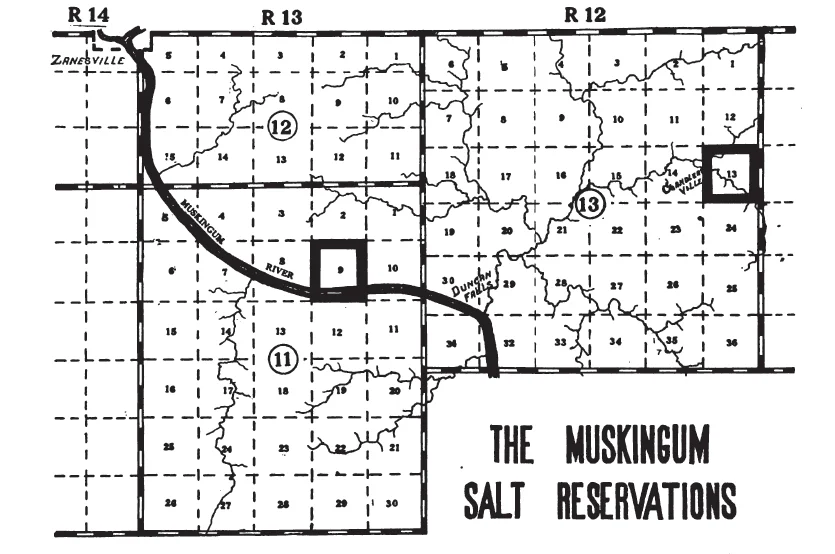
Congress acted twice in 1796 to lock the salt springs out of private sale. The Land Act of May 18 set up the rectangular survey system that would map Ohio into six-mile-square townships subdivided into one-mile sections, and section 3 explicitly reserved any salt spring with one square mile of surrounding land. The Scioto salt springs, near present-day Jackson, were named specifically. The Act of June 1 created the United States Military District for paying revolutionary veterans in land bounties, and section 1 reserved two-and-a-half mile squares around any salt springs discovered there. Surveys eventually identified the Scioto springs in Jackson County, two springs near the Muskingum River, and one in present-day Delaware County.
Handed to Ohio
When Ohio statehood approached, the federal government did not retain the salt reservations - it handed them over. The Ohio Enabling Act of April 30, 1802 granted the salt reservations to the new state for public use, with one strict condition: the state could lease them, but could not sell them or lease them for longer than ten years. Ohio's legislature set rental rates by kettle capacity - three cents per gallon per year in 1803, dropping to half a cent by 1810. A state agent at each reservation collected the fees and supervised the operations. Settlers leased plots, hauled the brine to giant iron kettles, boiled it down over hardwood fires, and sold the salt locally. For three decades this arrangement worked roughly as the Founders had hoped: salt at frontier prices, supplied by salt springs that no individual owned.
The Town of Jackson
By the 1820s, the federal restriction had loosened and Ohio was permitted to sell portions of the Scioto reservation. Section 29 of township 7, range 18 sold for 7,169 dollars, and the town of Jackson grew up where the brine had once been the only industry. The Saline Lands Act of January 12, 1877 finally allowed the sale of saline lands across the country, ending the 80-year experiment in federal salt anti-monopoly. By then, refrigeration was beginning to transform meat preservation. Salt mattered less. The reservations had served their purpose. What survives is mostly the geography - the names of springs, the existence of Jackson, Ohio, and the quiet historical fact that the early United States once decided that some natural resources were too important to let one person own.
From the Air
Located at 39.05 N, 82.63 W in Jackson, Ohio - the site of the original Scioto Salt Reservation. The Muskingum and Delaware salt reservations were in central and eastern Ohio respectively. John Glenn Columbus International (KCMH) is about 80 miles north. Best viewed at 3,000-5,000 feet, with the rolling foothills of southeast Ohio spread below.
Nearby Stories
- Gallipolis 6.9 km away
- Skatopia 11 km away
- Hardin Village Site 16 km away
- Hopewell Culture National Historical Park 18 km away
- Ripley and the Underground Railroad 47 km away
- Fort Ancient 66 km away
- The Y-Bridge of Zanesville 67 km away