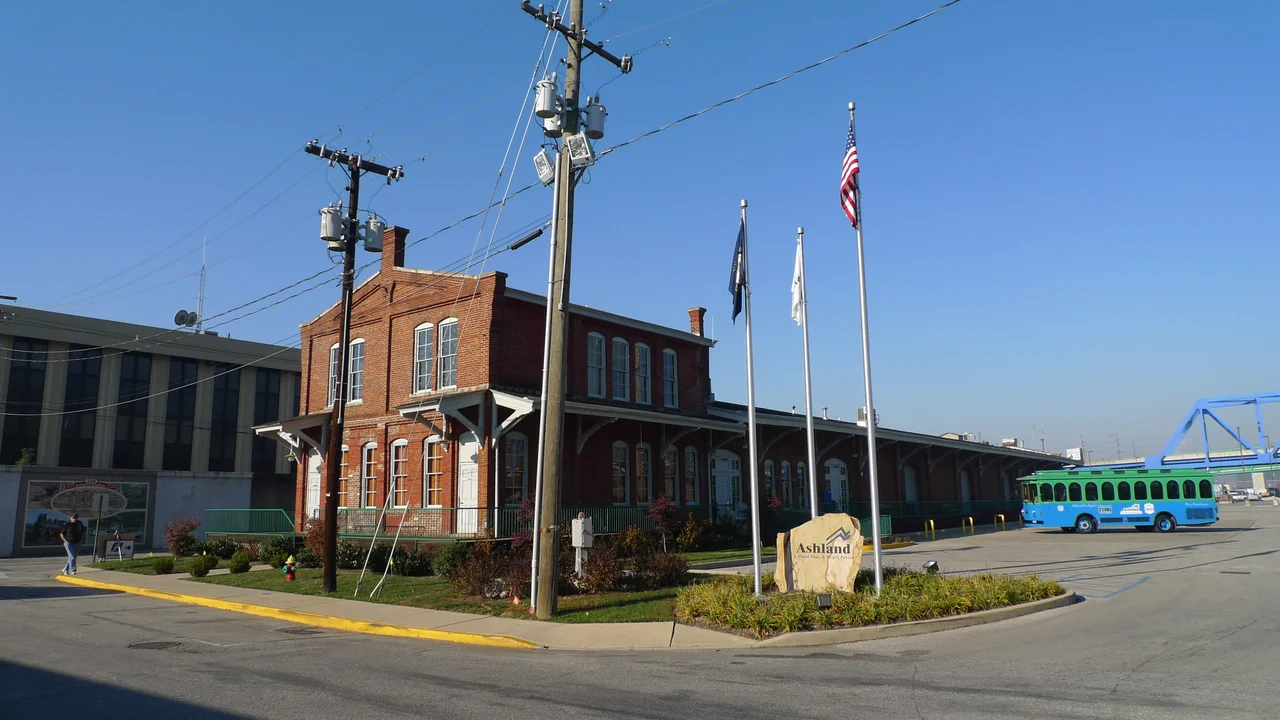

Ashland, Kentucky
Naomi Judd raised Wynonna and Ashley in a series of small houses around Boyd County, working as a nurse and singing harmonies that would one day fill stadiums. Billy Ray Cyrus grew up in nearby Flatwoods, just across the city line, before "Achy Breaky Heart" made him famous. Both stories started in Ashland - a working-class river town founded in 1786 as Poage's Landing, renamed Ashland in 1854 and formally incorporated in 1856, and shaped ever since by the steel mills, the oil refineries, and the railroads that converge at the confluence of the Big Sandy and the Ohio.
Two Rivers and a Stack
Ashland sits where the Big Sandy River, the border between Kentucky and West Virginia, empties into the Ohio. That junction is why the town exists. Riverboats stopped here, freight moved here, and in the late nineteenth century industry showed up to take advantage of cheap coal, easy water transport, and the iron ore that could be barged up from the south. By the early twentieth century, Ashland was a steel town with the gritty pride that came with it. The smokestacks of Armco Steel - which became AK Steel before the plant closed and was demolished in 2021 - defined the skyline for over a century. Drive in along Interstate 64 and you still see the footprint where they stood, a reminder of what the town built.
The Judds and the Cyruses
Music came out of Ashland the way coal came out of the surrounding hollows - constantly, naturally, in volume. Naomi Judd worked as a nurse at the local hospital while raising Wynonna and Ashley. Wynonna and her mother became The Judds, dominating country music in the 1980s before Wynonna launched a successful solo career. Ashley took a different path, becoming an actress and activist. Billy Ray Cyrus, born in Flatwoods just upriver, came out of the same musical ecosystem - Pentecostal churches, family bands, radio stations playing both country and bluegrass. His son Miley would later become a generational pop star in her own right. The cultural pipeline from this small Ohio River city to the national stage has been remarkably durable.
Cardinal Through Town
Amtrak's Cardinal stops in Ashland three times a week in each direction, on its long run between Chicago and New York City. Westbound trains pull in around 10 PM, eastbound around 6:30 AM, with delays common enough that locals build flexibility into their travel plans. The route is one of the most scenic in the eastern United States, threading through the New River Gorge, the Allegheny ridges, and the Blue Ridge before reaching the coastal cities. Ashland is the first stop in Kentucky going west from the East Coast, the doorway from one geography into another. For a town whose identity has always been about transportation - rivers, rails, highways - the persistence of passenger rail service is a small but meaningful continuity.
Summer Motion
Every year over the Fourth of July weekend, Ashland holds Summer Motion - a festival that has grown into one of the largest free events in the region. Concerts run nightly, with country, rock, and Christian artists working through the lineup. An air show fills the sky over the Ohio. A carnival sets up downtown. The closing night fireworks over the river draw crowds from Kentucky, Ohio, and West Virginia at once - this is one of the few places in America where you can stand in three states inside a single short drive. The festival is funded by sponsors and runs without ticket prices, a deliberate decision to keep it accessible to working families in a region that has had a hard run of decades.
Wet and Dry
Kentucky's complicated alcohol laws come into clear focus in Ashland. The city itself is "wet," meaning full retail liquor sales are permitted. Boyd County around it is dry, with one exception: restaurants seating at least 100 people may sell drinks. Nearby Russell, across in Greenup County, follows the same rule. The result is a patchwork that locals know by heart but that visitors find baffling. Cross the Ohio into Ohio or the Big Sandy into West Virginia, and the rules change again. From the air, the line between Ohio and Kentucky is just a river. From a restaurant menu, it can be the difference between a wine list and a glass of iced tea.
From the Air
Located at 38.478 degrees north, 82.638 degrees west, at the confluence of the Big Sandy and Ohio Rivers. Recommended viewing altitude 3,500 to 6,500 feet AGL to take in the three-state geography. Nearest airport is Ashland Regional (KDWU); Tri-State (KHTS) at Huntington, West Virginia is about 12 nautical miles northwest, just across the Big Sandy. The Ohio River runs roughly east-west here, with the former AK Steel works site a prominent feature on the Kentucky side. Best visibility in autumn when haze clears and the river reflects fall foliage along both banks.
Nearby Stories
- Yatesville Lake 8.4 km away
- Hardin Village Site 13 km away
- Morris Memorial Hospital for Crippled Children 14 km away
- Lake Tight 15 km away
- Hobet Coal Mine 26 km away
- The Kentucky Meat Shower: When Flesh Fell From a Clear Sky 38 km away
- Serpent Mound: The 1,400-Foot Snake Nobody Can Explain 40 km away
- Battle of Blue Licks 59 km away