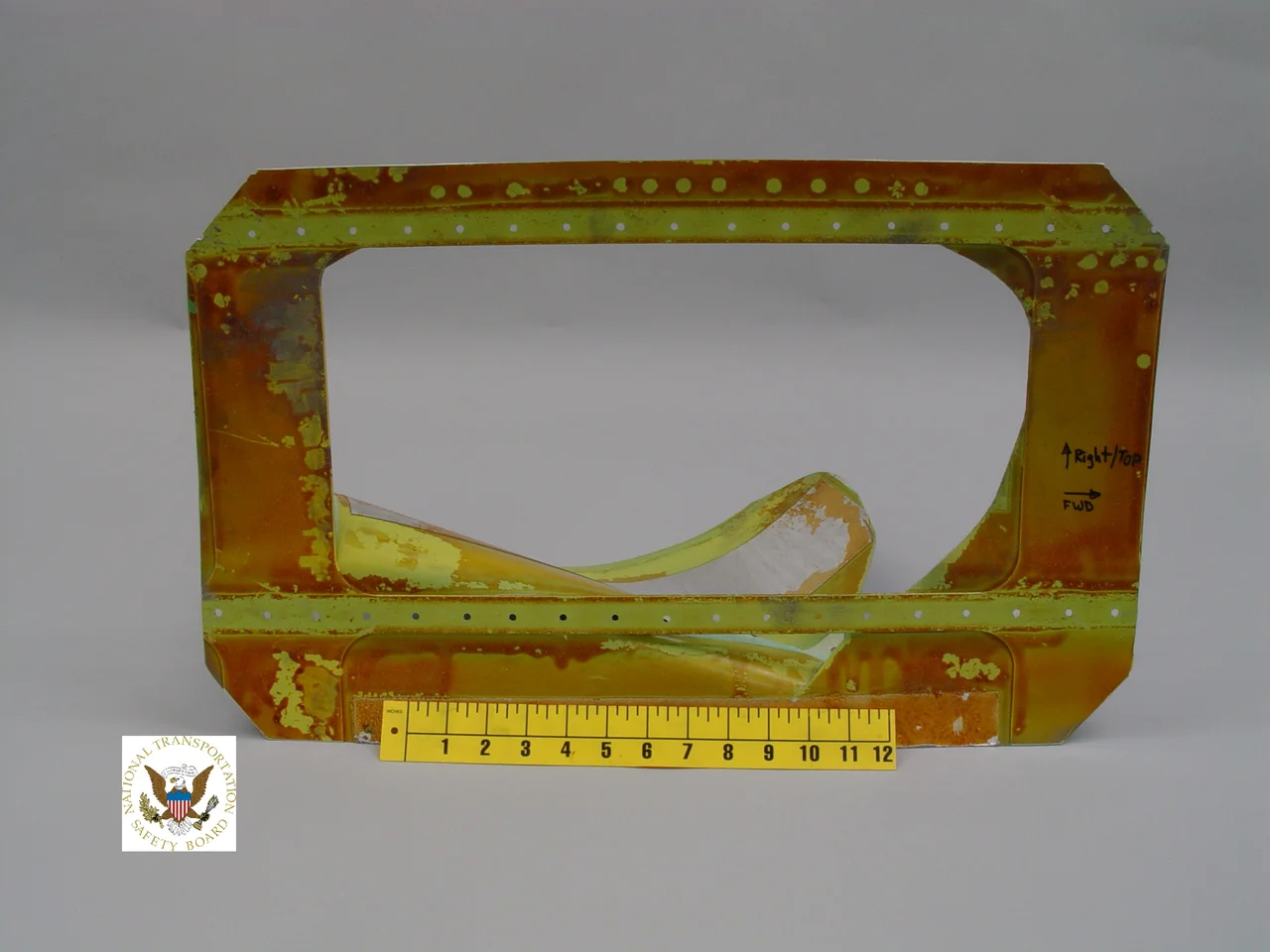

Southwest Airlines Flight 2294
About forty minutes into Southwest Airlines Flight 2294 from Nashville to Baltimore on the afternoon of July 13, 2009, the Boeing 737-3H4 was cruising at 35,000 feet when the cabin altitude warning sounded in the cockpit. The pressure was dropping rapidly. Oxygen masks fell from the overheads. Passengers later described a loud rushing of wind from above. There was, in fact, a football-sized hole torn through the aluminum skin on the top of the fuselage above row 16. The captain executed an emergency descent and diverted to Yeager Airport in Charleston, West Virginia, the nearest field with a runway long enough to take a 737. The aircraft landed safely. Nobody was seriously hurt. But the National Transportation Safety Board investigation that followed would lead to a fleet-wide change in how aging 737 Classic aircraft were inspected for metal fatigue.
Forty Minutes In
Flight 2294 departed Nashville at 4:05 p.m. Central Daylight Time (5:05 p.m. Eastern) with 126 passengers and 5 crew members on board. The aircraft, a Boeing 737-300 with manufacturer's serial number 26602, was about fifteen years old and had accumulated some 42,500 flight cycles - takeoffs and landings - over the course of its working life. The 737 Classic family had been in service since the mid-1980s; many were now well past the original design service life and were being kept airworthy by ongoing inspections and structural maintenance. The climb out of Nashville was routine. The crew leveled off at 35,000 feet about 25 minutes after takeoff. At roughly 5:45 p.m. Eastern, somewhere over eastern Kentucky or western West Virginia, the failure occurred. The skin separation was rapid and audible. The cabin altitude warning chimed almost immediately. The captain initiated an emergency descent.
The Descent and the Diversion
Emergency descents from cruise altitude in a depressurized airliner follow a standard procedure: get the airplane down to about 10,000 feet as quickly as possible, where the passengers no longer need supplemental oxygen, and divert to the nearest suitable airport. Yeager Airport in Charleston, code KCRW, sits on a famously flat-topped ridge above the Kanawha River. Its main runway is just under 6,800 feet long - shorter than a Southwest 737 normally operates from, but more than adequate for an emergency landing with a relatively light fuel load. The crew brought the aircraft down. From the surface, passengers and crew climbed off and got a look at what had been over their heads at 35,000 feet: a tear in the upper aluminum skin roughly the size and shape of a football, with the underlying fuselage frames visible through the opening. Several passengers and crew took photographs that went around the news cycle for the next several days.
The Investigation
The National Transportation Safety Board investigation, recorded as NTSB case number DCA09FA065, determined that the skin separation had been caused by metal fatigue. Specifically, the aluminum lap joint at the top of the fuselage had developed widespread fatigue cracking along the rivet line, and that cracking had reached a point where the skin gave way explosively under cabin pressurization loads. Metal fatigue is a function of how many times a part has been stressed and relaxed; for a pressurized airliner, that translates roughly to the number of flight cycles. Flight 2294's airframe had been pressurized and depressurized about 42,500 times. The lap joint design used on the 737 Classic had been known to be vulnerable to fatigue cracking, and inspection protocols were in place to detect it. The inspections, however, had been insufficient to catch the cracking before it propagated to failure on this airframe.
After the Hole
Less than two years later, on April 1, 2011, an almost identical incident occurred on Southwest Airlines Flight 812 - another 737-3H4, another mid-fuselage skin separation, another emergency landing (this time at Yuma, Arizona). The pattern made the FAA act decisively. The agency issued an Airworthiness Directive requiring more frequent and more sensitive inspections of upper-fuselage lap joints across all 737 Classic aircraft in service worldwide. The directive added significant cost to operating older 737s and accelerated the retirement of some of the oldest airframes in the fleet. Aircraft that had been expected to fly into the late 2010s were withdrawn earlier. Flight 2294 itself - the route number - was reassigned. Today the daily Southwest 2294 is a Honolulu-to-Hilo intra-Hawaii flight on a brand-new 737 MAX 8. The 1994 airframe that landed at Yeager with a hole in its roof has long since been retired. The mountain-top runway in Charleston, however, is still there, still available to any pilot in trouble who needs a place to put a 737 down in a hurry.
From the Air
Southwest Airlines Flight 2294 made its emergency landing at Yeager Airport (KCRW) in Charleston, West Virginia at 38.38 degrees north, 81.59 degrees west, on a flat-topped ridge above the Kanawha River about three miles east of downtown Charleston. Best viewed at 4,000 to 7,000 feet AGL: Yeager's distinctive runway sits on a man-made plateau carved from the surrounding hills, one of the most visually striking airfields in the eastern United States. The Kanawha River, the gold-domed state capitol, and the I-77/I-64 corridor are reliable orientation landmarks for the airport area.
Nearby Stories
- Mystery Hole 6.5 km away
- West Virginia Colored Children's Home 9.4 km away
- Clay, West Virginia 13 km away
- Staats Mill Covered Bridge 14 km away
- Hobet Coal Mine 23 km away
- Appalachia 23 km away
- Fred M. Vinson Museum and Welcome Center 30 km away
- Ponn Humpback Covered Bridge 43 km away