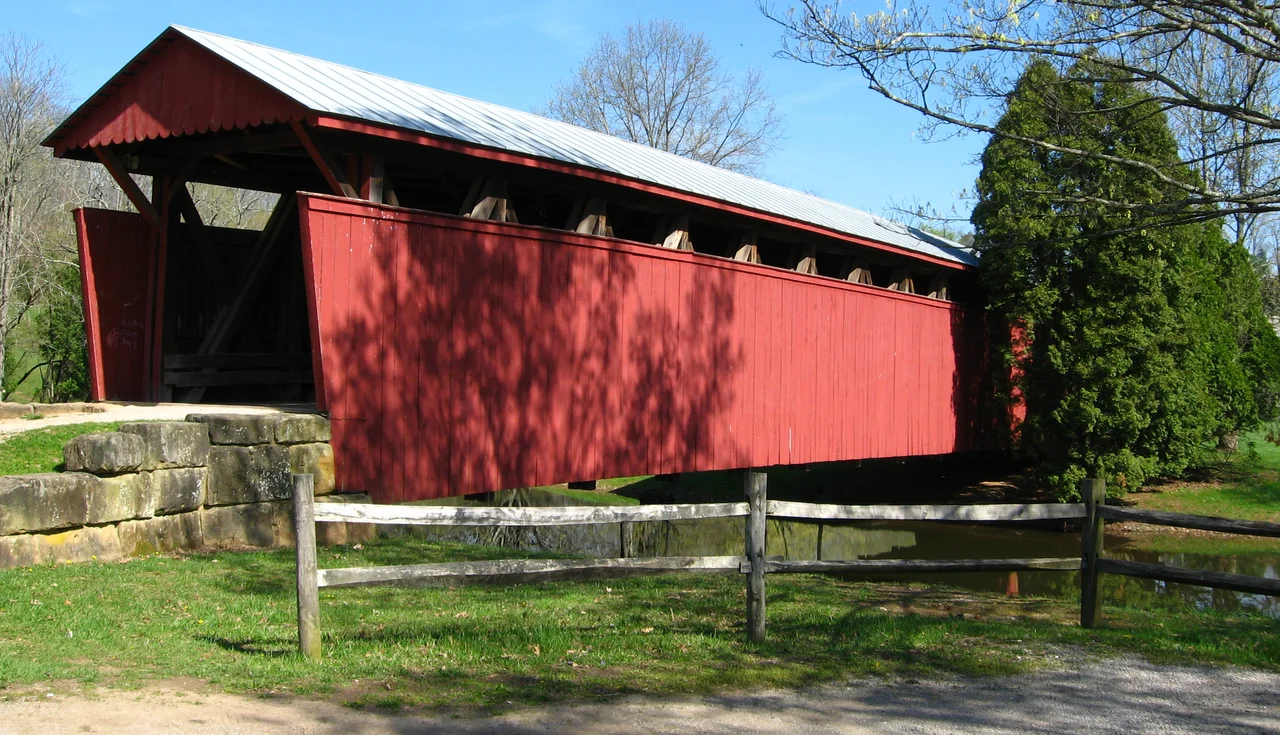

Staats Mill Covered Bridge
Jackson County paid one thousand seven hundred eighty-eight dollars and thirty-five cents to build it. That was the exact figure the county court entered in the 1887 ledger, the cost of nearly a hundred feet of trussed timber framed by local craftsmen across the Tug Fork of Big Mill Creek, next to Enoch Staats' water-powered mill. For close to a century, the Staats Mill Covered Bridge carried wagons, then Model Ts, then pickups across the creek, its trapezoidal silhouette a fixed point in the landscape of rural West Virginia. Then in 1983, the county did something unusual: it lifted the entire bridge, hauled it three miles, and rebuilt it across a pond at a youth camp, where it still stands today, no longer carrying cars but instead carrying a kind of memory.
The Long Truss
The Staats Mill bridge is one of the better surviving examples of the Long truss, a wooden bridge-building system patented in 1830 by Major Stephen H. Long of the U.S. Army Corps of Engineers. The system is recognizable by its X-braced diagonals inside each panel - the verticals carry the load down, the diagonals counterbrace, and the whole assembly distributes the weight of a wagon or a car evenly across the span. The Staats Mill bridge has eleven such panels, each eight feet long and fourteen feet deep, totaling close to a hundred feet of crossing. By 1887, the Long truss was already an older design - newer systems like the Pratt and the Howe had been refined for iron and steel - but for a county that had local timber and local carpenters and limited cash, the Long system was still the right answer.
The Staats Family and the Mill
The Staats family arrived in this part of what was then Virginia around 1780, just after the Revolution opened the trans-Allegheny country to settlement. Over the next century they built a mill, a store, and the small commercial cluster that the bridge served. Enoch Staats' water-powered grist mill ground corn and wheat for the surrounding farms, and the bridge gave wagons a way to reach it without fording the creek. When the bridge went up, it was infrastructure for a working agricultural economy, not a heritage piece. People used it because it was the way to get to the mill, and the mill was the way to turn a season's crop into something you could sell.
Listed, Lifted, Rebuilt
The bridge was added to the National Register of Historic Places in 1979, recognizing it as a rare surviving example of Long-truss construction in the state. By then it had been showing its age for decades. Rather than condemn it or rebuild it in place over the original creek, Jackson County took an unusual approach in 1983: hire engineers, dismantle the bridge piece by piece, and reassemble it three miles away at the FFA-FHA State Camp at Cedar Lakes, spanning a pond instead of a stream. The relocation cost $104,000 - roughly fifty-eight times what the original construction had cost a century earlier. Dr. Emory Kemp of West Virginia University, a pioneer in American industrial archaeology, supervised the technical work. The bridge today is open only to pedestrians, but it stands intact in its new setting, its Long-truss panels still doing the work they were cut to do.
Why It Matters
Of the hundreds of covered bridges that once dotted West Virginia, only seventeen survive. Each one represents a small civic decision made in the nineteenth century - a county court appropriating a few thousand dollars to make a creek crossable - and a much larger twentieth-century decision to keep it standing when concrete and steel were cheaper. The Staats Mill Bridge is a remnant of a way of building that disappeared from American infrastructure within a few decades of its own construction. The carpenters who framed it would have known the Long truss as standard. Their grandchildren would have considered it obsolete. Their great-grandchildren preserved it.
Flying Over the Foothills
From the air, the bridge is small - a single dark rectangle of cedar shingles set in the green grounds of the Cedar Lakes camp, three miles southwest of Ripley. The Tug Fork of Big Mill Creek, the bridge's original home, winds through pasture and woodlot a few minutes' drive northeast. The Allegheny foothills roll in long ridges around the area, and from cruising altitude you can see the network of small valleys that defined how nineteenth-century Jackson County actually worked: a mill at each stream junction, a road to each mill, a bridge at each crossing. Most of those bridges are gone. This one was saved by being moved.
From the Air
Located at 38.79°N, 81.69°W on the grounds of Cedar Lakes Camp, approximately 3 miles southwest of Ripley in Jackson County, West Virginia. The bridge spans a small pond on the camp property, with the original creek site at Staats Mill a short distance to the northeast. Nearest airports: Jackson County Airport (KI19) about 5 nm northeast and Mid-Ohio Valley Regional (KPKB) about 35 nm northwest. The structure is small - best identified from 2,000-3,000 feet AGL with the camp's larger buildings as orientation.
Nearby Stories
- John E. Amos Power Plant 7.6 km away
- Ponn Humpback Covered Bridge 9.9 km away
- Clay, West Virginia 12 km away
- Guyandotte 13 km away
- Mound Cemetery Mound 19 km away
- Appalachia 19 km away
- Hillbilly Hot Dogs 28 km away
- North Bend Rail Trail 36 km away