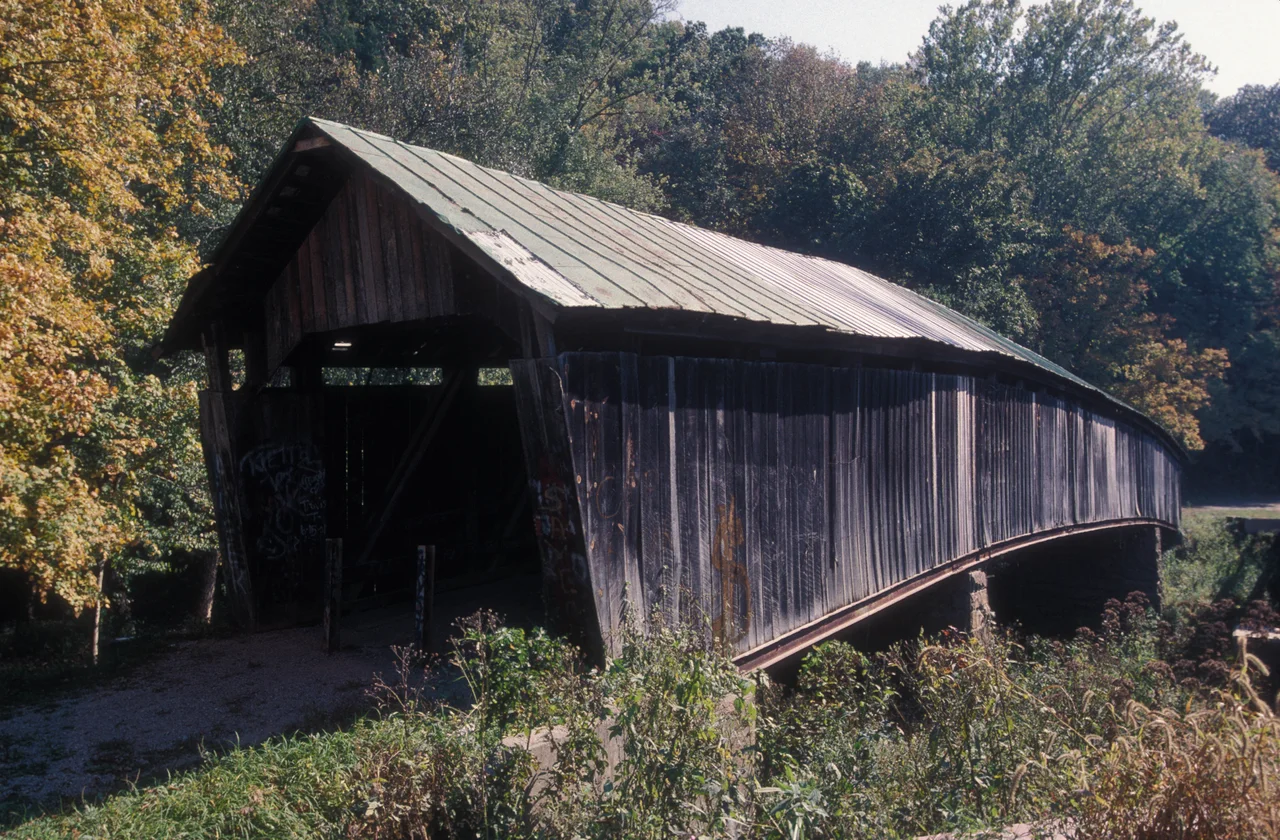

Ponn Humpback Covered Bridge
Some bridges have luck, and some bridges have a recurring problem with fire. The Ponn Humpback Covered Bridge had the latter. It was built in 1874 to replace a Raccoon Creek covered bridge that an unknown arsonist had burned four years earlier. The county put up a thousand-dollar reward for the original arsonist's capture, which was a substantial sum in 1874, but the reward was never paid. The 1874 replacement carried road traffic across the creek southwest of Wilkesville for almost 140 years - longer than most covered bridges anywhere - and then in 2013 someone set fire to it too.
The Humpback Profile
The bridge got its nickname from its silhouette. Most covered bridges run flat - level deck, level roofline, walls perpendicular to the road. The Ponn bridge was different. Its Burr arch truss design carried a 19-inch camber, an upward curve in the trusses that gave the roofline a gentle hump in the middle. The arch was approximately 1% of the bridge's 165-foot length, subtle but visible from the bank. The Burr arch truss combined an arched timber compression member with a multiple king post truss - an 1804 design by Theodore Burr that proved unusually durable. The camber was both structural and aesthetic: it gave the bridge its distinctive profile and helped distribute load efficiently across the span.
Built by Tax
The story of the Ponn Bridge is also a story about how communities respond to deliberate destruction. Within days of the 1874 arson, Vinton County officials imposed a special tax to fund a replacement bridge. They hired Martin McGrath and Lyman Wells to lead the construction. The work finished within the year at a cost of 1,898 dollars. The new bridge was meant to last - which it did, even as similar covered bridges across Ohio fell to floods, neglect, or modern road improvements. By the mid-20th century the bridge was tired enough that engineers worried about its load capacity, so the county rerouted traffic to a parallel steel truss bridge and left the Ponn Bridge in place as a tourist attraction.
Vinton County's First
In April 1973 the Ponn Humpback Covered Bridge was added to the National Register of Historic Places - the first site in Vinton County to receive the designation. Hope Furnace near Zaleski, the iron furnace that once smelted ore for Ohio's iron belt, followed a month later. The Zaleski Mound Group was added in 1974. By 2013, when the bridge burned, it was one of about ten Vinton County sites on the register. The designation did not protect the bridge from fire, but it did ensure that the loss made local and state news, and that any future plans for the site would have to grapple with the bridge's recognized historical value.
The 2013 Fire
On the morning of June 6, 2013, the Ponn Humpback Covered Bridge was found burned to the ground. Investigators concluded that the fire was deliberately set. As of the most recent reports, no suspect has been charged. The 139-year-old bridge that had survived more than a century of floods, ice storms, lightning, and ordinary decay was lost in a single night to someone with a match. Local response combined grief and the recognition that arson had also taken the bridge's predecessor. The story has a stubborn symmetry. The site remains, the stone abutments still standing in Raccoon Creek, the Burr arch a memory now rather than a structure. The 1,000-dollar reward of 1874 went unclaimed. Whether the 2013 arsonist will be identified is still an open question, and the bridge that connected the two incidents - the only physical witness to both - is no longer there to be asked.
From the Air
Located at 39.05 N, 82.38 W on Raccoon Creek in southeast Vinton County, Ohio, southwest of the village of Wilkesville. The bridge itself is gone since 2013, but the site is still a historical landmark. John Glenn Columbus International (KCMH) is about 80 miles north. Best viewed at 2,500-4,000 feet on clear days, with the wooded valleys of southeast Ohio spread below.
Nearby Stories
- Hopewell Culture National Historical Park 3.2 km away
- Hocking Hills State Park 11 km away
- Portsmouth 13 km away
- Buffington Island 18 km away
- Staats Mill Covered Bridge 21 km away
- Lake Tight 21 km away
- The Ohio River Museum 40 km away
- Serpent Mound: The 1,400-Foot Snake Nobody Can Explain 41 km away