
Portsmouth
Walk west along the Ohio River in Portsmouth and you walk past a painted city. Sixty murals, each twenty feet tall, run for over 2,000 feet along the floodwall the U.S. Army Corps of Engineers built after the 1937 flood almost erased the town. The paintings cover Hopewell mound-builders, the Shawnee leader Tecumseh, the Underground Railroad, the Portsmouth Spartans who became the Detroit Lions, and the steel mills that closed in 1980. Most cities tell their history on plaques. Portsmouth told its on the wall that holds back the river that built it.
A Town at the Confluence
Portsmouth sits where the Scioto River meets the Ohio, a confluence the Hopewell culture chose for ceremonial earthworks between 100 BC and 500 AD. The Portsmouth Earthworks were one of the largest mound complexes in the Ohio Valley. By the time the first European-American settler, Emanuel Traxler, arrived in 1796, the Hopewell were long gone. An early town called Alexandria stood at the river junction, but the floods kept ruining it. In 1803 a Virginia surveyor named Henry Massie laid out a new town slightly inland, named it for Portsmouth, New Hampshire, and started the city that has stood, more or less, ever since.
The Underground Railroad and a 13th Amendment
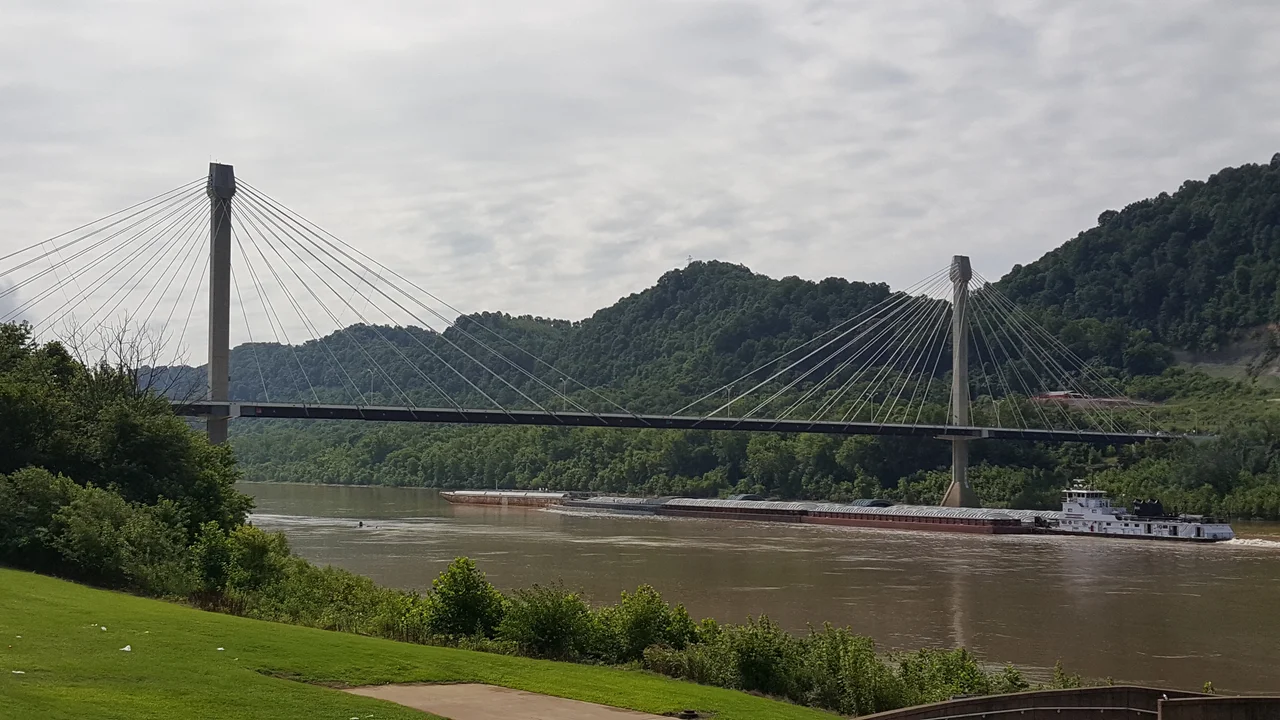
Despite settler demographics that leaned anti-abolitionist - many had migrated up from the South - Portsmouth became an important Underground Railroad crossing. Self-emancipating people crossed the Ohio from Kentucky to free soil here, often continuing up the Scioto toward Detroit and on to Canada. A historical marker near the Grant Bridge commemorates the route. Portsmouth's contribution to abolition was not only logistical. James Ashley, raised in Portsmouth after his family moved there when he was two years old, was elected to Congress from the Toledo district and authored the Thirteenth Amendment to the Constitution, which abolished slavery upon its ratification in December 1865. The man who drafted the words that ended American slavery learned politics in this river town.
The Boom Years
By 1916 Portsmouth had become the fourth-largest shoe manufacturing center in the United States and the country's largest producer of fire and paving bricks. Wheeling-Pittsburgh Steel, later Empire-Detroit Steel, employed over 1,000 workers. One hundred other manufacturers turned out furniture, engines, and everything else heavy. The Portsmouth Spartans entered the NFL in 1930 and on September 24 of that year hosted the league's first night game, beating the Brooklyn Dodgers 12 to 0. The Spartans were sold and moved to Detroit in 1934, where they became the Lions. The grand 1931 Norfolk and Western Art Deco passenger station signaled how seriously the city took itself. The population peaked just above 42,000 in 1930.
Floodwall and Comeback
The 1937 flood was catastrophic. The Corps of Engineers responded with a floodwall that has held back two more major floods, in 1964 and 1997. By 1980 the steel was gone too - Armco closed the Portsmouth Works rather than rebuild the open-hearth furnaces, laying off 1,200 workers. The shoe factories had already moved. The 1990s brought an opioid epidemic centered on oxycodone that produced national investigations and the 2011 state crackdown on pill mills. But Portsmouth has been rebuilding. The Boneyfiddle Historic District has been listed on the National Register. The floodwall mural project, begun by muralist Robert Dafford in 1993, finished its main sixty panels in 2003 and keeps adding. Shawnee State University, chartered in 1986, brings 3,000 students into downtown. The Portsmouth Wall of Fame stars on the riverside floodwall include Branch Rickey, Roy Rogers, and Jim Thorpe, who played for the semi-pro Portsmouth Shoesteels in the late 1920s. A river town remembering itself, painting by painting.
From the Air
Located at 38.74 N, 82.99 W at the confluence of the Ohio and Scioto rivers in southern Ohio, across from Kentucky. The Grant Bridge over the Ohio is a distinctive cable-stayed structure. Greater Cincinnati/Northern Kentucky International (KCVG) is about 90 miles west; Tri-State Airport (KHTS) about 30 miles east. Best viewed at 3,000-5,000 feet on clear days, with the river confluence and the floodwall snaking along the riverfront.
Nearby Stories
- Lake Tight 6.6 km away
- Greenbo Lake State Resort Park 6.9 km away
- Serpent Mound: The 1,400-Foot Snake Nobody Can Explain 9.5 km away
- Skatopia 12 km away
- Lake Katharine State Nature Preserve 12 km away
- Morris Memorial Hospital for Crippled Children 16 km away
- Serpent Mound 31 km away
- The Kentucky Meat Shower: When Flesh Fell From a Clear Sky 56 km away