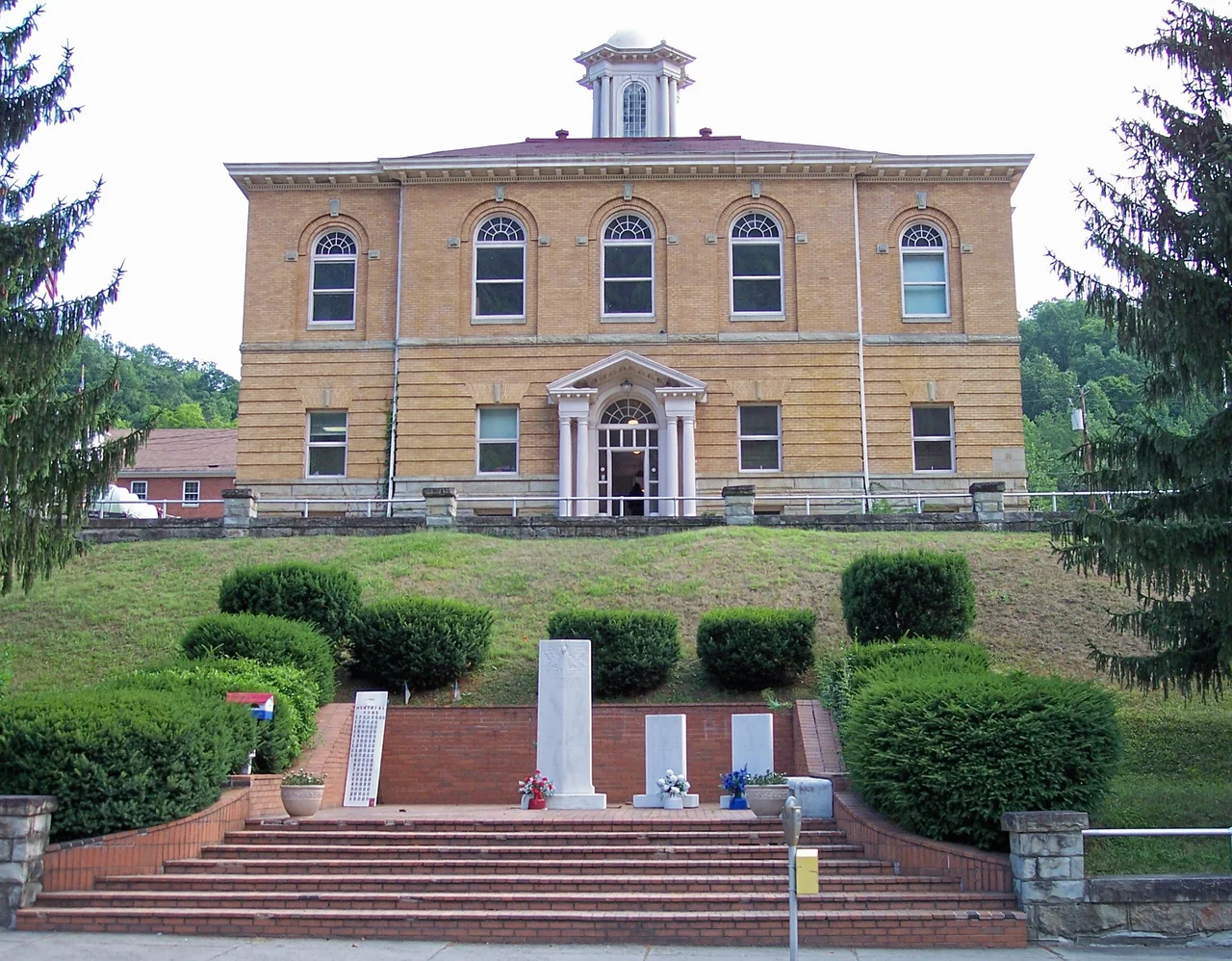

Clay, West Virginia
On a hillside above the Elk River in 1905, a farmer named Anderson Mullins noticed a single apple tree on his property bearing fruit that was unlike anything else in the orchard. The skin was yellow-green, the flesh sweet and firm. He brought a sample to the Stark Brothers Nursery in Missouri, who sent representatives east and bought the entire tree, the rights to propagate it, and a few surrounding acres. By 1914, the variety was being sold to commercial growers nationwide under the name Golden Delicious. The world's most widely grown yellow apple was born in Clay County, West Virginia, a few miles from the small town of Clay - county seat, population about 440, sometimes affectionately called Clayberry by people who live there and people who do not want them to feel bad about it.
Town of Clay
Clay sits at the intersection of WV Route 4 - which runs northeast toward Sutton and Interstate 79 - and WV Route 16, which runs from near Parkersburg in the west all the way south to Fayetteville. The Clay County Courthouse dominates the small downtown, a turn-of-the-century brick building that has the dignified bulk that Appalachian county seats almost always have. There is a single major eating establishment, the Go-Mart deli at the junction of Routes 4 and 16, which locals consider an institution. They are not wrong about the potato wedges. The town has a pet store called Spunky le Chat, named after a local cat with a following. The population, around 440, has been slowly declining for a generation. The river still flows past.
The Golden Delicious
When Anderson Mullins's chance seedling produced its first crop in 1905, the apple world was dominated by red varieties - the Red Delicious that emerged about the same time, the Mcintosh, the Stayman Winesap. Yellow apples were considered second-tier. The Stark Brothers, who had already commercialized the Red Delicious, recognized something different in Mullins's chance discovery. They paid $5,000 for the tree - an enormous sum in 1914 - and fenced it off with a barbed-wire enclosure. The original Golden Delicious tree died sometime in the 1950s. Clay County held the first Golden Delicious Festival in 1972, an annual September celebration that fills the town each year. The Golden Delicious is now the parent or grandparent of dozens of important commercial apple varieties worldwide, including the Gala, the Jonagold, the Pink Lady, and the Mutsu. Clay was where it started.
Solomon's Secret and the Booger Hole
On two weekends each September, an outdoor drama called Solomon's Secret runs at Dundon Hill, a few minutes from downtown Clay. The show is the work of a local theater company; the story follows one Cherokee family's struggle through Appalachian history. Performances begin at 8 PM; admission costs less than a movie ticket. A more famous, much darker, attraction is a hollow east of Clay called Booger Hole - more formally, Rush Fork of Big Otter Creek. In the late 1800s and early 1900s, a series of unsolved disappearances and murders gave the hollow its name and a reputation that has not entirely faded. Paranormal investigators and television crews occasionally turn up to film. Locals will tell you that the trouble is real, even if the spirits are debatable. Driving the hollow at dusk, with the wooded ridges closing in, is an experience that does not require much imagination.
Outdoor Country
Most people who come to Clay County come for the outdoors. The Elk River runs through the county, broad and slow in places, with class II rapids in others - a great paddling river for canoeists and kayakers who do not need the dramatic gradient of the Gauley or the New. Laurel Creek and the smaller tributaries hold smallmouth bass and rock bass. The Wallback Public Hunting Area covers thousands of acres of forested ridge for whitetail deer and turkey. In 2024, Rail Explorers USA opened a Clay County division of their rail bike attraction, running two-hour tours on the historic Buffalo Creek and Gauley Railroad bed along the Elk River, passing a small waterfall called Devils Sawmill and crossing the rebuilt Sandfork Bridge. Sutton is about 50 minutes northeast. Charleston is about an hour southwest. Fayetteville is about an hour south. Summersville is about an hour southeast. Clay is a small town in the geographic middle of West Virginia, and most of the state is within an easy day trip.
From the Air
Clay sits at 38.46 N, 81.08 W, on the Elk River in west-central West Virginia, county seat of Clay County. Recommended viewing altitude is 2,500 to 4,500 feet AGL. The town and the river are visible from the air; WV Routes 4 and 16 form the main crossroads. The Wallback Wildlife Management Area covers the ridges to the northwest. Nearest airports are Yeager (KCRW) in Charleston about 40 miles southwest and Braxton County Airport (K48I) in Sutton about 35 miles northeast.
Nearby Stories
- Southwest Airlines Flight 2294 4.5 km away
- Hawks Nest, West Virginia 7.6 km away
- Appalachia 15 km away
- Staats Mill Covered Bridge 17 km away
- Friars Hole Cave System 18 km away
- Webster Sycamore 18 km away
- West Virginia State Wildlife Center 27 km away
- Hobet Coal Mine 37 km away