
West Virginia State Wildlife Center
By 1911, the bison were gone. So were the elk, the wolves, the cougars, and most of the wild turkey, and the white-tailed deer was so reduced that hunters could ride a horse across central West Virginia for a week without seeing one. The mountain state's wildlife had been hunted out and habitat-stripped to a degree that shocked even the timber barons whose operations had caused much of it. In 1923, the state created the French Creek Game Farm in southern Upshur County with the idea of breeding native species in captivity for release back into the wild. The reintroduction strategy did not work - captive-bred animals lacked the instincts to survive - but the facility itself became something else, more durable: a teaching zoo where West Virginians could see the animals their grandparents had hunted to local extinction, walking past them along a mile-and-a-quarter trail through a working piece of mature hardwood forest.
What Happened Before 1923
The collapse of West Virginia's wildlife in the late nineteenth and early twentieth centuries was not a slow attrition. It was a fast one. Industrial-scale logging had stripped most of the state's old-growth forest by 1910, removing the habitat the larger mammals depended on. Market hunting - shooting deer and turkey for the urban meat trade - took the food animals. Predators were shot on sight as a public service. By the time the state government had organized itself enough to do something about it, the major fauna of the central Appalachians had collapsed: bison were gone before statehood; elk by the 1870s; wolves by the 1890s; cougars (variously called mountain lions, panthers, or pumas) by the early 1900s. Even white-tailed deer and wild turkey, animals that today are so common they cause traffic accidents and damage gardens, had become nearly impossible to find. The reduction was so severe that no living West Virginian in 1923 could remember what an intact native fauna looked like.
The Game Farm Idea
The French Creek Game Farm was the state's response. The model was a breeding facility: capture, hold, and breed native species in captivity, then release the offspring to repopulate the wild. The 1920s was the era of these kinds of facilities across the United States, all attempting some version of the same thing. The science underlying the model was new, the methods were experimental, and the results were largely disappointing. Captive-born deer released to the woods got hit by cars or eaten by predators they had no instinct to avoid. Game birds released for sport were too tame to flush. By the middle of the twentieth century, most state game farms had concluded that reintroduction worked better through translocation - moving wild animals from healthy populations to depleted areas - than through captive breeding. West Virginia's elk reintroduction, decades later, used Kentucky animals trapped in the wild rather than captive-bred stock.
From Game Farm to Wildlife Center
What the French Creek facility became was a destination. Visitors had been coming since the 1920s to see the bison, elk, and bears the farm kept in pens, animals that no longer existed in the wild in West Virginia. The crowds gave the facility a second mission as a teaching tool. In 1986 the state recognized the shift formally by renaming it the West Virginia State Wildlife Center. The 338-acre property now displays twenty-nine species of native West Virginia mammals, birds, and reptiles along a 1.25-mile trail through second-growth hardwood. About fifty thousand people visit each year. Many of them are schoolchildren on field trips; some are families on weekend outings; a number are out-of-staters who have come for the Buckhannon strawberry festival or the Stonewall Resort and have added the Wildlife Center to their itinerary.
What You See Along the Trail
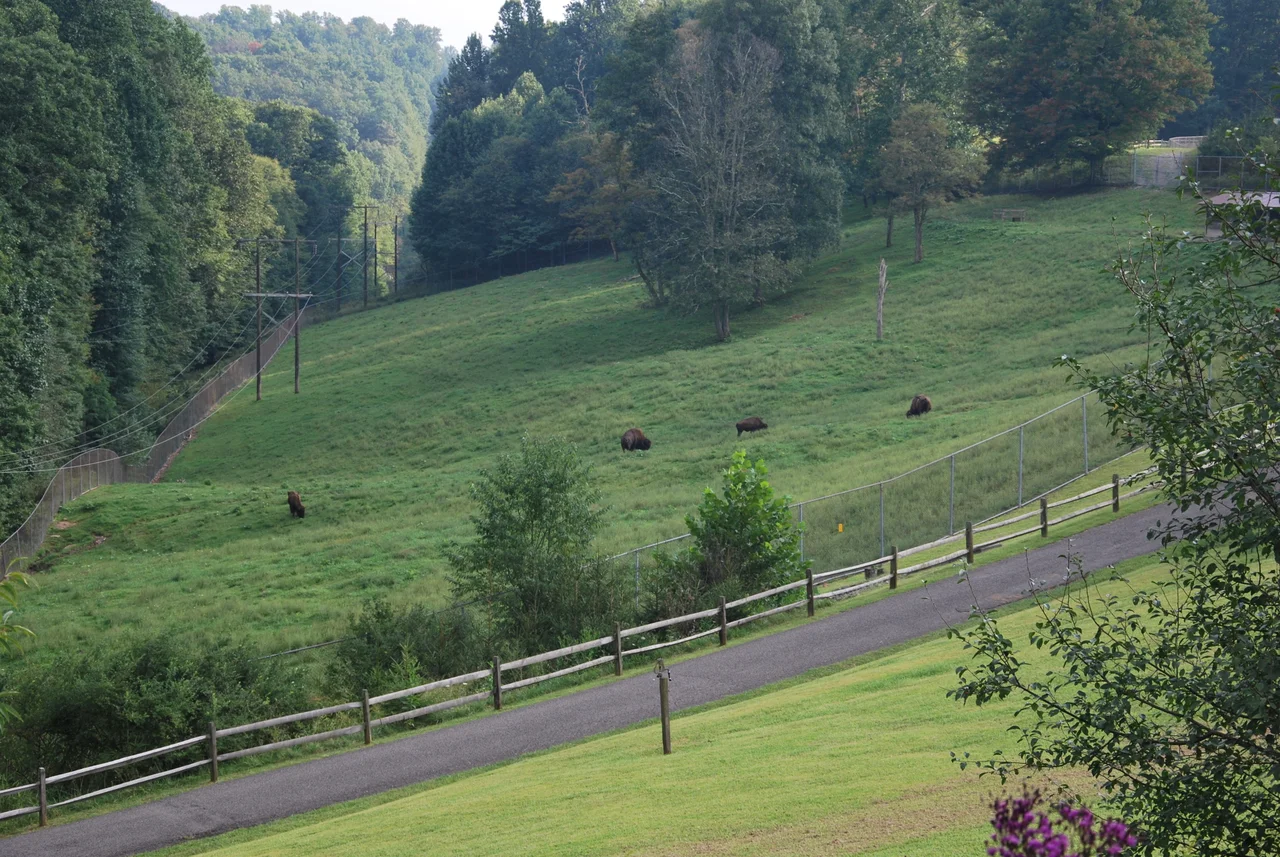
The trail loops through the woods past large naturalistic enclosures, each holding one or two species. Black bears amble in their fenced section of forest; bobcats sleep in trees; coyotes pace along their fence lines; foxes dart through underbrush. The most striking exhibits are the species the state lost. Bison stand in a flat pasture where they have nothing in particular to do; elk - reintroduced to the wild population since 2016 - browse along their boundary; wolves, extirpated since the 1890s, pace and watch. The cougar, also extirpated, is one of the more popular animals on the loop; for many visitors it is the only one they will ever see. The center keeps several birds of prey - bald and golden eagles, red-tailed hawks, three kinds of owls - many of them recovered from injuries that have left them unable to fly well enough for release. The reptile exhibits include eastern copperheads and timber rattlesnakes, the two venomous snakes a West Virginia hiker is most likely to encounter.
French Creek Freddie and the Pond
The center's most famous resident is a groundhog named French Creek Freddie. Every February 2, Freddie performs the state's official Groundhog Day prediction - West Virginia's regional equivalent of Punxsutawney Phil - and his pronouncement is solemnly recorded by the West Virginia Division of Natural Resources and broadcast across the state. The ritual is good-humored and durable; it has been performed for decades. Beyond Freddie, the center offers picnic areas with grills, a separate trail through the forest behind the animal exhibits, a gift shop, and a stocked fishing pond where children can try for trout, bass, catfish, or bluegill. The whole complex is twelve miles south of Buckhannon on WV 20, at the intersection with Alexander Road - locally still known as the Game Farm road, in honor of what the place used to be before it became something more interesting.
From the Air
Located at 38.86 N, 80.31 W in southern Upshur County, central West Virginia. Best viewed at 2,500-4,000 feet AGL; the cleared animal enclosures and the surrounding hardwood forest along WV-20 mark the position. Nearest airport: Upshur County Regional (KW22) at Buckhannon, about 12 nm north. The Buckhannon River valley to the north and the foothills of the Monongahela National Forest to the southeast provide visual references. The center is about 25 nm east of I-79 and Sutton.
Nearby Stories
- Holly River State Park 0.8 km away
- Quiet Dell School 3.9 km away
- West Virginia Maneuver Area 5.2 km away
- Cedar Creek State Park 6 km away
- North Bend Rail Trail 14 km away
- Camp Bartow Historic District 16 km away
- End of the World Turn 17 km away
- Cathedral State Park 27 km away