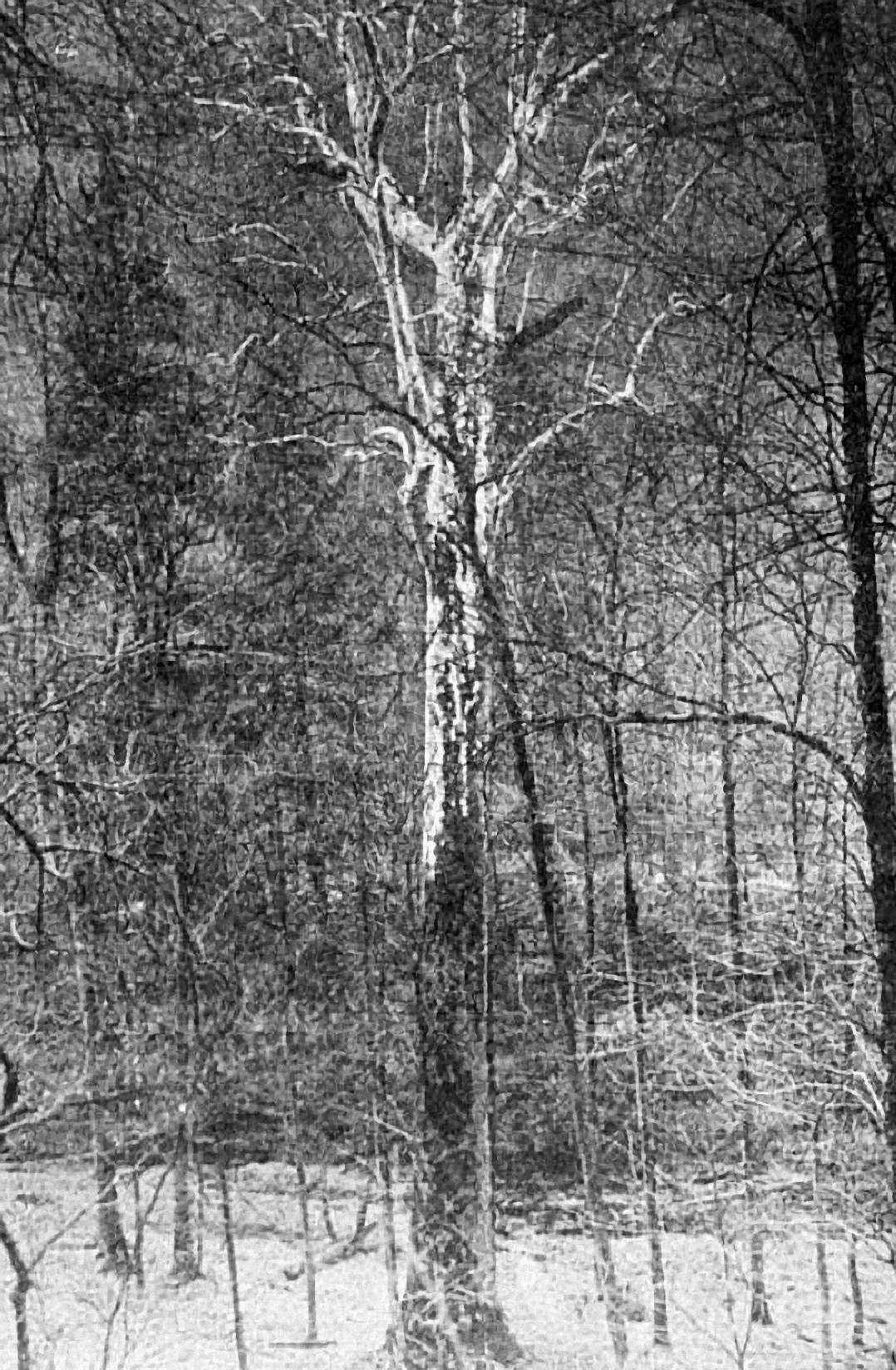

Webster Sycamore
It had stood since around the year 1500 - before Columbus's third voyage, before the Reformation, before any European had reached this part of North America. The American sycamore on the bank of the Back Fork of the Elk River grew to 112 feet tall and 25 feet around. It was the largest tree of its species in West Virginia and, for three weeks in 1955, the largest American sycamore in the United States. It survived the Cherry River lumber boom that took every other big tree off these hills. It survived 500 years of floods, ice storms, and lightning. It did not survive a 17-year-old boy from Bergoo with a lighter.
The Tree
Platanus occidentalis, the American sycamore, grows in moist bottomland soils along streams across the eastern United States. The mottled bark - olive, gray, and bone-white in irregular patches - is unmistakable. Mature sycamores can reach 100 feet or more and live for centuries, especially the ones that settle along big rivers in deep alluvial soil. The Webster Sycamore did all of this. Its trunk forked at 45 feet, and the lower trunk was already 4.33 feet in diameter at the fork. Its crown spread 90 feet. West Virginia University biologist W. H. Gillespie called it 'a memorial of the original virgin forest' - one of the last single specimens that gave a sense of what the central Appalachian hardwood forest looked like before the lumber industry arrived.
How It Survived
The tree stood on land owned by the Pardee and Curtin Lumber Company, headquartered in nearby Webster Springs. In the 1950s, when Pardee and Curtin logged the surrounding ridges, they made a decision that lumber companies rarely make: they spared this tree. The land around it became Big Sycamore Park, kept open for visitors. The Webster Wildwater Weekend in April and the Webster County Nature Weekend in May regularly included a hike to the sycamore. Photographs of the tree from the 1920s and the 2000s, archived by the West Virginia Department of Arts, Culture and History, show essentially the same tree - taller, perhaps slightly thicker, but recognizably the same massive presence. A 1964 newspaper article called it the Big Sycamore on Back Elk and noted that a piggyback partner - a smaller sycamore that had grown into the larger one's lower fork - was clearly visible.
The National Title, Briefly
In 1955 the American Forests Association declared the Webster Sycamore the largest American sycamore in the United States. The title lasted exactly three weeks. The association then identified a slightly larger sycamore in Maryland and revised the listing. The Webster Sycamore remained the West Virginia state champion and one of the largest in the eastern range. A 1963 statewide survey of big trees placed it second only to a giant white oak in Randolph County. For a tree that had probably never been measured for its first 460 years, this brief brush with national recognition was a strange late-life development.
The Fire
On the afternoon of September 3, 2007, someone set a fire in the base of the trunk. The fire burned up through the hollow center of the tree - sycamores commonly hollow out at the base as they age, leaving a chimney-like void inside an otherwise living trunk - and ate the interior structural wood. The tree did not fall right away. It survived the immediate blaze. But the structural integrity that 500 years of growth had produced was compromised in an afternoon. In January 2008, prosecutors charged a 17-year-old from Bergoo, West Virginia, with felony arson. The West Virginia Division of Forestry assessed the surviving tree and labeled it an extreme hazard. Sycamores damaged like this become dangerous - they can shed massive branches without warning, or fall entirely - and there was no engineering remedy.
The Fall
In the summer of 2010, the Division of Forestry brought the Webster Sycamore down. The trunk that had stood since the late 1400s was reduced to a pile of cordwood and a stump in a single working day. It was approximately 500 years old. The arson took its life in the way an arsonist sometimes takes a person's life - not immediately, but irrevocably, in a sequence of physical and medical events that the law and biology together work out over time. The Webster Sycamore is not the only ancient tree to die this way. The Senator, a 3,500-year-old bald cypress in Florida, was burned by an arsonist in 2012. There is a small grim subculture of people who feel compelled to destroy old trees. The trees themselves outlast almost everything else. They do not outlast that.
From the Air
Located at 38.52 degrees N, 80.36 degrees W in Webster County, West Virginia, on the Back Fork of the Elk River about 4.5 nm east of Webster Springs. The site is now memorialized by a clearing where the tree stood; the surrounding Big Sycamore Park remains accessible. Yeager Airport (KCRW) in Charleston is the nearest tower-controlled field about 65 nm southwest. Elkins-Randolph County Regional Airport (KEKN) is about 40 nm northeast. Recommended viewing altitude 4,500 to 6,500 feet MSL. Expect ridge-and-valley terrain throughout the area; valley fog common in the Elk River drainage mornings.
Nearby Stories
- West Virginia State Wildlife Center 2 km away
- Cedar Creek State Park 3.8 km away
- Cranberry Wilderness 4.8 km away
- Camp Bartow Historic District 6.4 km away
- West Virginia Maneuver Area 9 km away
- Gad, West Virginia 9.2 km away
- End of the World Turn 10 km away
- Bath County Pumped Storage Station 12 km away