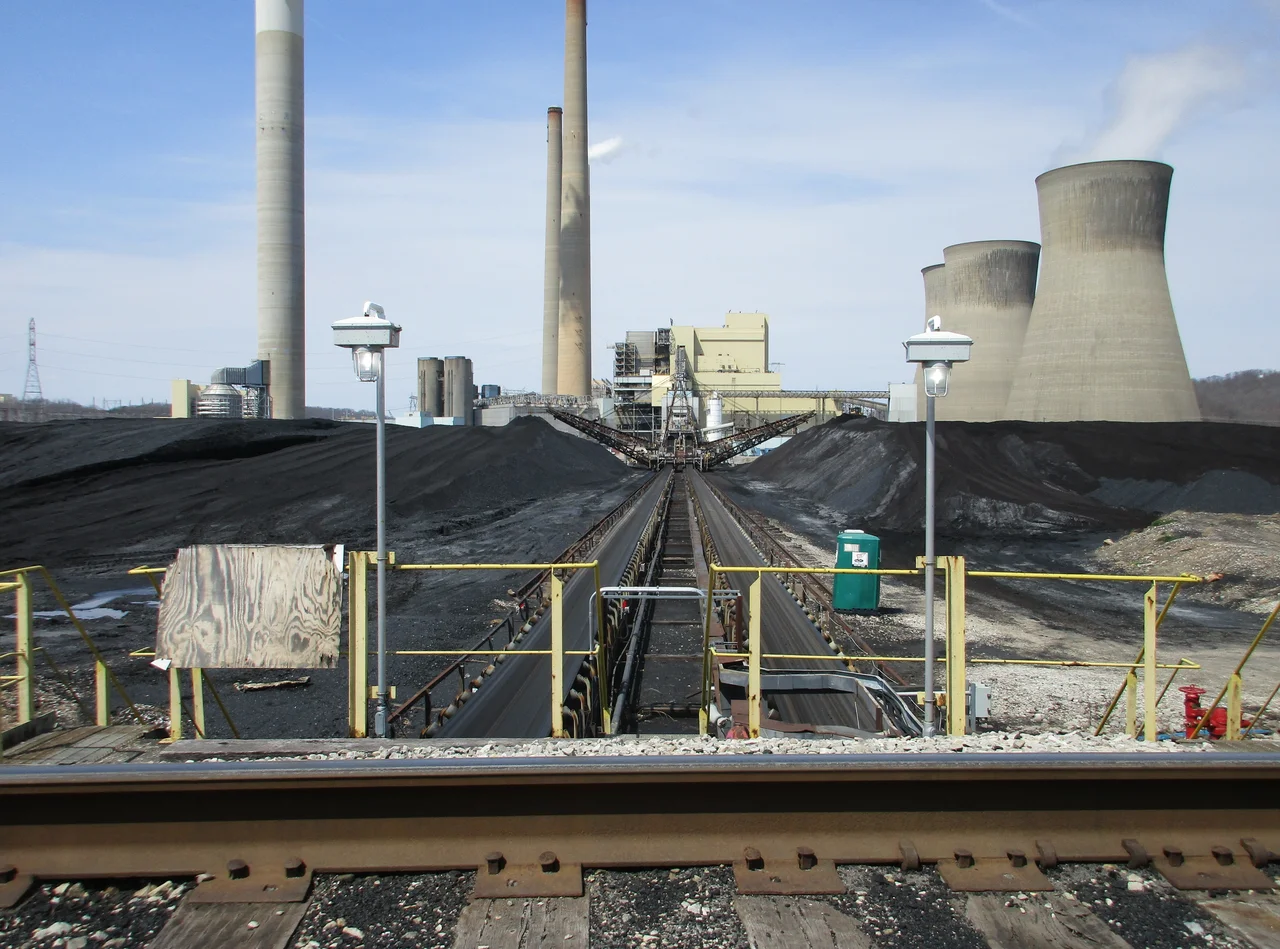

John E. Amos Power Plant
From the air at altitude, the John E. Amos Power Plant is unmistakable: three immense brown-and-white cooling towers, each more than four hundred feet tall, lined up on a riverbank in Putnam County, West Virginia. The towers vent the waste heat from one of the largest coal-fired power stations in the United States. The plant generates 2,933 megawatts on three units, more than any other plant in the American Electric Power system, and at full capacity burns about 26,000 tons of coal a day - the equivalent of roughly 260 fully loaded coal hopper cars. The electricity it produces is enough to power approximately two million homes. The towers' steam plumes are visible from Charleston, fifteen miles east, on cold winter mornings - rising in straight white columns until they catch the prevailing westerlies and curve away across the ridges.
Named for a Power Broker
John E. Amos was a state senator from Charleston, a Democratic National Committee member from West Virginia, and a board member of American Electric Power. AEP gave him the unusual honor of attaching his name to its largest generating station - a thank-you in three steel-and-concrete units. The plant was built in stages: Unit 1 went online in 1971, Unit 2 in 1972, Unit 3 in 1973. The three units were sized to take advantage of the engineering economies of scale that defined American thermal generation in the 1960s and 1970s. Unit 3, at 1,300 megawatts, was for a long time among the largest single coal-fired generating units in the United States. The plant sits between West Virginia Route 817 - locally called Winfield Road - and the Kanawha River. Coal arrives by barge up the Kanawha from Appalachian mines and by rail on the Norfolk Southern line that runs along the south bank.
How a Pile of Coal Becomes 26,000 Volts
The process at Amos is the same process that powered most of America's twentieth-century electrical grid, just at a much larger scale. The coal yard can hold 1.75 million tons - several weeks of operating supply at full draw. Coal moves by conveyor belt into the plant, where pulverizers grind it into a powder roughly the consistency of talcum. Primary fans blow the coal dust into the boilers, where it burns at about 1,000 degrees Fahrenheit. The heat boils water into superheated steam. The steam spins turbine blades that drive the generators. Each generator produces electricity at 26,000 volts. Transformers outside the plant step that voltage up to 345,000 volts or 765,000 volts for transmission across the AEP grid. The plant employs about 300 people, with an annual payroll of roughly $27 million. Most of those jobs are highly skilled - boiler operators, control room engineers, electricians, instrumentation technicians.
Cleaning Up What Coal Produces
Coal-fired generation produces substantial emissions: nitrogen oxides, sulfur dioxide, carbon dioxide, mercury, and fine particulates. Federal Clean Air Act regulations through the 1990s and 2000s required existing plants to install pollution-control equipment. At Amos, Appalachian Power installed selective catalytic reduction (SCR) systems on its three units, starting with Unit 3 in 2002, Unit 2 in 2004, and Unit 1 in 2005. The SCRs use ammonia injection over a catalyst to convert nitrogen oxides into nitrogen and water - cutting NOx emissions by about 90 percent. The total cost of the three SCRs was $346 million. AEP also installed flue gas desulfurization systems (scrubbers) on the plant to reduce sulfur dioxide. These investments extended the plant's regulatory life, but they did not change the fundamental carbon-dioxide footprint, which has become the dominant question for coal plants in the climate-policy era.
Last Decades of a Coal Plant
The economics of coal-fired generation have shifted dramatically since the 1970s. The expansion of cheap natural gas through hydraulic fracturing, combined with the cost reductions in solar and wind generation, have squeezed coal plants out of the merit order across most of the United States. AEP's other West Virginia coal plants have been retired or scheduled for retirement. Amos remains in operation because of its scale and the long-term capital already invested - but its future is conditional on whatever combination of federal regulation, state policy, and economic competition prevails in the coming decade. The plant's three units have firm operating retirements scheduled in the 2030s and 2040s under current AEP planning, though those schedules have been revised more than once. The towers continue to send their steam plumes up into the sky over the Kanawha Valley. For now.
From the Air
The John E. Amos Power Plant sits in Putnam County, West Virginia at 38.47 degrees north, 81.82 degrees west, on the south bank of the Kanawha River about fifteen miles west of Charleston near the town of Winfield. Best viewed at 5,000 to 10,000 feet AGL: the three massive cooling towers are visible from a great distance, especially on cool mornings when steam plumes are prominent. Yeager Airport (KCRW) is about fifteen miles east in Charleston. The Kanawha River bend and the cooling tower cluster make this one of the most visible industrial landmarks in the Kanawha Valley.
Nearby Stories
- Mystery Hole 6.5 km away
- West Virginia Colored Children's Home 9.4 km away
- Clay, West Virginia 13 km away
- Staats Mill Covered Bridge 14 km away
- Hobet Coal Mine 23 km away
- Appalachia 23 km away
- Fred M. Vinson Museum and Welcome Center 30 km away
- Ponn Humpback Covered Bridge 43 km away