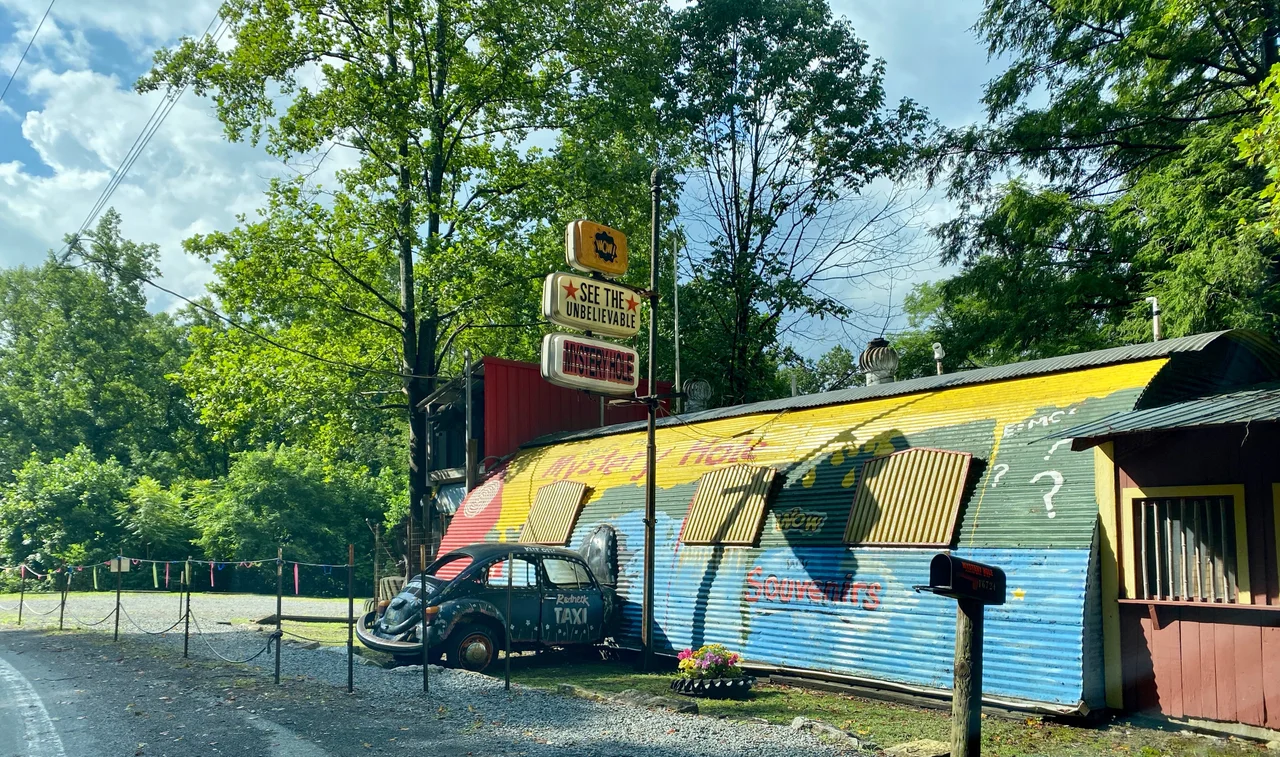

Mystery Hole
There is a sign on US Route 60 in Ansted that promises gravity-defying wonders. There is a small concrete building set into the hillside. There is a 1960s Volkswagen Beetle, painted in flower-power colors, embedded permanently in the wall as though it had driven right through it. There is a ticket window. Inside, balls roll uphill. Water flows in defiance of physics. Visitors who walk through find themselves leaning at angles that no upright human should be able to hold. This is the Mystery Hole, founded by Donald Wilson in 1973, neglected after his death, rescued from oblivion in the late 2010s, and still operating as one of the great low-budget American roadside attractions of the post-war era.
Donald Wilson's Vision
Donald Wilson opened the Mystery Hole in 1973, in the same stretch of southern Fayette County that already hosted Hawks Nest State Park, Cathedral Falls, and the various coal-era oddities of the Midland Trail. The Midland Trail - US Route 60 - had long been the principal road across this part of West Virginia, and the years after the Interstate Highway System diverted long-distance traffic onto faster routes were when small American attractions like this one bloomed. Wilson built a structure into the hillside, leveraged the natural slope, and added the kind of carefully arranged ramps and chambers that make a gravity-hill attraction work. The illusion is largely a matter of misaligned visual cues - tilted floors, sloping walls, conflicting horizons - that override the inner ear's sense of which way is up.
The Volkswagen Bug
The Mystery Hole's signature exterior feature is a 1960s-era Volkswagen Beetle, painted in psychedelic colors, mounted on the outside wall of the attraction as though it had collided with the building at speed. The original paint job was the work of local artist Sherd Maynard. After Maynard's death, his daughter Amber refreshed the Beetle with updated artwork, keeping the colors bright against the green of the surrounding hillside. The car is one of the most photographed roadside oddities in West Virginia. Together with the Mystery Hole's hand-painted signs and its slightly disreputable promise of mystery, the Bug has earned the attraction a permanent slot in the canon of American kitsch tourism documented by Roadside America and Atlas Obscura.
Closure and Resurrection
Donald Wilson closed the Mystery Hole in 1996. He died shortly afterward. The attraction sat abandoned for years, vandalized by passing teenagers, its windows broken, the Bug fading. The Maynard family kept watch over the property. In 2016, the entire site - the attraction itself, several outbuildings, and a cabin - went up for sale at a price of $495,000. Press coverage in Mother Jones and other outlets brought new attention to the property. Eventually new owners took it on, restored the interior to working order, fixed up the Bug, and reopened it on a seasonal weekend basis. The attraction is now operated out of an old auto garage in Cedar Grove during off-season periods, partially inhabited by crickets - the kind of detail that the Mystery Hole's faithful would consider an asset rather than a problem.
Why It Still Works
Gravity hills and mystery spots have been a fixture of American roadsides since at least the 1930s - the Oregon Vortex opened in 1930, Santa Cruz's Mystery Spot in 1939. They rely on a remarkably simple trick: building a structure on a steep grade and then disguising the floor, ceiling, and walls so that the viewer's sense of horizontal becomes confused. Once the eye gives up on the actual horizon, the inner ear surrenders too. Visitors find themselves leaning forward at impossible angles. Balls released on apparently flat surfaces appear to roll uphill. Tour operators long ago figured out how to make the experience theatrical, and the Mystery Hole carries on that tradition with the patter and the props of the 1970s era it was born in. The result is one of the few authentic surviving examples of pre-Internet American roadside tourism still on its original site, mid-century weirdness included.
From the Air
The Mystery Hole sits at 38.12 N, 81.14 W, along US Route 60 just east of Ansted in Fayette County, West Virginia, on the rim of the New River Gorge near Hawks Nest State Park. Recommended viewing altitude is 2,500 to 4,000 feet AGL. The attraction itself is small and easy to miss from the air - look for the hillside building and the painted Volkswagen Beetle near the side of US 60. Nearest airports are Raleigh County Memorial (KBKW) in Beckley about 25 miles south and Yeager (KCRW) in Charleston about 30 miles west-northwest.
Nearby Stories
- West Virginia State Capitol 4.7 km away
- Greenbrier County, West Virginia 13 km away
- Beckley, West Virginia 13 km away
- Clay, West Virginia 16 km away
- The Greenbrier 18 km away
- Webster Sycamore 26 km away
- Kanawha State Forest 26 km away
- Welch, West Virginia 40 km away