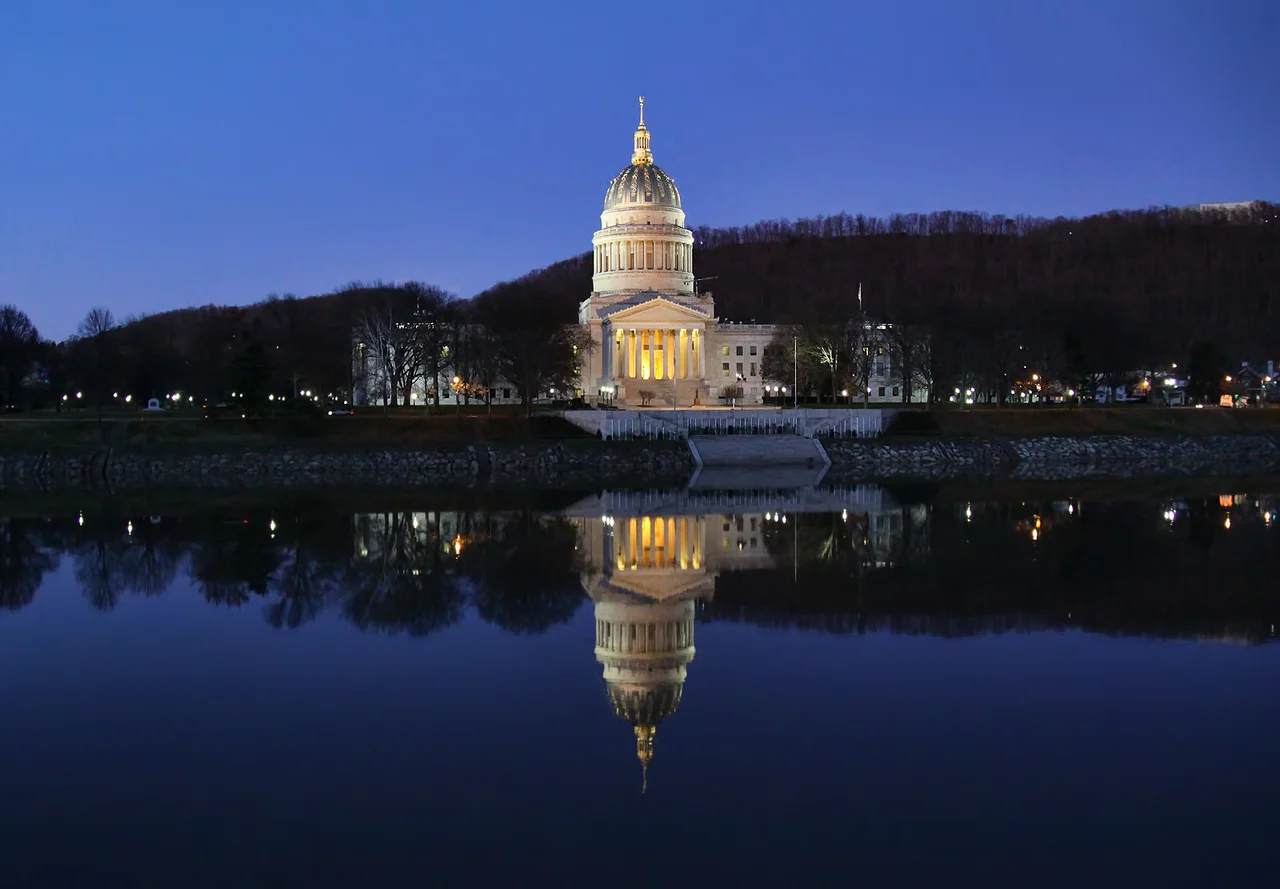

West Virginia State Capitol
Charleston went through two capitols before they got one that could survive a fire. The first burned. The second, a temporary wooden replacement so flimsy locals called it the pasteboard capitol, also burned. By the time Cass Gilbert was hired to design the building that stands today, the West Virginia legislature had every reason to want stone. Gilbert gave them buff Indiana limestone, a 292-foot gold-leafed dome, and an east wing chamber he liked so much he reused the design for the U.S. Supreme Court.
A Capital That Could Not Sit Still
West Virginia could not decide where to put its capital. For nearly two decades after statehood in 1863, the seat of government bounced between Wheeling and Charleston, with Martinsburg and Clarksburg lobbying for consideration too. The legislature finally fixed Charleston as the permanent capital by referendum on August 7, 1877. The first downtown capitol building, designed by Leroy S. Buffington of Cincinnati in 1869, mixed French Baroque, Second Empire, and High Victorian Gothic so freely that descriptions usually settled for eclectic. Wheeling persuaded the legislature back in 1875 by offering to build a fresh capitol there, the rail access being better. Charleston got the seat back permanently in 1885 - in a new High Victorian Gothic building that burned in 1921, leaving only its exterior walls.
The Pasteboard Capitol
The state hastily threw up a temporary wooden capitol on Washington Street, expecting to rebuild on the same downtown site. That plan collapsed when the legislature chose a riverside lot at the eastern end of the city instead and sold the downtown property to private developers. The temporary building stood through six legislative sessions, the press calling it the pasteboard capitol for its visible flimsiness. Then it too burned, in 1927, three years after construction had finally begun on the building that would replace it. Two capitols destroyed by fire in six years left a state government working out of borrowed offices and a sense that the third try had to last.
Cass Gilbert's Last Capitol
The 1921 Capitol Building Commission picked Cass Gilbert, the New York architect whose Woolworth Building had briefly been the tallest in the world and who would later design the U.S. Supreme Court. Gilbert imagined a buff limestone Renaissance Revival structure with a dome that would dominate the Kanawha River bend. Construction began in 1924 in three stages. The cornerstone was laid November 5, 1930. Governor William G. Conley dedicated the finished capitol on June 20, 1932, the final bill just under 10 million dollars. Gilbert was so pleased with his design for the East Wing legislative chamber that he carried the same scheme into his Supreme Court commission in Washington, where it became the larger room the justices still sit in today. The Charleston original is the smaller sibling.
The Grounds and the River
The Capitol faces the Kanawha River across Kanawha Boulevard, with the open quadrangle behind it framed by perpendicular east and west wings. Statues populate the plaza. Fred Torrey's Abraham Lincoln Walks at Midnight depicts the president, head bowed, wrapped in a robe, taking the midnight walks he was said to take during the darkest months of the Civil War - the war that created West Virginia. A Stonewall Jackson statue, the Confederate general was born in what is now West Virginia, stands at the southeast corner. Holly Grove Mansion, the Governor's Mansion, the Culture Center, and the West Virginia Music Hall of Fame all share the complex. At 292 feet, the Capitol is the tallest building in the state. The game Fallout 76 used it as a set piece - Charleston Capitol Building - which is how some out-of-state visitors first learn to recognize the dome.
From the Air
Located at 38.336 N, 81.612 W on the south bank of the Kanawha River in Charleston, West Virginia. The 292-foot gold-leafed dome dominates the city skyline and is unmistakable from the air. Yeager Airport (KCRW) is 4 miles northeast. Best viewed at 2,500-4,000 feet on clear days, when the dome glints and the river bend traces the plaza below.
Nearby Stories
- Mystery Hole 6.5 km away
- West Virginia Colored Children's Home 9.4 km away
- Clay, West Virginia 13 km away
- Staats Mill Covered Bridge 14 km away
- Hobet Coal Mine 23 km away
- Appalachia 23 km away
- Fred M. Vinson Museum and Welcome Center 30 km away
- Ponn Humpback Covered Bridge 43 km away