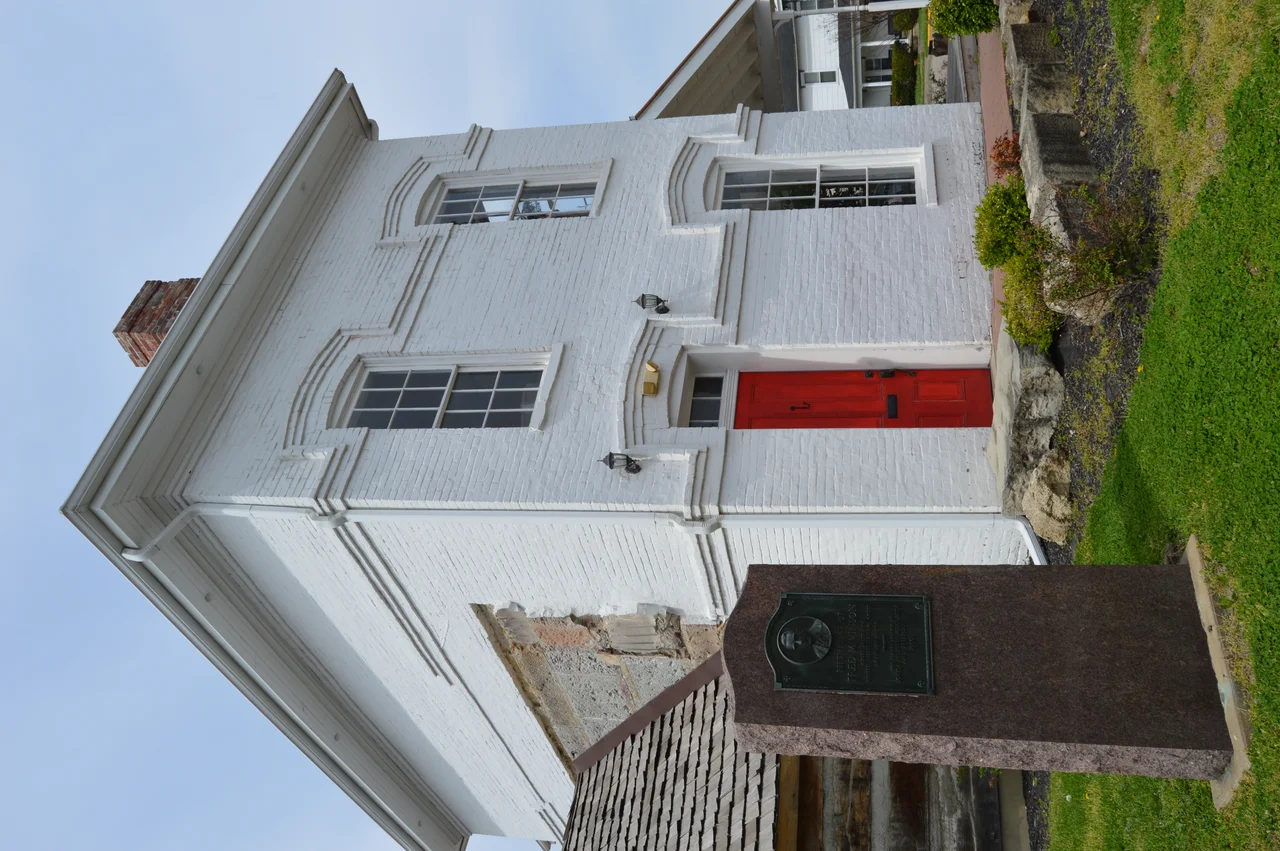

Fred M. Vinson Museum and Welcome Center
The jailer's son who grew up in this brick house above the Lawrence County cells became the thirteenth Chief Justice of the United States. Fred Moore Vinson was born here on January 22, 1890, the year after his father moved the family into the new Jailer's Residence on Courthouse Square. The building still stands at the corner of East Madison and Vinson Boulevard - a boulevard named for the kid who once played in its yard. Inside, the eight rooms now hold a museum about his life, and a welcome center for the town of Louisa.
The Jailer's House
Lawrence County completed the brick residence in 1889 to give its jailer a respectable place to live next to the work. Two stories, eight rooms, set on Courthouse Square in the county seat of Louisa - a substantial building for a town of its size and a clear sign that local government took the jailer position seriously. James Vinson moved his family in soon after construction was finished. A year later his son Fred was born, on the second floor by family tradition, and grew up running between the kitchen of his mother's house and the cells where his father did his job. That juxtaposition - domestic comfort and public order, child's play and locked doors - shaped the future jurist's earliest sense of how American life actually worked.
From Louisa to Washington
Vinson left Louisa for Centre College in Danville, then law school, then practice. He was elected to Congress, served as Director of the Office of Economic Stabilization during World War II, and became Secretary of the Treasury under Harry Truman. In 1946 Truman appointed him Chief Justice of the United States, the head of the Supreme Court. He served seven years on the Court before dying suddenly of a heart attack on September 8, 1953 - just months before the Court would decide Brown v. Board of Education under his successor Earl Warren. Vinson's tenure ended at one of the great hinges of American constitutional history, with his death reshaping what the Court would become.
Old Jailer's House
The building was added to the National Register of Historic Places in 1974 under the name Old Jailer's House, a more honest title than the museum's later name suggests. It remembers a system of small-town governance that has largely vanished. Most counties no longer house their jailer next door to the jail. Most county jails no longer sit on the courthouse square. The brick walls here preserve a working architecture of an era when local government was small enough to be lived in - when the man who locked the cell door at night went upstairs to dinner with his family afterward.
Inside Today
The Fred M. Vinson Museum occupies the house now, with exhibits tracing the path from Louisa schoolboy to Chief Justice. The welcome center function runs alongside, giving travelers stopping in Lawrence County information about the surrounding region. Louisa sits at the confluence of the Tug Fork and Levisa Fork of the Big Sandy River, right on the Kentucky-West Virginia border. The Vinson story is one of the town's strongest claims to national history, and the museum honors it without inflating it - a careful small-town presentation of one of the highest offices the country has.
Reading the Town
From above, Louisa shows the classic Kentucky river-town pattern: a grid of streets squeezed between water and ridge, the courthouse marking the center, the surrounding blocks holding the older brick buildings. The Vinson birthplace is on the square. The Big Sandy River curls around the town's eastern edge, marking the West Virginia line. The Mountain Parkway feeds traffic in from the west. Beyond the town, the hollows and ridges of eastern Kentucky take over, the same landscape that produced Vinson and so many others who left these mountains and came back to be remembered.
From the Air
Located at 38.115 degrees north, 82.602 degrees west, on Courthouse Square in Louisa, Kentucky. Recommended viewing altitude 3,500 to 5,500 feet AGL to see the town's grid plan and the river confluence. Nearest airport is Lawrence County Airport-Louisa (K24), about two nautical miles west of town. Tri-State (KHTS) at Huntington is about 32 nautical miles northeast. Louisa sits at the meeting of the Tug Fork and Levisa Fork of the Big Sandy River, an easy landmark from the air.
Nearby Stories
- Heritage Farm Museum and Village 6.6 km away
- Tornado 6.6 km away
- Battle of Blair Mountain 22 km away
- Mingo County, West Virginia 27 km away
- Lower Shawneetown 45 km away
- Welch, West Virginia 49 km away
- The Kentucky Meat Shower: When Flesh Fell From a Clear Sky 69 km away
- Cumberland Gap 147 km away