
Heritage Farm Museum and Village
Mike and Henriella Perry moved out of Huntington in 1973 for a farmhouse on the edge of town. While doing renovation work they noticed something unexpected: the wooden logs in the walls of their house. The Perrys started asking questions. What kind of logs were these? How had a cabin like this been built? What tools had been used? They began collecting answers, and tools, and then whole old cabins from elsewhere in West Virginia. Half a century later, what started as a curiosity has become Heritage Farm Museum and Village - an open-air living history museum that became West Virginia's first Smithsonian-affiliated museum, with seven main museum buildings, a working petting zoo with a camel, and reassembled cabins where visitors can sleep.
From Antiquing to Museum
The Perrys started as antiquers - the hobby that combines collecting, restoring, and learning about old American material culture. Their interest in their own farmhouse logs expanded outward into broader Appalachian craftsmanship. They began accumulating authentic old structures - cabins, outbuildings, tools, equipment - that would let them and eventually visitors understand how nineteenth-century Appalachians actually lived. The collection grew. The barn that originally held it overflowed. The first May Festival opened the village to the public on May 4, 1996. For its first decade, that festival was the only day Heritage Farm was open in any given year. By 2006 the operation had grown enough to support a regular schedule. Today the village operates Fridays and Saturdays from May through October, plus four Christmas Village evenings in December.
Seven Museums Under One Sky
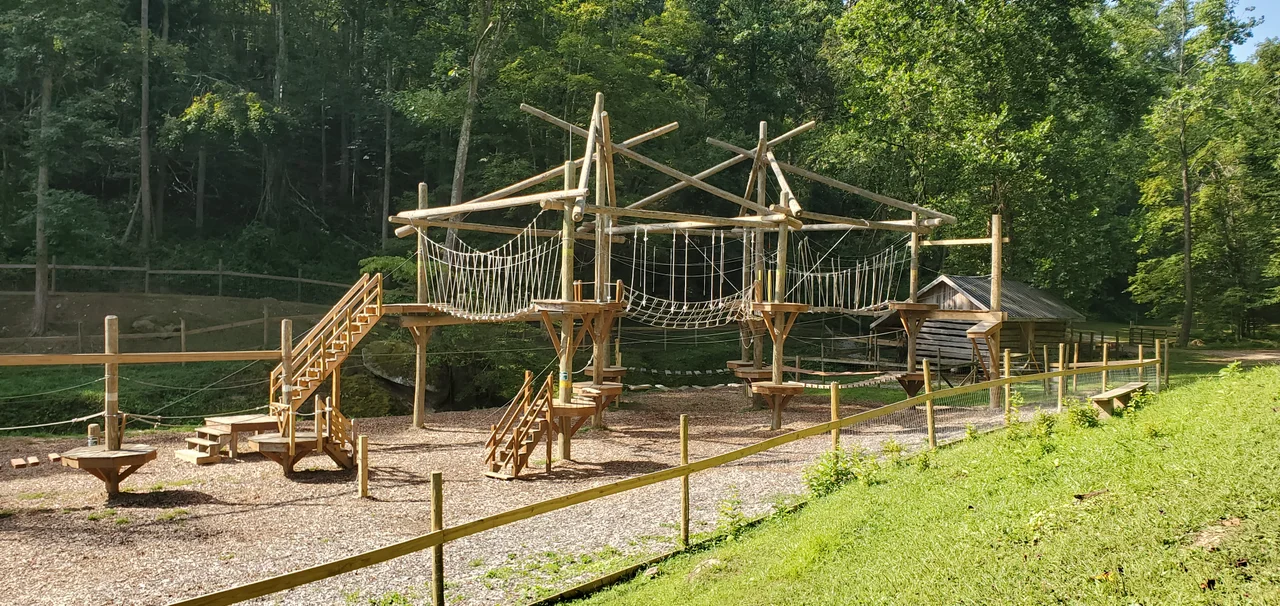
Heritage Farm has seven main museum buildings, each focused on a different aspect of Appalachian life. The Country Store displays the merchandise and rhythms of a rural store at the turn of the twentieth century. The Doll and Toy Museum displays the playthings that filled rural Appalachian childhoods. The Transportation Museum traces the wagons, buggies, and early automobiles that moved people across these hills. The Children's Activity Museum lets younger visitors handle tools and try the work of an earlier era. Additional buildings cover everything from blacksmithing to textiles. The Smithsonian affiliation, granted as the first in West Virginia, formally recognized what the Perrys and their successors had built - a serious, well-curated museum operation in a part of the country where such institutions are rare and have to fight harder for funding and recognition.
Sleeping in History
Visitors can rent buildings to sleep in. The Strawberry Inn, the first cabin reassembled at the farm, is built from nineteenth-century logs gathered from various cabins throughout Cabell and Wayne counties in West Virginia. The Blackberry Inn started as a cabin from Lavalette, West Virginia, with two later additions made from logs sourced in Mason County. The Hollyberry Inn was a farmhouse on the property before Heritage Farm existed. The Woodbury Inn is the newest cabin. The Applebutter Inn sits inside Heritage Village itself. Visitors who want to stay in a railroad caboose can do so - a 1940s Norfolk and Western caboose, fitted with fold-out beds, sleeps four. The 9,000-square-foot Barn Conference and Retreat Center, reconstructed from a nineteenth-century dairy barn, hosts larger gatherings.
The Camel and the Llamas
The petting zoo at Heritage Farm operates on festival days and through the summer. Standard farm animals - goats, pigs, sheep, miniature horses, rabbits - are joined by livestock not typically associated with Appalachian agriculture. The peacocks make spectacular noise. The llamas are a long-running attraction. And there is a camel, kept on the farm for reasons that probably involve children's enthusiasm more than historical accuracy. The mix of authentic period livestock and exotic crowd-pleasers reflects the operational realities of a small private museum that needs paying visitors to survive. Heritage Farm has solved that problem by being interesting on multiple fronts simultaneously.
Television Visitors
Heritage Farm has accumulated a small filmography. The History Channel filmed America's Greatest Feud: The History of the Hatfields & McCoys on location at the village in 2012, taking advantage of the authentic period buildings as backdrops for the documentary about the legendary Appalachian feud. American Pickers visited in late 2011 for a Pickin' Perry-dise episode that documented the Perrys' collection in their own context. Barnwood Builders, the DIY Network show about reclaiming and rebuilding old cabins, featured Heritage Farm in a 2015 episode called Grandma's Cabin. The exposure has helped make the museum a regional destination, drawing visitors from across the Appalachian region and beyond. The location near Huntington gives it road access from the interstate corridor.
From the Air
Located at 38.376 degrees north, 82.467 degrees west, in the Harveytown neighborhood on the southern edge of Huntington, West Virginia. Recommended viewing altitude 2,500 to 4,000 feet AGL for clear views of the village's spread of historic buildings. Nearest airport is Tri-State (KHTS), about 5 nautical miles northeast. The farm sits in the rolling hills south of the Huntington core, identifiable from the air by the irregular cluster of small buildings, with surrounding open fields.
Nearby Stories
- Battle of Scary Creek 6 km away
- Portsmouth 7.2 km away
- Fred M. Vinson Museum and Welcome Center 14 km away
- Staats Mill Covered Bridge 24 km away
- Lake Tight 25 km away
- Battle of Blair Mountain 32 km away
- Lower Shawneetown 35 km away
- The Kentucky Meat Shower: When Flesh Fell From a Clear Sky 68 km away