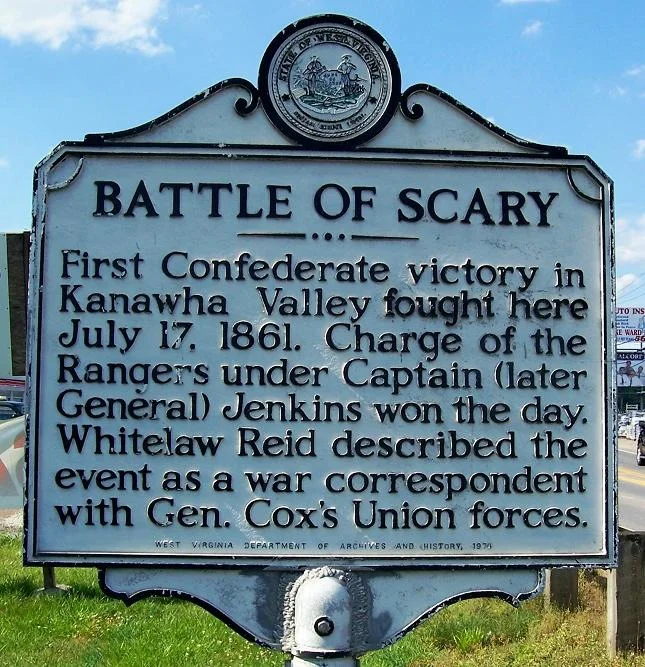

Battle of Scary Creek
The first Confederate victory in the Kanawha Valley was won at a place called Scary Creek by a Confederate officer named George Smith Patton, who happened to be the grandfather of the George S. Patton of World War II fame. It was three months into the Civil War, four days before First Manassas. The Union plan was simple: push up the Kanawha from the Ohio River, take Charleston, and secure the salt works. On the afternoon of July 17, 1861, on a hot Putnam County hillside two miles back from the river, about 1,500 Ohio soldiers ran into about 800 Virginians dug in behind a small creek with one of the more memorable names in American military history. By 5:00 p.m. the Ohioans were falling back to the river. By midnight both armies had quietly abandoned the field, each thinking the other was about to come at them again.
Two Armies on the Kanawha
Union Brigadier General Jacob Cox started up the Kanawha from the Ohio River in June 1861. By early July his force had taken Ravenswood, Ripley, and Guyandotte. He split his column into three pieces for the final push to Charleston. On the south bank of the Kanawha, near the modern town of St. Albans, Confederate Brigadier General Henry A. Wise commanded a couple thousand troops drawn largely from western Virginia militia units with names that read like an inventory of local pride: the Kanawha Riflemen, the Buffalo Guards, the Elk River Tigers, the Fayetteville Rifles, the Mountain Cove Guard, the Kanawha Border Rangers. Among those Border Rangers was Captain Albert G. Jenkins, the same Jenkins who lived at Green Bottom on the Ohio. Cox established his main camp at Poca on the north bank, opposite the mouth of Scary Creek. Wise sent Lieutenant Colonel Patton to fortify a defensive position behind the creek with the Kanawha Riflemen and several other companies.
The Fight
On the morning of July 17, after several days of probing, Cox sent Lieutenant Colonel Carr B. White with a detachment of the 12th Ohio to feel out the Confederate position. They were ferried across the Kanawha, marched to Scary, met Confederate pickets at the creek mouth, and pulled back to camp. Colonel John Lowe of the 12th Ohio asked Cox for permission to take a full force across and clear the position. Cox said yes. Lowe assembled about 1,500 men - the rest of the 12th Ohio, two companies of the 21st Ohio under Colonel Jesse Norton, George's Ohio Cavalry, Cotter's and Barnett's Ohio Artillery. They advanced along two roads to within sight of the Confederate line about 2:00 p.m. and opened with cannon and musket. An hour later, Norton's 21st Ohio companies launched a bayonet charge against the bridge over Scary Creek. Lowe's 12th Ohio detachment forded the creek and hit the Confederate left.
Patton Wounded, Jenkins in Command
Three-quarters of the Confederate left collapsed in panic at the bayonet charge. Patton tried to rally his men and took a bullet in his left shoulder. Albert G. Jenkins assumed field command. Norton, leading the Ohio assault, was struck severely in the hip and captured. Then fresh Confederate reinforcements arrived from Coal Knob and shoved the Ohioans back from the bridge and the left flank by 5:00 p.m. The Union force began withdrawing toward the river. Jenkins, watching them go, assumed they were regrouping for another assault and ordered his own troops to fall back as well, leaving the battlefield literally empty. When the Confederates realized what had happened, they returned and burned several buildings on the field to deny them as cover for any future assault. The smoke was visible across the Kanawha. Union officers at Camp Poca saw it and assumed - wrongly - that the smoke meant a Union victory. Several detachments crossed the river to consolidate the supposed gains and were captured by Jenkins's men. Colonels De Villiers and Woodruff, along with several other officers, were sent to Libby Prison in Richmond.
A Tactical Win, A Strategic Loss
Casualties were modest. The Union lost 14 killed, about 30 wounded, several missing. The Confederates lost between one and five killed and perhaps half a dozen wounded, including Patton himself. By the standards of what was about to come at Manassas, Antietam, and Gettysburg, this was a skirmish. But it was the first Confederate victory in the valley, and it should have been the beginning of a Confederate hold on western Virginia. Instead, Wise lost his nerve. He blamed the local militia for the difficulties of the campaign, wrote to Robert E. Lee that his Virginia volunteers had 'lost from three to five hundred by desertion' and that the Kanawha Valley was 'wholly disaffected and traitorous,' and ordered a withdrawal up the valley toward Fayette and Greenbrier counties. The retreat was widely criticized at the time. It opened the Kanawha Valley to Union control, where it would remain - with the exception of Loring's brief Charleston counteroffensive the following year - for the rest of the war. The Confederates had won the fight at Scary Creek and lost the campaign anyway.
From the Air
The Battle of Scary Creek site sits in Putnam County, West Virginia at 38.43 degrees north, 81.85 degrees west, along Scary Creek on the south bank of the Kanawha River across from the city of Nitro. Best viewed at 3,000 to 5,000 feet AGL: look for the small drainage of Scary Creek meeting the Kanawha River on the south bank, with the I-64 corridor running just south of the battlefield. Yeager Airport (KCRW) is about fifteen miles east in Charleston. The wide Kanawha River bend and the industrial Nitro plants on the north bank are reliable orientation landmarks.
Nearby Stories
- Mystery Hole 6.5 km away
- West Virginia Colored Children's Home 9.4 km away
- Clay, West Virginia 13 km away
- Staats Mill Covered Bridge 14 km away
- Hobet Coal Mine 23 km away
- Appalachia 23 km away
- Fred M. Vinson Museum and Welcome Center 30 km away
- Ponn Humpback Covered Bridge 43 km away