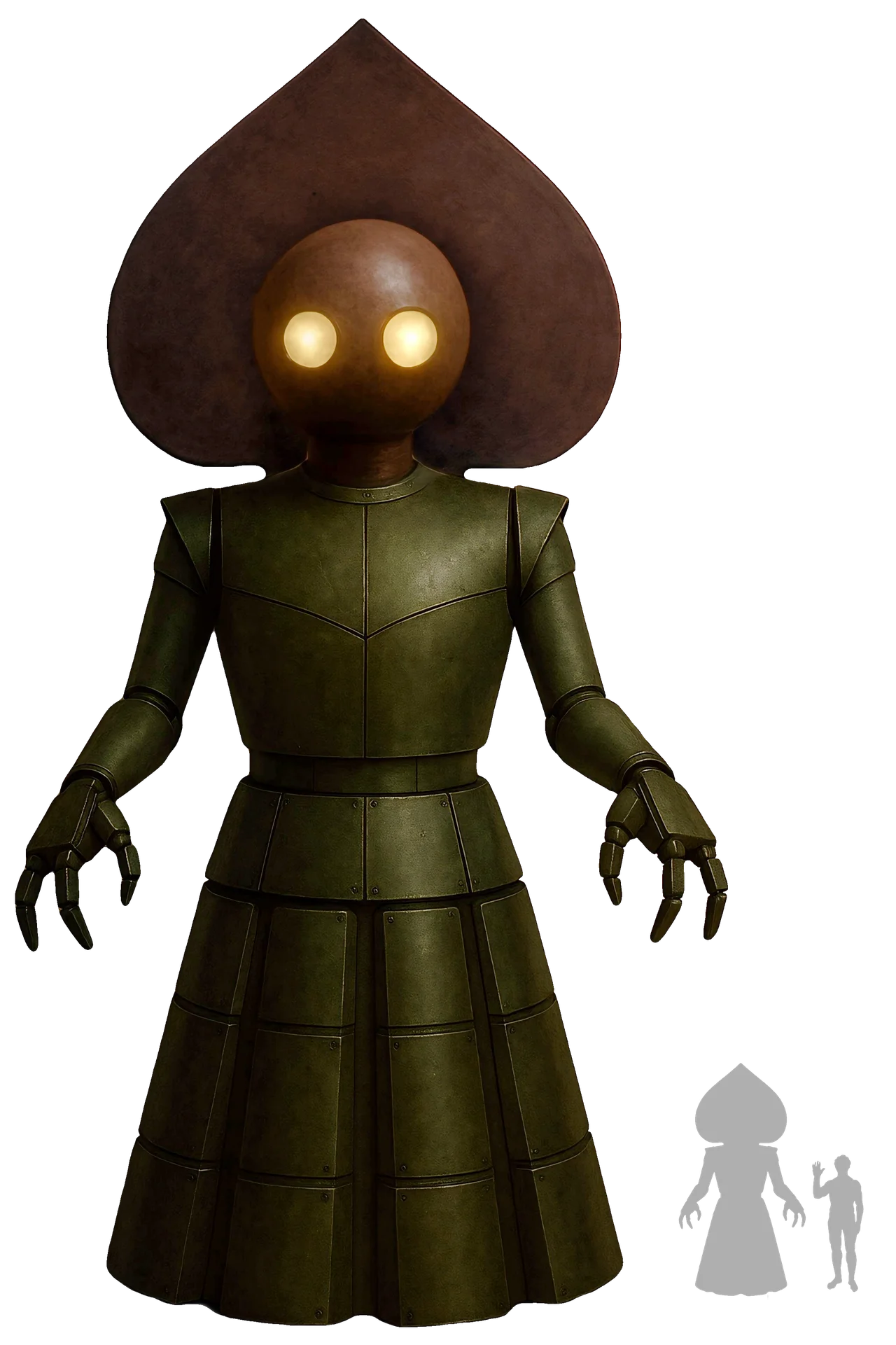

Flatwoods Monster
On the evening of September 12, 1952, a meteor crossed the sky over Maryland, Pennsylvania, and West Virginia, and a group of frightened boys in Flatwoods, West Virginia, climbed a hillside to find where it had landed. What they found - or what they thought they found - is now stitched into the official identity of Braxton County. Five enormous green chairs shaped like the creature serve as roadside attractions; the town welcomes visitors as the 'Home of the Green Monster'; an annual convention draws cryptid enthusiasts; and the figure called Braxie has been referenced in video games, History Channel episodes, and decades of UFO literature. The story holds together because the witnesses described what they saw in detail, and because the most sober explanation for what they saw is, in its own way, almost as strange as the monster itself.
September 12, 1952
At 7:15 in the evening, Edward and Fred May - brothers, ages 13 and 12 - were playing on a school playground with their friend Tommy Hyer when a bright object crossed the sky and appeared to land on G. Bailey Fisher's farm a short walk away. They ran home and told Edward and Fred's mother, Kathleen May. Kathleen, the three boys, two more local children named Neil Nunley and Ronnie Shaver, and a 17-year-old National Guardsman named Eugene Lemon - Kathleen's cousin, who happened to be there - decided together to investigate. They walked up the hillside toward the place where the object had apparently come down. At the top of the rise, Nunley said he could see a pulsing red light. Lemon shone his flashlight in that direction and, for an instant, the beam illuminated something none of them ever forgot.
What They Described
Accounts of the figure vary by witness and by interview, but a recognizable creature emerges. It was tall - estimates ran around ten feet. Its face was round and red, like a clock face, surrounded by a pointed hood that came up behind the head in a peaked shape. Eye-like openings emitted a greenish-orange glow. The body was dark, possibly black or dark green, and folded like fabric. The hands - in some accounts - were small and claw-like. As Lemon aimed his flashlight at it, the figure made a hissing sound and seemed to glide toward the group. Lemon dropped the flashlight; the entire group turned and ran back down the hill. They reported a pungent, sulfurous mist in the air and several of the witnesses became nauseated. By the time the local sheriff arrived to investigate a report of a possible plane crash, the witnesses' fear had become a full-blown event.
Meteors, Beacons, and Owls
The skeptical investigation came much later. Joe Nickell of the Committee for Skeptical Inquiry took up the case in 2000 and worked through it piece by piece. The bright light in the sky was almost certainly the meteor reported across three states that night. The pulsing red light at the top of the hill was probably one of three flashing aircraft hazard beacons visible from that area. The figure itself, Nickell argued, matched the silhouette of a startled barn owl perched on a tree limb: the heart-shaped facial disc could read as a round red face, the wing tufts as a pointed hood, the glowing eyes as exactly that. A flashlight beam striking such an owl would freeze it for an instant before it took off, and an owl's hissing threat display would account for the noise. The pungent mist, Nickell suggested, was the smell of crushed weeds and possibly local industrial activity, amplified by adrenaline. The Air Force investigators reached substantially the same conclusion.
How the Story Took Hold
Whatever happened on the hill, the story spread fast. A UFO writer named Gray Barker interviewed the witnesses with a tape recorder and wrote up the encounter for Fate Magazine, where it joined a growing post-Roswell genre of saucer-and-creature stories. A. Lee Stewart Jr. of the Braxton Democrat reported finding skid marks and a gummy deposit at the scene the next day - details that have never been satisfactorily corroborated but cemented the case in cryptid lore. Through the 1950s and 1960s the Phantom of Flatwoods, as it was sometimes called, became one of the standard cases cited in books on UFOs and unexplained phenomena. Each new wave of paranormal interest picked the story back up; each retelling added a layer of detail that was sometimes invented and sometimes simply remembered differently.
Braxie, Inc.
Modern Flatwoods has made peace with its monster and turned it into civic identity. The Braxton County Convention and Visitors Bureau erected five tall chairs shaped like the creature - a pointed green hood, a round red face - at locations around the county. Visitors who photograph all five receive a Free Braxie sticker. The town hosts a Flatwoods Monster Convention every autumn, and a small museum displays witness affidavits, vintage magazine articles, and souvenirs. The 2019 History Channel series Project Blue Book devoted an episode to the incident; Fallout 76 and Everybody's Golf 4 contain references to the figure. Whether the witnesses on the hill that night saw an extraterrestrial, a barn owl, or something else entirely matters less now than the durable fact of the story itself - the rare American legend that has refused to fade and has, instead, become a small but real local economy.
From the Air
Flatwoods sits at 38.72 N, 80.65 W in Braxton County, central West Virginia. The town lies along I-79 at exit 67, and the surrounding ridges - including the hillside above the former Fisher farm where the 1952 sighting took place - are clearly visible from 2,500-5,000 feet AGL. Braxton County Airport (K48I) lies just outside town and offers an excellent approach view of the area. The wooded hills, the I-79 corridor, and the Sutton Lake reservoir to the southwest provide easy navigation references.
Nearby Stories
- Audra State Park 8.1 km away
- Robey Theatre 13 km away
- Snowshoe Mountain 17 km away
- Trans-Allegheny Lunatic Asylum 18 km away
- Tygart Valley Homesteads Historic District 22 km away
- Volcano, West Virginia 24 km away
- Nicholas County, West Virginia 25 km away
- Mount Olive Correctional Complex 29 km away