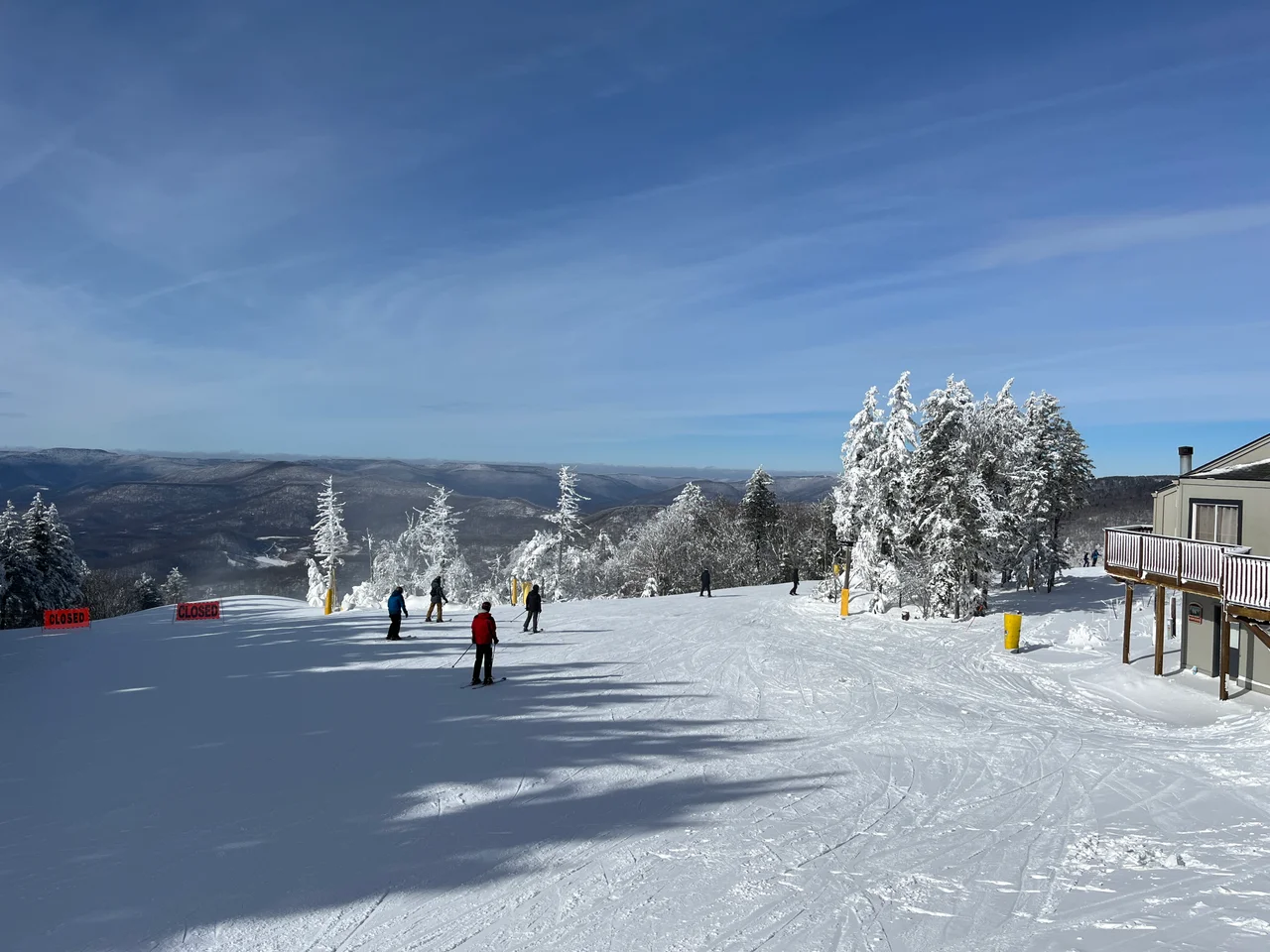

Snowshoe Mountain
Most ski resorts are arranged with the lodge and parking at the bottom of the mountain, so visitors look up at the runs and ride lifts to the top. Snowshoe Mountain, in central West Virginia, did the opposite. The village - hotels, restaurants, shops, condominiums - sits near the summit at 4,800 feet, and skiers descend from there. The reason was a North Carolina dentist named Thomas "Doc" Brigham, who looked at this former logging clearcut in the early 1970s and noticed that the only place flat enough to build a sizable village was on top. Snowshoe opened on December 13, 1974, with the village in the wrong place, and the wrong place turned out to be the right place after all.
On Top of a Cut-Over Mountain
The mountain is actually called Cheat Mountain, not Snowshoe. Cheat's highest point is Thorny Flat, which reaches an elevation of 4,848 feet on private land within the resort's footprint. The resort sits in a bowl-shaped convergence where Cheat and Back Allegheny Mountain meet, at the head of the Shavers Fork of the Cheat River. The land had been heavily logged from about 1905 to 1960 by the lumber companies that built the Cass Scenic Railroad and a network of company towns across Pocahontas County. By 1970, the great virgin spruce-fir forests were gone and the cleared mountain was largely abandoned. Doc Brigham, who had already built Sugar Mountain and Beech Mountain in North Carolina, saw the clearcut as an opportunity. The trees were already down. The slopes were already exposed. All the resort needed was lifts, runs, and a base of operations - which, given the local topography, made more sense at the top of the mountain than at the bottom.
Names from the Logging Era
Brigham named the ski runs and lifts after the vocabulary of mountain logging. Grab Hammer. J-Hook. Ball Hooter. Skidder. Two trails, Shay's Revenge and Heisler Way, took their names from the brands of gear-driven steam locomotives that had hauled timber down these same slopes a half-century earlier. The Shay and Heisler were both purpose-built for steep grades and tight curves - workhorse engines that could pull loaded log cars up gradients that no normal railroad locomotive could manage. Examples of both still operate today on the Cass Scenic Railroad State Park, just a few miles away, pushing tourist excursion trains up Cheat Mountain on rail lines originally laid for logging. The connection between Snowshoe and Cass is direct: the same mountain, the same lumber companies, the same set of names that pass between a state park railroad and a destination ski resort.
Financial Trouble and a Japanese Rescue
The first decade was hard. The resort hemorrhaged money. The remote location - more than three hours from any city - made marketing difficult, and the West Virginia ski market was not large to begin with. Snowshoe limped through the 1980s on small operating margins. In 1990, the Tokyo Tower Development Company Limited, a Japanese developer of leisure facilities, bought the resort. It was the era of substantial Japanese investment in American real estate, and the resort fit the profile. The Japanese ownership lasted only five years. In 1995, Tokyo Tower sold Snowshoe to Intrawest, the Canadian ski-resort operator that had pioneered the village model of mountain resorts - condominium-hotel complexes built around a pedestrianized commercial core, owned individually but managed centrally. Intrawest's expertise transformed Snowshoe.
Building a Mountaintop Village
Starting in 1999 with Rimfire Lodge, Intrawest expanded the existing village rapidly. Highland House, two phases of Allegheny Springs, the Seneca, Expedition Station - condominium-hotel buildings filled out the village over the next decade. Soaring Eagle Lodge in 2006 and Sawmill Village in 2007 added outlying neighborhoods. The original Eight Rivers project, planned for 2007, was postponed and never built. The resort now has about 1,400 condominium and lodge hotel units. The skiable terrain spans 244 acres on 60 trails. Two trails - Cupp Run and Shay's Revenge - have a 1,500-foot vertical drop, which is among the largest in the Southeast and Mid-Atlantic, comparable to larger New England resorts on a per-trail basis. The mountain receives an average of 180 inches of snowfall a year, supplemented by extensive snowmaking. In 2017 Intrawest was itself acquired by the Alterra Mountain Company, which now operates Snowshoe.
The Mountain Biking Capital
The four-season vision Brigham had originally pitched took decades to materialize, but it eventually did. The Snowshoe Bike Park is now considered one of the largest, best, and most challenging downhill mountain bike parks in the world. Snowshoe has been a regular stop on the UCI Mountain Bike World Cup since the mid-2010s. The downhill track on the Western Territory side of the mountain is widely considered one of the most punishing courses on the world circuit, running through roots, rocks, and jumps that include a notorious feature called "Threading the Needle" - a narrow gap between two trees that riders must thread at speed. Gary Player designed a championship golf course at lower elevations. The resort also hosts an annual Grand National Cross Country off-road motorcycle and ATV race. About 480,000 skiers visit each winter. Many of the same people come back for bikes, golf, and the Allegheny summer the rest of the year.
From the Air
Located at 38.41 degrees north, 79.99 degrees west, on Cheat Mountain at the head of the Shavers Fork in Pocahontas County, West Virginia. Snowshoe is one of the highest-altitude ski areas in the eastern United States, with the village sitting at about 4,800 feet MSL. The mountain village and its lifts are visible from a wide area in winter when snow-covered runs cut across the dark forest. Best viewed from VFR altitudes of 6,500 to 9,500 feet AGL. The closest airport is Marlinton Municipal (W99) about 10 nautical miles east. The Green Bank radio quiet zone is east - check NOTAMs. Watch for mountain wave activity, rotor turbulence, and rapidly changing weather typical of Allegheny ridges.
Nearby Stories
- Pendleton County, West Virginia 8.1 km away
- Mountains and Lakes Country 9.4 km away
- Fort Edward Johnson 12 km away
- Tygart Valley Homesteads Historic District 13 km away
- Fort Dinwiddie 14 km away
- 2020 Williamsburg Massacre 17 km away
- Richwood, West Virginia 21 km away
- Frontier Culture Museum 35 km away