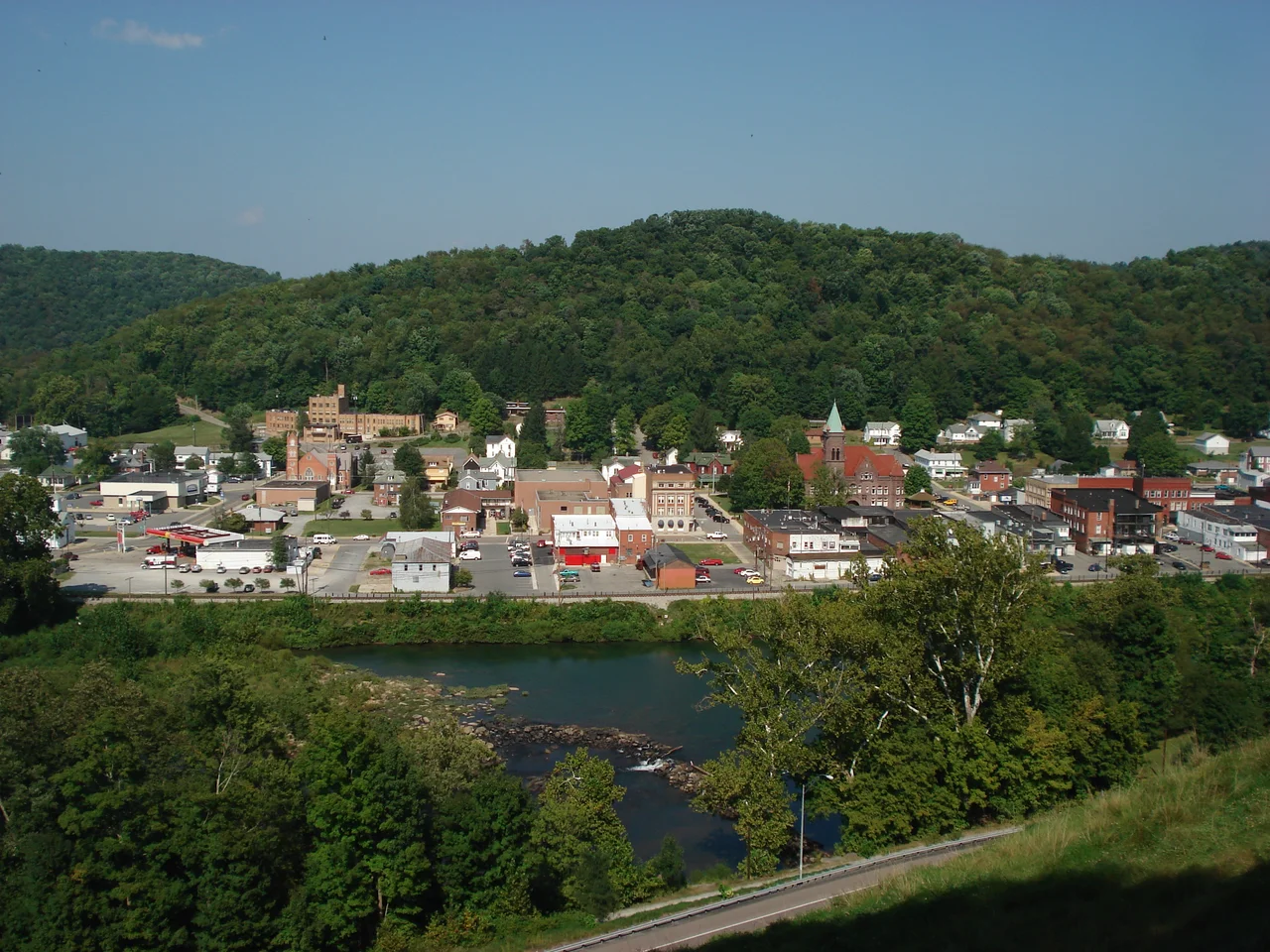

Mountains and Lakes Country
The smallest church in 48 states sits beside US-219 near Silver Lake. It is twenty-four feet by twelve, made of fieldstone and pine, and around it cluster a wishing well and what its keepers claim is the smallest mailing office in the country - a tiny outpost where a person can in theory walk in, write a postcard, and have it stamped. Our Lady of the Pines is exactly the kind of detail that defines the Mountains and Lakes Country region of north-central West Virginia: small, eccentric, scenic, and slightly contested. (Plenty of other places make the same 'smallest church' claim.) The region runs from the Maryland border south and west through Preston County and the high country around Kingwood and Morgantown, where the Allegheny Mountains soften into a patchwork of bogs, hemlock groves, manmade lakes, and tiny brick-built towns.
Tunnels of the 1850s
Near Tunnelton, on route 26, a long railroad tunnel burrows through Cheat Mountain — the original Kingwood Tunnel, joined by a second bore added in 1911. The original Kingwood Tunnel was dug by hand between 1849 and 1852 by Baltimore and Ohio Railroad crews, and when it opened it was the longest railroad tunnel in the United States at 4,137 feet. They mattered enormously during the Civil War: the B&O was the principal east-west rail link between the loyal states, and disrupting it - or defending it - was strategically critical to both sides. Confederate raiders made repeated attempts on the line, and Union troops were stationed throughout these hills to keep it open. The tunnels are still in use by CSX today, more than 170 years after pick-and-shovel crews drove them through solid rock, and the landscape around them still feels like the rough, vertical country those nineteenth-century crews struggled across.
Smallest Church, Smallest Office
Our Lady of the Pines was built in 1958 as a roadside devotional, a tiny chapel that any passing traveler could stop into. The interior holds six pews. Couples occasionally rent it for weddings; the venue is, by necessity, intimate. Beside the chapel stands its companion claim to fame, a miniature post office cabin reduced to symbolic dimensions. Neither the church nor the office is genuinely the smallest of its kind in America - the category is crowded - but together they make a peculiar little roadside attraction in the West Virginia hills, the sort of thing that lingers in the memory of a road trip more reliably than the larger scenery around it. Travelers stop, take a photo, drop a coin in the wishing well, and continue on.
Bogs, Hemlocks, and Brachiopods
The Mountains and Lakes Country has older treasures than the chapel. Near Kingwood, Cathedral State Park preserves 133 acres of ancient hemlock forest - the only stand of mixed virgin timber left in West Virginia. The dim, cool understory beneath those uncut hemlocks gives a glimpse of what most of the state looked like before nineteenth-century logging. Further east, on the Maryland border, the Cranesville Swamp preserve protects 1,600 acres of subarctic wetland left over from the last Ice Age. Boardwalks lead through bogs where carnivorous sundews capture insects, cranberries ripen in sphagnum moss, and several federally listed plants and animals find a habitat that exists nowhere else nearby. Fossil hunters, meanwhile, head for the road cut across from Hebron Church in the tiny community of Hebron, where the exposed shales yield brachiopods - Paleozoic shellfish that lived in shallow seas hundreds of millions of years ago.
Big Bear and Buckwheat
Big Bear Lake, east of Morgantown, is a 35-acre artificial lake at the center of a resort complex - mountain-bike and hiking trails, a waterslide on the beach, miniature golf, country-western dance nights, rental cabins. It has the slightly homemade feel of a regional getaway built by a single family over decades, where the games room and the volleyball court coexist with serious back-country trails into the surrounding hills. Down the road, the village of Bruceton Mills is buckwheat country. The crop has been grown here since the nineteenth century, and from mid-September through December, locally milled buckwheat flour appears on store shelves - the basis of buckwheat cakes, which Preston County celebrates each autumn with its long-running Buckwheat Festival in Kingwood. It is one of the older food festivals in the state, and one of the most distinctively local.
How to See It
The region is best approached by car, looping a long figure-eight that takes in the tunnel at Tunnelton, Cathedral, Cranesville, Silver Lake, and Bruceton Mills over the course of a couple of days. None of these attractions is famous outside the region; each is small. The cumulative impression, though, is of a place where layers - geologic, biological, industrial, devotional - have been left undisturbed within a few miles of each other. A road cut full of fossil brachiopods, a stand of trees older than the state of West Virginia, a chapel barely large enough to stand up in, a railroad tunnel that once held the longest record in the United States - all of it fits inside an area you could drive across in an afternoon.
From the Air
Centered around 38.75 N, 80.55 W in north-central West Virginia, though the region actually extends further north and east toward the Maryland border and Morgantown. (Note: the coordinate given for this region is approximate; key attractions like the Kingwood tunnels and Cathedral State Park lie further north around 39.4-39.6 N.) Best appreciated at 3,500-5,500 feet AGL where the patchwork of ridges, forested hollows, manmade lakes, and small towns reads clearly. Morgantown Municipal-Hart Field (KMGW) provides the best regional aviation gateway. The Cheat River valley provides a clear north-south visual reference; I-68 traces the northern edge of the region from Morgantown east toward Maryland.
Nearby Stories
- Audra State Park 8.1 km away
- Robey Theatre 13 km away
- Snowshoe Mountain 17 km away
- Trans-Allegheny Lunatic Asylum 18 km away
- Tygart Valley Homesteads Historic District 22 km away
- Volcano, West Virginia 24 km away
- Nicholas County, West Virginia 25 km away
- Mount Olive Correctional Complex 29 km away