.jpg)
Frontier Culture Museum
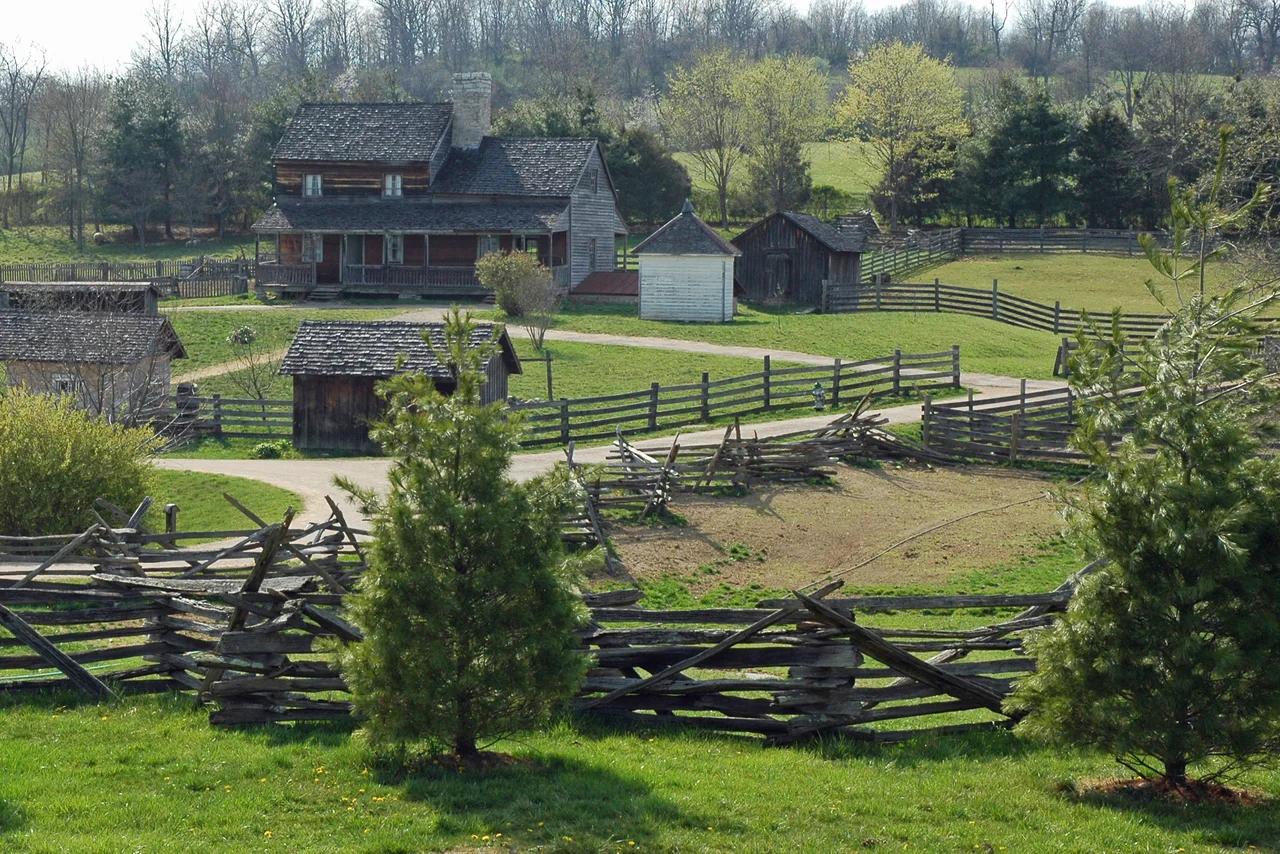
Most museums put history under glass. This one puts a roof over it. On 188 acres outside Staunton, the Frontier Culture Museum has reassembled actual buildings disassembled from their original sites - a 17th-century English yeoman's timber-frame from Worcestershire, an Ulster farmhouse from County Tyrone, a Palatinate German farm, an Igbo compound from southeastern Nigeria - and arranged them across a walking trail through the Shenandoah Valley landscape. Costumed interpreters chop wood, tend pigs, and explain how the people who once lived in each building got here, by choice or by force, and how their traditions tangled together to make something new.
An Idea Born at the Bicentennial
The Frontier Culture Museum traces its origins to America's 1976 bicentennial, but it took the Virginia General Assembly another decade to formally establish it. The Museum of American Frontier Culture opened to the public on September 9, 1988, with just three permanent exhibits: an English cattle shed, an Irish farmhouse, and what was then called the American Farm Exhibit. Today there are eleven exhibits across 1.8 miles of paved trail. The premise is unusual and effective: rather than build replicas, the museum dismantled real historic structures overseas, shipped them across the Atlantic, and rebuilt them piece by piece in Virginia. The English farmhouse came from near Hartlebury, in Worcestershire. The Irish forge came from County Fermanagh. Each represents the place an immigrant group left before they remade the valley.
The Igbo Compound
About four in ten enslaved people brought to the Shenandoah Valley came from Igbo communities in what is now southeastern Nigeria - the highest proportion from any single ethnic group. The museum's West African site reconstructs an 18th-century Igbo family compound to make that history visible. The interpretation acknowledges what the language often obscures: these were not laborers who happened to arrive. They were captured, transported across the Atlantic in conditions designed to break them, and kept in bondage. They also carried culture across with them. The instrument we now call the banjo descends from West African forerunners. So do strands of foodways, agricultural practice, and music that thread through Appalachian culture to this day. The compound is currently under renovation; temporary structures host programming in the meantime.
Why People Came
The reasons varied. An English yeoman's son who would not inherit might try Virginia rather than poverty at home. An Irish tenant farmer in County Tyrone might choose the colonies over a landlord's lease. A Palatinate German peasant, tied to the land and a local prince, had to pay a manumission fee just for permission to leave - and many paid it anyway, because the Holy Roman Empire was overcrowded and the soil was tired. Skilled trades traveled best: blacksmiths and coopers found favorable terms even as indentured servants. Each exhibit at the Frontier Culture Museum sits next to the next, deliberately, so visitors can walk from one ocean of history to another in the span of a quarter-mile. By the time you reach the 1760s settlement house, the Irish thatch and English timber and German fachwerk have already begun blending into something American.
What the Valley Became
The American side of the museum walks visitors forward through time. The 1760s log cabin shows early settler life - one room, often temporary, built with techniques learned partly from Indigenous neighbors who already knew the land. The 1820s and 1850s farms reflect a Valley becoming prosperous; the 1850s farmstead from Botetourt County represents the plain folk who owned modest acreage and kept a few livestock. A one-room schoolhouse built around 1840 in Rockingham County stands nearby. So does an 1860s log church, originally home to the Mount Tabor United Methodist congregation in New Hope, Virginia - a building tied to the post-Civil War movement of Black congregations leaving white-led denominations to form their own. In 2025, the museum announced the American Journey Gallery, a new building meant to update the visitor center and add modern exhibit space. The Valley keeps adding chapters; the museum keeps moving the buildings.
From the Air
Located at 38.1246N, 79.0494W on the outskirts of Staunton, Virginia, in the Shenandoah Valley. Recommended viewing altitude is 3,500 to 5,500 feet for an overhead of the 188-acre site - look for the cluster of small structures separated by green walking paths. The Blue Ridge rises to the east; the Allegheny Front to the west. Nearest airport is Shenandoah Valley Regional (KSHD) about 4 nm north of downtown Staunton; Charlottesville-Albemarle (KCHO) sits 30 nm east across the Blue Ridge. Watch for valley haze in summer and convective buildups in afternoon.
Nearby Stories
- United States National Radio Quiet Zone 7.3 km away
- Bridgewater College 7.6 km away
- Fork Union Military Academy 13 km away
- Shenandoah: The Skyline Drive Through America's Oldest Mountains 24 km away
- Bath County, Virginia 25 km away
- Amherst, Virginia 26 km away
- Dolley Madison 27 km away
- Peaks of Otter 40 km away