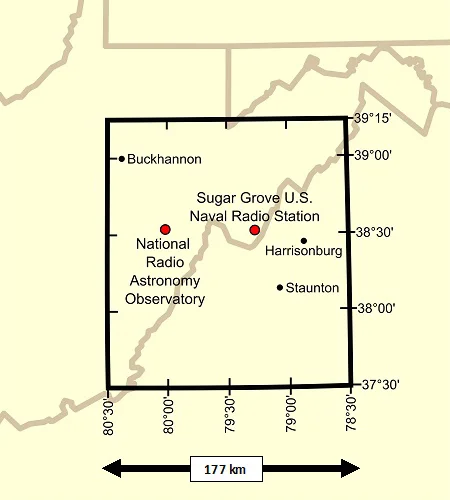

United States National Radio Quiet Zone
A house across the street from the Green Bank Observatory operated a Wi-Fi network with the SSID "Screw you NRAO," an unsubtle middle finger from a resident who had grown tired of being told to turn things off. The Green Bank health clinic had Wi-Fi too. So did the senior center. "We're not supposed to," John Simmons, the Pocahontas County director of senior programs, told a Wired reporter, "but I think all that stuff about the noise levels is fabricated." In 2019, the Green Bank Interference Protection Group was detecting roughly 175 active hotspots within two miles of the observatory. The federal radio quiet zone is still on the books. Compliance, especially among locals who have lived inside its boundaries for generations, has become increasingly negotiable.
Why the Zone Exists
The Federal Communications Commission created the U.S. National Radio Quiet Zone in 1958 to protect the radio telescopes at Green Bank, West Virginia, and the antennas at Sugar Grove Station - then a U.S. Navy facility. The zone covers about 13,000 square miles centered on Green Bank, stretching across parts of three states: extreme southern Garrett County in Maryland, a swath of west-central Virginia from Augusta to Albemarle to Bath to Highland, and most of east-central West Virginia including all of Pocahontas County. The Sugar Grove station, now the Navy Information Operations Command, is reportedly a key listening post in the ECHELON signals intelligence system operated by the National Security Agency. The zone protects astronomical research and electronic intelligence gathering at the same time, which has fed half a century of conspiracy theories about what is actually happening in the West Virginia mountains.
Five Zones, Five Rules
The Green Bank Interference Protection Group divides the area into five graduated zones with different legal instruments behind each. Zone 1, the Radio Astronomy Instrument Zone, covers most of the observatory property itself. Intentional radio emitters are restricted to those deemed essential. Unintentional emitters must meet strict protection criteria. Gasoline-powered vehicles are banned because spark-ignition engines generate radio interference - all vehicles and equipment in Zone 1 must be diesel-powered. Zone 2, the Observatory Building Zone, allows licensed intentional radiators but bans Wi-Fi, cordless phones, and other consumer wireless equipment. Digital cameras are forbidden in Zone 2; only film photography is allowed. Zones 3 and 4 are governed by Chapter 37A of the West Virginia Code, the Radio Astronomy Zoning Act. Zone 3 covers the area within 2 miles of the observatory, where restrictions are tightest. Zone 4 extends to 10 miles with progressively looser restrictions. Zone 5 is the outermost layer of the overall quiet zone.
The Wi-Fi Refugees and the Hypersensitivity Question
Beginning in the 2000s, Green Bank attracted national attention as a refuge for people who claimed to suffer from electromagnetic hypersensitivity - a condition in which sufferers report headaches, fatigue, and other symptoms they attribute to ambient radio waves. Some moved to Pocahontas County specifically for the quiet. A small expatriate community formed. The trouble is that controlled scientific experiments have consistently shown the symptoms are caused by the nocebo effect rather than electromagnetic waves: blinded double-blind studies have found no correlation between the actual presence of radio fields and the reported symptoms. The experience of suffering is real. The mechanism is psychosomatic. Green Bank's quiet may help people feel better whether or not the symptoms have the cause those people attribute to them. The community has been the subject of newspaper features, BBC documentaries, and at least one Hollywood film treatment.
Enforcement vs. Cooperation
In practice, the observatory has gradually shifted from enforcement to negotiation. The original protocol was that observatory staff would identify a source of interference, knock on the door, and ask the owner to turn it off. Compliance was usually voluntary. As consumer electronics proliferated and as the political environment grew less deferential, the observatory began pulling back on aggressive enforcement. Locals who had grown up with the rules began bending or ignoring them. The Green Bank Interference Protection Group still tracks RFI sources. The legal apparatus still exists. But the underlying contract between observatory and community has weakened. The 175 Wi-Fi hotspots within two miles of the observatory in 2019 represented a significant local exception to a rule that was supposed to keep that area essentially radio-silent. The observatory adapts - it uses signal processing to filter out known interference patterns - but the original premise of a radio-quiet zone is harder to maintain than it used to be.
Starlink Changes the Math
In October 2024, the National Radio Astronomy Observatory announced that 99.5 percent of the National Radio Quiet Zone had become eligible for Starlink satellite internet service. The arrangement involves coordination between SpaceX and the observatory - Starlink terminals in the zone use specific frequencies and beam patterns negotiated to minimize interference with Green Bank's instruments - but the practical effect is that the zone's residents now have access to high-speed satellite broadband that was unavailable to them for decades. The change is bittersweet. The zone was created to protect quiet that, until recently, the geography of the central Appalachians enforced almost automatically. Now the satellites overhead are sending data continuously, and the only thing keeping the observatory's data clean is engineering and coordination rather than absence. The radio quiet zone has not been abolished. But what it actually means in 2026 is very different from what it meant in 1958.
From the Air
The Quiet Zone covers approximately 13,000 square miles centered near 38.43 degrees north, 79.84 degrees west at the Green Bank Observatory. The zone extends roughly from southern Garrett County, Maryland in the north, through Pendleton and Pocahontas counties in West Virginia, to Augusta and Highland counties in Virginia, with portions reaching Charlottesville and the University of Virginia grounds. CRITICAL FOR PILOTS: Within 10 nautical miles of the Green Bank Observatory, aircraft radio transmissions including transponders may require coordination. Always check current NOTAMs before transiting. Many small airports including Marlinton (W99), Elkins-Randolph County (KEKN), Ingalls Field (KHSP), and Shenandoah Valley (KSHD) operate within or near the zone. Watch for mountain wave activity in the Allegheny ridges.
Nearby Stories
- Pearl S. Buck Birthplace 4.3 km away
- Sinks of Gandy 4.9 km away
- Frontier Culture Museum 5.1 km away
- Helvetia, West Virginia 5.4 km away
- Natural Chimneys 6 km away
- Bath County, Virginia 14 km away
- Yew Mountains 20 km away
- Orkney Springs Hotel 28 km away