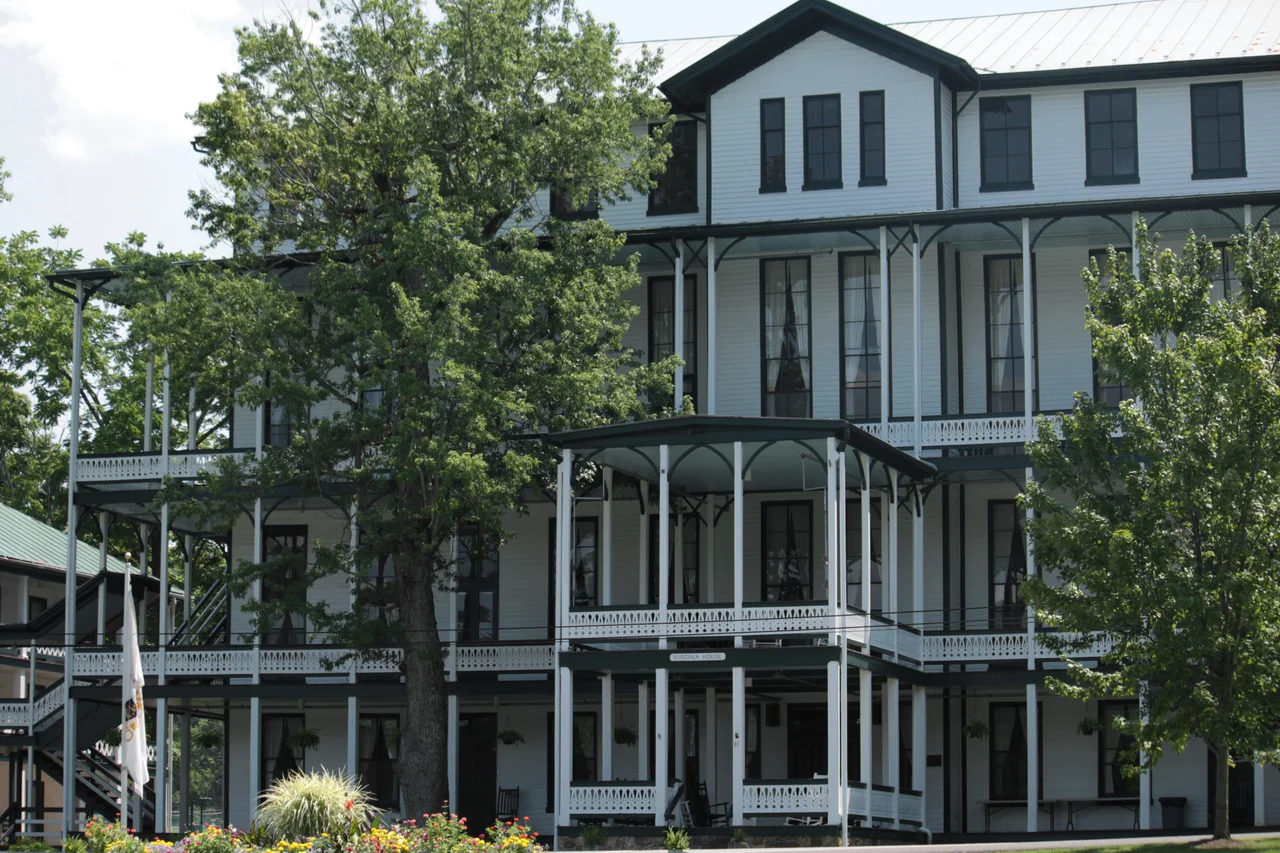

Orkney Springs Hotel
Virginia House is a hundred feet by a hundred and sixty-five, four stories of stuccoed frame in the shape of a giant capital H. A three-story verandah wraps the front and inside corners. The whole hotel - 175 bedrooms - was built between 1873 and 1876, when Americans still believed mineral water could cure almost anything and the resorts that sold them that water were among the grandest buildings in the country.
The Springs Came First
The water came first, the buildings followed. Orkney Springs sits in a fold of the Shenandoah Mountains in northern Virginia, where iron-rich mineral water bubbles up cold from the rock. By the middle of the 19th century, mountain mineral springs were the American answer to European spa towns. The oldest building of the complex, the two-story Maryland House, went up in 1853 - rectangular, stuccoed, ringed on every side by double galleries to catch the breeze. Pennsylvania House followed in 1867, a smaller three-story structure built once the Civil War had ended and the spa trade revived. Then came the centerpiece: Virginia House itself, raised between 1873 and 1876 in a wave of post-war optimism, when even Confederate veterans needed somewhere to take the waters.
An H-Shape Full of Galleries
Virginia House was designed for hot Shenandoah summers in the era before electricity. The H-shaped footprint meant cross-ventilation through every wing. The wraparound three-story verandah turned the entire facade into an outdoor room, allowing guests to walk, lounge, and socialize without ever sitting in direct sun. Seven identical two-story, six-room hipped-roof cottages were arranged around the main hotel for families and longer stays, each one a small mirror of the resort's wooden architecture. A small columned pavilion stands next to the mineral spring itself, the architectural equivalent of underlining the whole point of the place. By the time the buildings were finished, Orkney Springs was a complete resort town wrapped around a few cold drinks of water.
The Spa Industry Collapses
American mineral spring resorts had a brutal 20th century. Modern medicine made their health claims look quaint. Automobiles let visitors travel further than the nearest mountain hollow. Air conditioning replaced the high-altitude breezes that had made the trade possible in the first place. Through the early and mid 1900s, hundreds of these grand wooden resorts across Appalachia closed, burned, or were torn down. Orkney Springs survived for an unusual reason: the Episcopal Diocese of Virginia bought it. The diocese turned the antebellum and Victorian resort buildings into Shrine Mont, a working retreat center, and added the Cathedral Shrine of the Transfiguration on the grounds. The cottages, the verandahs, and the H-shaped main hotel found a second life sheltering church conferences and summer camps instead of paying spa guests.
Listed and Still Standing
The Orkney Springs Hotel complex was added to the National Register of Historic Places in 1976, just over a century after Virginia House opened. The listing recognized the full ensemble - Maryland House (1853), Pennsylvania House (1867), Virginia House (1873-1876), the seven cottages, and the spring pavilion - as a near-complete surviving example of a 19th-century Appalachian mineral spring resort. Few comparable complexes still stand intact. The architecture has weathered. The verandahs creak. But the resort's bones, including those three stories of veranda railings on Virginia House, remain instantly recognizable to anyone who has ever seen an old photograph of a Shenandoah summer in the 1880s. The diocese has continued to maintain the site, and most years, the music of a summer festival drifts out over the hotel lawn the way string quartets once did.
From the Air
Located at 38.79 degrees north, 78.82 degrees west, in the upper Shenandoah Valley of Shenandoah County, Virginia. From 4,000 to 6,000 feet AGL the cluster of white-painted hotel and cottage buildings stands out clearly in the wooded mountain hollow at the base of Great North Mountain. Nearby airports include New Market (8W2), Front Royal-Warren County (KFRR), and Winchester Regional (KOKV). Bryce Resort's small airstrip (VG18) lies just to the northeast.
Nearby Stories
- Canaan Valley Resort State Park 1.1 km away
- Eastern Mennonite University 4.9 km away
- Moorefield 5.6 km away
- United States National Radio Quiet Zone 14 km away
- Sinks of Gandy 17 km away
- The Inn at Little Washington 21 km away
- First Battle of Kernstown 23 km away
- Battle of Cedar Mountain 31 km away