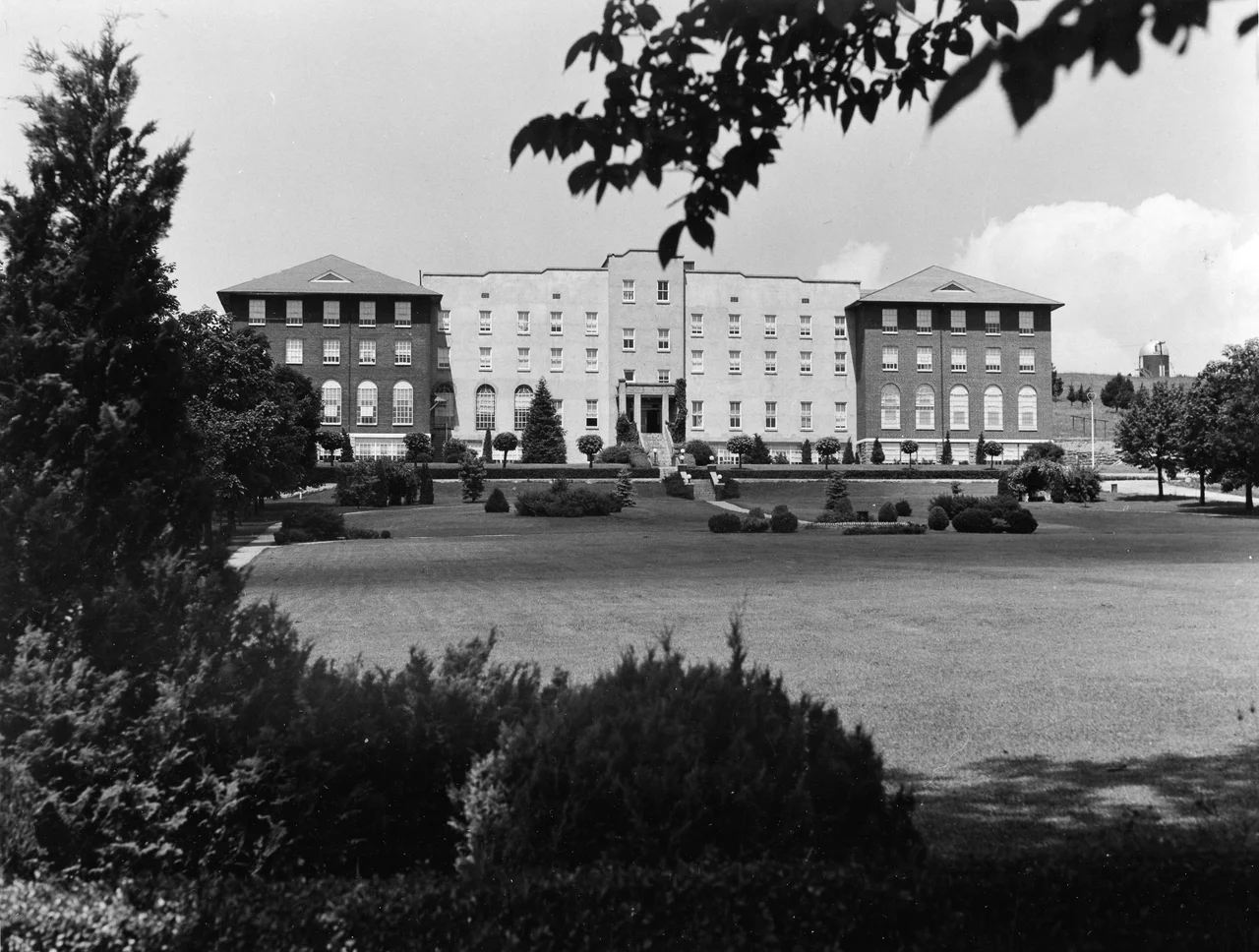

Eastern Mennonite University
Leymah Gbowee earned her master's degree at Eastern Mennonite University in 2007. Four years later she shared the Nobel Peace Prize for the women's nonviolent movement she led that helped end the Second Liberian Civil War. Hassan Sheikh Mohamud, the president of Somalia, attended EMU's Summer Peacebuilding Institute in 2001. The university in the Shenandoah Valley, founded by Mennonites in 1917 to keep their young people out of secular colleges, has somehow become one of the most internationally connected institutions in American higher education - not through size or wealth, but through a graduate program in conflict transformation that has trained more than 3,000 peacebuilders from 124 countries.
A School Born of Distrust of the World
Eastern Mennonite School opened in 1917 in Harrisonburg with a clear premise: Mennonite young people, the founders believed, were enrolling in secular universities and losing their faith there. Bishop George R. Brunk Sr., one of the founders, declared that worldly education was "self-centered, self-exalting, and materialistic." The school would offer an alternative. From the beginning, though, the first registrar - John Early Suter - argued for secular academics alongside Bible classes. That tension between separation and engagement has shaped the institution ever since. In 1947 the school began offering bachelor's degrees in subjects beyond theology and renamed itself Eastern Mennonite College. In 1994 it became Eastern Mennonite University. By then it was serving thousands of students who were not Mennonite at all - drawn to a school that combined peace, social justice, environmental commitment, and community life.
Integration in 1948
In 1948, EMU admitted a local Black student, making it one of the first historically white colleges in the U.S. South to integrate - sixteen years before the Civil Rights Act of 1964. The decision drew on Mennonite peace-church theology and the practical organizing of a few Mennonite leaders willing to break with the racial conventions of Virginia. The University of Arkansas integrated the same year. Both decisions were quiet by today's standards, but they preceded the larger institutional integrations that came only after federal pressure in the 1960s. EMU's early integration is the kind of historical detail easy to miss in the broader narrative of Southern higher education, but it shaped the institutional culture that decades later made the school plausible as a center for peace and reconciliation work.
The Center for Justice and Peacebuilding
EMU hosts the Center for Justice and Peacebuilding, established in 1994. Its graduate program in conflict transformation - a term coined by founding director John Paul Lederach - rejects the language of conflict resolution in favor of something more ambitious: transforming the conditions that produce conflict in the first place. The center has trained over 3,000 people from 124 countries. Its faculty have included Lederach himself, considered a foundational figure in peace studies, and Howard Zehr, whose books made restorative justice a mainstream concept in criminal justice debates. Alumni of CJP have gone on to mediate civil wars, run reconciliation commissions, and head peacebuilding organizations on every inhabited continent. Each year's Summer Peacebuilding Institute draws practitioners working in active conflict zones to study together for four consecutive sessions in Harrisonburg.
Wrestling with Itself
EMU's Community Lifestyle Commitment, adopted in 2001, set expectations for behavior on campus that were typical of conservative religious colleges - including a reservation of sexual relationships to heterosexual marriage. The policy was used for years to terminate faculty members in same-sex relationships, alongside heterosexual employees who violated similar standards. In November 2013 the board suspended enforcement of the same-sex relationship policy. On July 16, 2015, EMU added sexual orientation to its non-discrimination policy, allowing the hiring of faculty and staff in same-sex marriages. The decision drew sharp criticism from other Christian colleges, and EMU left the Council for Christian Colleges and Universities later that year. Eight LEED-certified buildings, a major solar array, an environmental studies program, and a cross-cultural travel requirement - all reflect a university still working out what its founding ethic of peace and care obliges it to do.
From the Air
Located at 38.471N, 78.8795W on the northern edge of Harrisonburg, Virginia, in the Shenandoah Valley. The campus is set against a hillside with views of Massanutten Mountain to the east and the Allegheny Front to the west. Recommended viewing altitude is 3,500 to 5,500 feet for views of the campus in context with downtown Harrisonburg. Nearest airport is Shenandoah Valley Regional (KSHD) about 14 nm south. Watch for valley haze in summer.
Nearby Stories
- United States National Radio Quiet Zone 5.5 km away
- Waynesboro 9.3 km away
- Shenandoah: The Skyline Drive Through America's Oldest Mountains 14 km away
- Orkney Springs Hotel 17 km away
- Sinks of Gandy 17 km away
- The Inn at Little Washington 21 km away
- Bath County, Virginia 27 km away