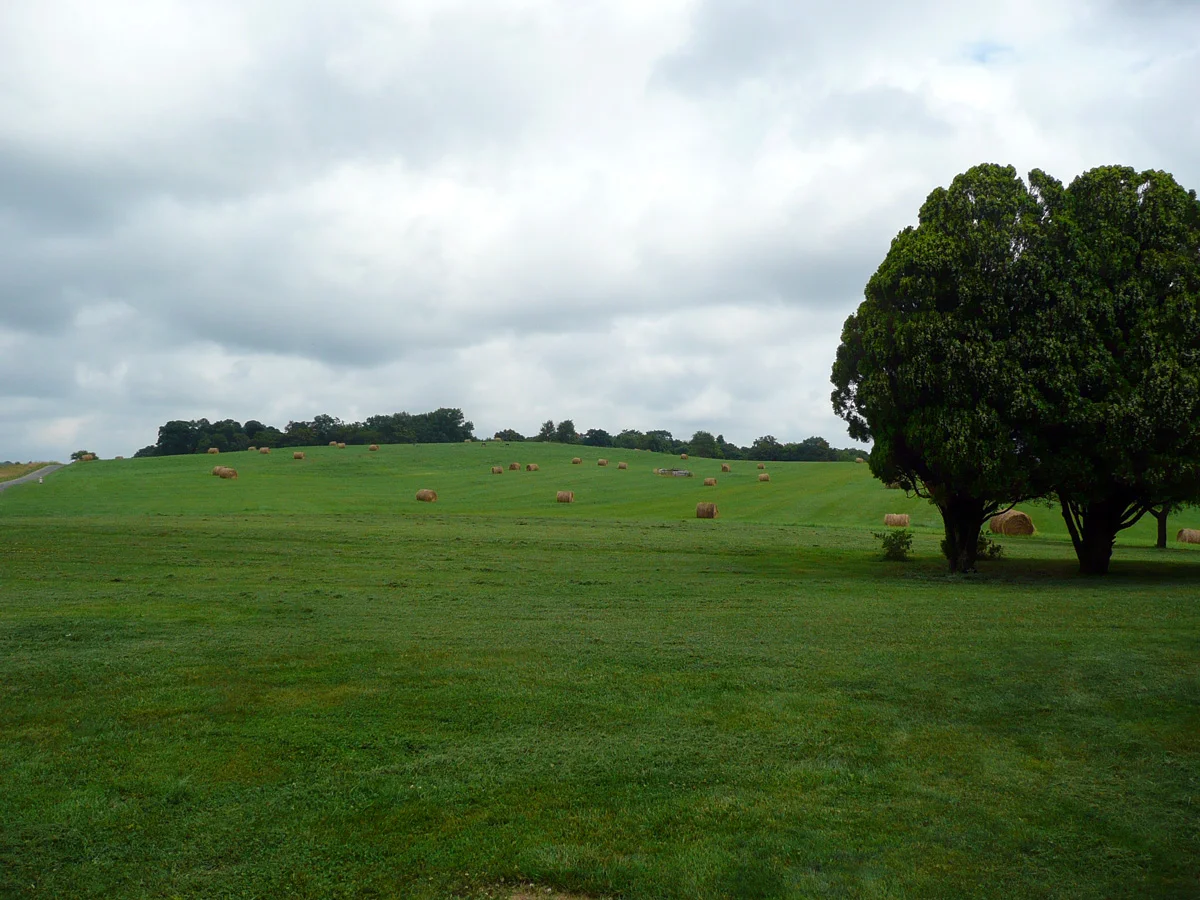

First Battle of Kernstown
Stonewall Jackson hated fighting on Sundays. He was a deacon at his Lexington Presbyterian church and made no secret of his belief that the Sabbath should be kept. On Sunday, March 23, 1862, he fought anyway. He believed he had cornered four Union regiments. He had instead stumbled onto a full Union division of nearly 9,000 men. By nightfall he had lost the battle, his old Stonewall Brigade had run out of ammunition, and he had ordered the arrest of its brigadier general for retreating without permission. He had also, almost by accident, won the strategic point that would shape the next four months of the war.
What Jackson Was Sent to Do
In March 1862, Joseph E. Johnston's Confederate army was pulling back from the Centreville-Manassas area to defend Richmond against George B. McClellan's Peninsula Campaign. Jackson's small division, posted in the Shenandoah Valley, had a single job: prevent the Union forces in the Valley - Nathaniel Banks's command - from leaving to reinforce McClellan. If Banks moved his army east, Richmond's defenders would face overwhelming odds. On March 21 word reached Jackson that Banks was indeed sending divisions back to Washington, and that only James Shields's division remained in the lower Valley. Jackson turned his men around and marched them hard - 25 miles on March 22, another 15 to Kernstown on the morning of March 23. The Confederate cavalry under Turner Ashby had skirmished the day before; Shields had been wounded in the arm by an artillery shell fragment and turned tactical command over to Colonel Nathan Kimball.
Bad Intelligence
Confederate loyalists in Winchester sent word to Ashby that Shields had left only four regiments and a few guns - about 3,000 men - and that they were preparing to march for Harpers Ferry. Ashby, normally a careful scout, did not verify the civilian reports. He passed them on to Jackson. Jackson moved north with his 3,000-man division, reduced by straggling, expecting to find a force roughly equal to his own. What waited for him on Pritchard's Hill was Kimball with about 9,000 troops in three brigades, 16 cannons, and a strong defensive position. When Jackson's aide Sandie Pendleton climbed to a vantage point on Sandy Ridge in the early afternoon and counted the Union forces deployed against them, he estimated 10,000. He reported this to Jackson. Jackson's reply has come down as one of the most fatalistic sentences of his career: Say nothing about it. We are in for it.
The Stone Wall on Sandy Ridge
Jackson decided to swing around the Union right via Sandy Ridge, hoping to cut off Kimball's line of retreat to Winchester. Samuel Fulkerson's brigade reached a stone wall at the edge of a clearing on the ridge moments before Erastus Tyler's Union brigade could occupy it. Tyler attacked around 4 p.m. in a strange tight formation - 24 lines of two companies each, only 75 yards wide and 400 yards deep. The narrow front was easy for the Confederates to mow down with volleys from behind the stone wall. Jackson sent Burks's reserve brigade forward to support the wall. But by 6 p.m. Richard Garnett's Stonewall Brigade had run out of ammunition. Garnett pulled them back rather than wait for resupply, exposing Fulkerson's right flank. The line collapsed. Jackson tried to rally the retreating men, calling to one soldier Where are you going, man? The soldier said he was out of ammunition. Jackson shouted Then go back and give them the bayonet. The soldier kept running. By nightfall Jackson's army was in full retreat.
Casualties and Court-Martial
Union casualties came to 590 - 118 killed, 450 wounded, 22 captured or missing. Confederate losses were heavier in proportion to the smaller force engaged. The 84th Pennsylvania's colonel, William Gray Murray, was among the Union dead. Jackson refused to accept any responsibility for the defeat. He arrested Richard Garnett, brigadier general of his own former Stonewall Brigade, for ordering retreat without permission - despite the fact that Garnett's men had borne the heaviest fighting of the day and Garnett himself had no good options once his men ran out of ammunition. The arrest was widely seen as unjust. Garnett was replaced by Charles S. Winder. Robert E. Lee ordered the charges dropped in September during the invasion of Maryland, but Garnett carried the humiliation for over a year. He was killed at Gettysburg during Pickett's Charge in July 1863. By the end of the war, Lee himself would write to Garnett's family acknowledging he had served honorably.
Strategic Victory Out of Tactical Defeat
Lincoln read the news of the battle and made a decision that would shape the rest of the spring. If Jackson had attacked 9,000 men with 3,000 of his own, the implication was that Jackson believed he had a real force behind him - or expected reinforcements. To protect Washington from a possible Confederate advance through the Valley, Lincoln cancelled the orders sending two divisions to McClellan's Peninsula Campaign and held nearly 35,000 troops in the Shenandoah and around Washington. Those troops were never released. The Confederate capital, defended by inadequate numbers, was preserved partly by what Jackson had failed to do at Kernstown. The Civil War Trust and its partners now preserve 388 acres of the battlefield three miles southwest of Winchester. The Kernstown Battlefield Association operates the site at the 1854 Pritchard-Grim Farm, with walking trails, a small museum, and a visitor center in the farmhouse. A portion of the battle ground was added to the National Register of Historic Places in 2024.
From the Air
The First Battle of Kernstown battlefield sits at about 39.142 N, 78.183 W, three nautical miles southwest of Winchester, Virginia, on the 1854 Pritchard-Grim Farm. Recommended viewing altitude is 2,000 to 3,500 feet AGL for a clear look at Pritchard's Hill, Sandy Ridge to the west, and the preserved acreage. The nearest airport is Winchester Regional (KOKV), about 2 nm north. Front Royal-Warren County (KFRR) lies 14 nm southeast. The Blue Ridge rises about 10 nm east; the Allegheny Front about 15 nm west. Interstate 81 runs along the east side of the battlefield. Best light is mid-morning for the stone-wall section on Sandy Ridge.
Nearby Stories
- Bryce Resort 3.6 km away
- Disney's America 4.8 km away
- Loudoun County, Virginia 6.1 km away
- Hardy County, West Virginia 15 km away
- The Inn at Little Washington 16 km away
- Camp David: Where Presidents Escape and History Gets Made 36 km away
- Antietam: The Day America Lost 23,000 Men 42 km away
- Garrett County, Maryland 49 km away