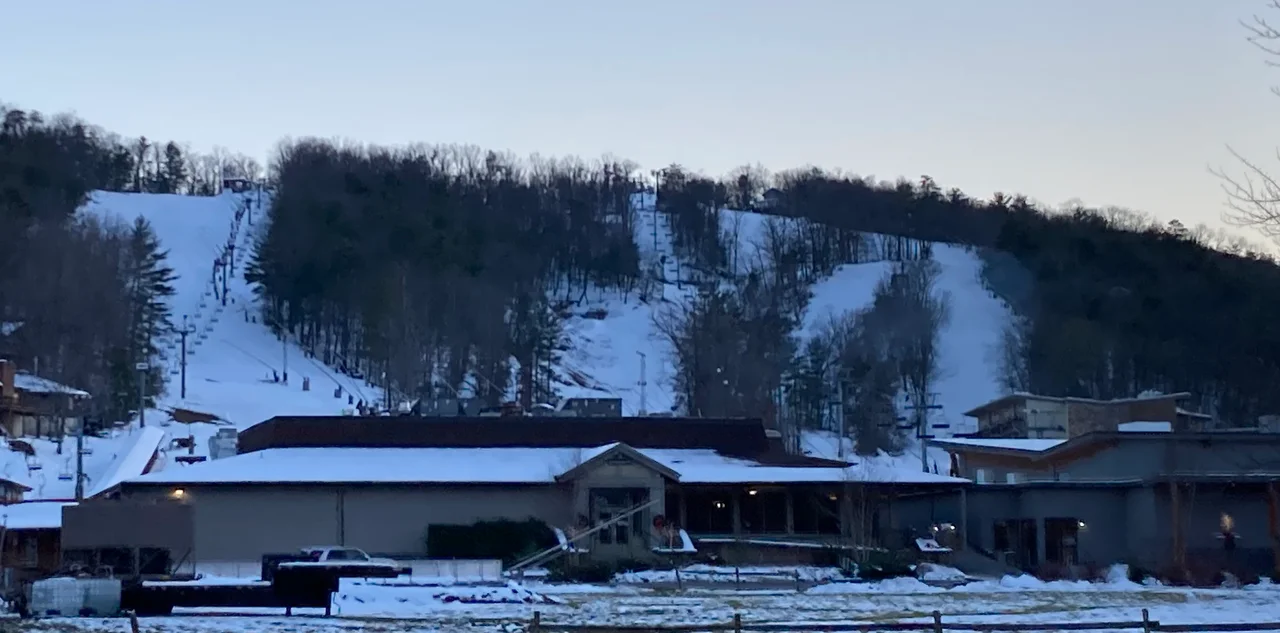

Bryce Resort
Bryce Resort has its own airport. Roll a small plane onto runway VG18, a 2,240-foot strip slicing across a Shenandoah Valley meadow, and you can taxi off to a dog park, a golf course, or a ski lift depending on the season. That detail tells you most of what you need to know about Pete and Julie Brice's 1965 idea: build a place where weekend visitors from Washington, D.C., could do almost anything, and let them get there however they wanted.
Built to Serve the Springs
Bryce opened in 1965, twelve months a year by design. Pete and Julie Brice picked the site to capture some of the traffic already flowing to nearby Orkney Springs, the once-famous mineral spring resort tucked into the same fold of the Shenandoah Mountains. The Brices' resort was something different - a member-owned community with public access, 400 acres of slopes, fairways, lake, and lodging, eleven miles west of Mount Jackson and a hundred and fifteen miles down I-66 from Washington. The model worked. The Locher brothers, Horst and Manfred, took over management and ran the operation until 1997. Ryan Locher manages it today. Sixty years on, Bryce is still operating on the same site, with the same logic: capture a city-bound family on Friday night and keep them busy until Sunday.
Grass Skiing and Other Improvisations
Northwestern Virginia is not exactly Colorado. The climate is too warm for reliable snow, which has shaped Bryce's character from the start. Snowmaking does most of the work in winter, an 800-foot tubing run extends the season at the bottom of the mountain, and an ice rink fills in when the lifts close. In the summer Bryce became one of the first North American resorts to offer grass skiing, sending skiers down the slopes on wheeled boards as if the snow had been replaced with carpet. The activity is no longer supported, but the spirit survives in downhill mountain biking, which now uses the lifts to send riders down the same fall lines. Add an 18-hole PGA Championship course played year-round when weather allows, a driving range, tennis, disc golf, and the artificial Lake Laura, and you have a resort that has rarely committed to a single season.
Lifts Past, Lifts Present
The mountain has been steadily upgrading. The first quad chair went in in 2012. A second quad replaced an old double lift in 2022, giving Bryce two modern fixed-grip quads that each access the entire skiable face. Beginners have two carpet lifts on the lower slopes. In 2021 the resort cut a two-acre terrain park called Thunder Jug, accessible off the Red Eye trail near Lift 2, though anyone who rides it has to skate or hike back to a lift. The biggest change came for the 2025-26 season: a third quad and four new trails on the back side of the mountain, expanding skiable terrain by about 35 percent. For a resort this size, that is the equivalent of opening a whole new ski area attached to the existing one.
What's Below the Lifts
Off the snow, Bryce reads like a small town with a lot of amenities. The main lodge houses the Copper Kettle Restaurant. The Shenandoah Center cafeteria runs in ski season. Carter's Hutte sells warm food at the base, and the Express Grill keeps the poolside crowd fed in summer. There is a full-service ski and bike rental operation, a ski shop, and a golf shop. The Southern Alpine Racing Association uses Bryce's slopes for one of the largest club race teams in the league, with more than 60 racers running gates through the winter. Add the FAA-identified airstrip, a year-round dog park beside it, and the surrounding Shenandoah ridges, and the resort feels less like a destination than a small recreational ecosystem - one that has been quietly compounding additions for six decades.
From the Air
Located at 38.82 degrees north, 78.77 degrees west, in northern Shenandoah County, Virginia. The resort's own airstrip is FAA-identified VG18 with a 2,240-foot runway. From pattern altitude the ski runs cut white lines down the eastern slope of Great North Mountain in winter, with Lake Laura and the golf course visible at the base. Nearby airports include New Market (8W2), Front Royal-Warren County (KFRR), and Winchester Regional (KOKV). Watch for ridge-induced turbulence in westerly winds and obstructions on the unattended airstrip.
Nearby Stories
- Canaan Valley Resort State Park 1.1 km away
- Eastern Mennonite University 4.9 km away
- Moorefield 5.6 km away
- United States National Radio Quiet Zone 14 km away
- Sinks of Gandy 17 km away
- The Inn at Little Washington 21 km away
- First Battle of Kernstown 23 km away
- Battle of Cedar Mountain 31 km away