
Peaks of Otter
Thomas Jefferson was a careful man, but he could be spectacularly wrong. The mountains of the Blue Ridge, he wrote, and of these the Peaks of Otter, are thought to be of a greater height, measured from their base, than any others in our country, and perhaps in North America. He was not even close. Mount Mitchell, in the Black Mountains of North Carolina, tops out at 6,684 feet. The Rockies were still a continent away from being measured. But before anyone got around to correcting Jefferson, the Commonwealth of Virginia had already sent stones quarried from the Peaks of Otter to be installed in the Washington Monument as the state's contribution. The stones are still there. So is Jefferson's mistaken claim. So are the three peaks - Sharp Top, Flat Top, and Harkening Hill - rising above Bedford County in the central Blue Ridge.
Three Summits, One Name
The cluster contains three named summits arranged around Abbott Lake, the manmade lake at the heart of the basin. Flat Top is the tallest. Harkening Hill is the smallest. Sharp Top, the most famous of the three, is the one most people climb - 1.5 miles up, with about 1,300 feet of elevation gain, ending in a 360-degree view that on a clear day reaches dozens of miles in every direction. There is also a separate cliff formation off the side of Sharp Top called Buzzard's Roost, with views nearly as good. For visitors who cannot make the climb, a shuttle from the Peaks of Otter Lodge takes you to within a fifteen-minute walk of the summit. Combined, the three peaks offer about twelve miles of hiking. Around Abbott Lake itself runs a flat, one-mile paved trail. A 1.6-mile loop leads to a waterfall two miles north on the Blue Ridge Parkway.
What the Name Might Mean
The origin of the name is genuinely uncertain. Archaeological evidence under Abbott Lake shows that Native Americans visited the Peaks for at least 8,000 years - hunting, traveling, resting. One theory is that the mountains got their name from the Cherokee word Otari, meaning high places. Another, more pedestrian, suggests they were named for the Otter River, which starts nearby and was presumably named for actual otters somewhere downstream. The most interesting theory traces the name to two early European settlers. In 1766, Thomas Wood and his family from Pennsylvania settled in the basin. National Park Service documents indicate that brothers Charles and Robert Ewing were among the early residents. Some have argued that the Peaks were named for the Ewing surname as pronounced in Scottish Gaelic: Clann Eoghain na h-Oitrich, meaning Clan Ewing of Otter. Similarly Otter-themed Scottish place names give the theory some weight, and the resemblance of Flat Top to Beinn Dorain, in the ancestral Ewing country of Argyll and Bute, gives it a bit more.
Polly Wood and the Mons Hotel
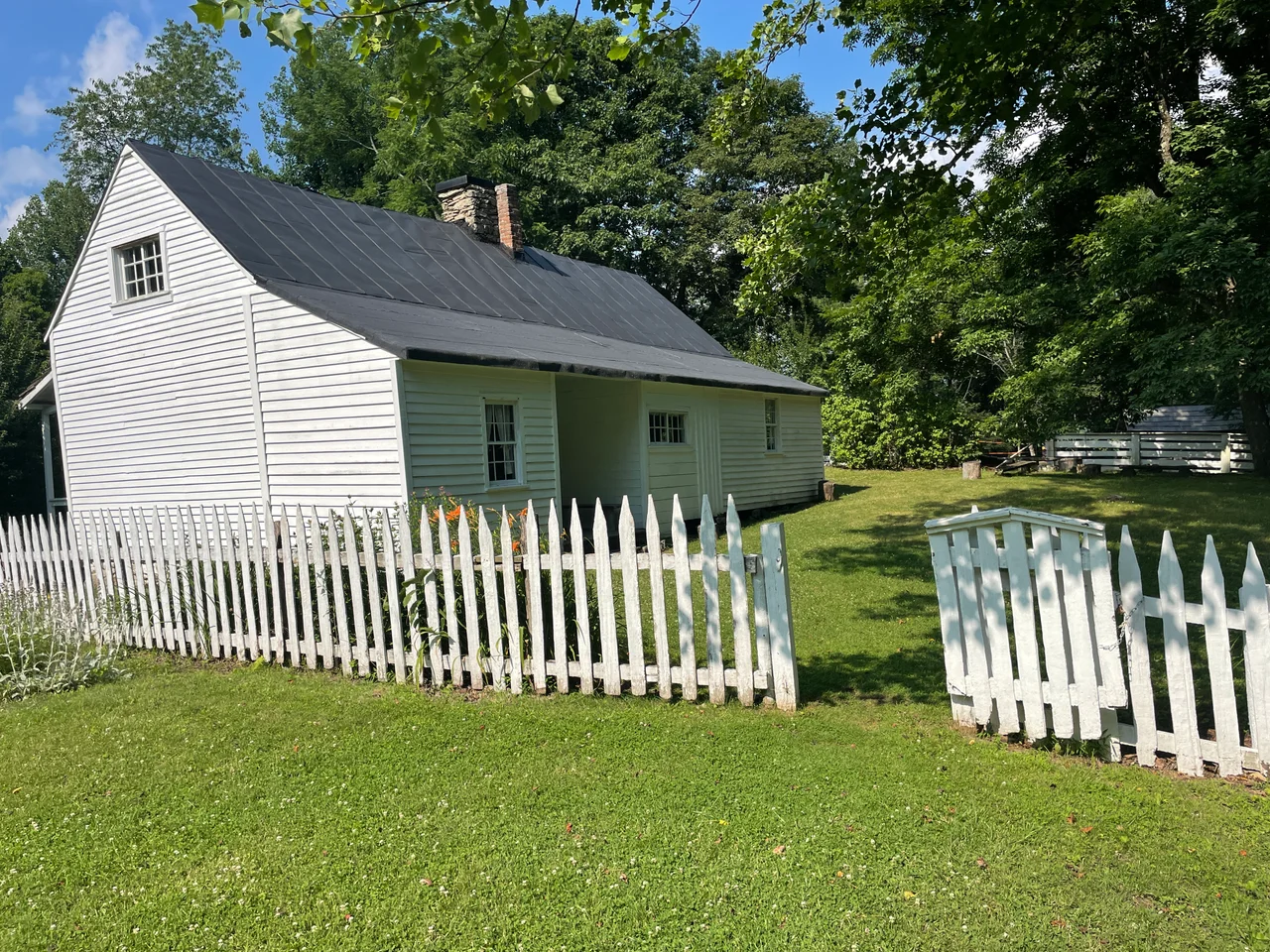
By 1834, the basin had its first inn. Polly Wood, a widow, opened what she called an Ordinary in her log cabin - a place where travelers could spend the night and get a warm meal. By the 1870s, Benjamin Wilkes had built the more substantial Mons Hotel, and the Peaks of Otter community had grown to over 20 families, a school, a church, and the hotel itself. The Johnson family, one of the original settlers, lived in their farmstead for three generations until the 1930s. The Johnson Farm is now historically restored and open for free tours June through September - a four-room log cabin first bought by John T. Johnson in 1852, with its outbuildings, gardens, and small orchard preserved in their 1930s form. By the early 1900s, the National Park Service had taken notice. Abbott Lake was created in 1964, along with the current Peaks of Otter Lodge, which still operates.
The Bomber That Could Not Be Recovered
On the far side of Sharp Top, just off the summit, the wreckage of a B-25 bomber rests where it crashed during a World War II training exercise. Five Army airmen died in the impact. The aircraft was too heavy and the mountainside too steep for any recovery operation, so the plane simply remained where it fell. A small memorial sits on a rock at the top of the crash site. Most of the wreckage can still be found along the mountain, returning slowly to the rhododendron and the stone. The site is a quiet, sobering thing to encounter on a hike that began as a view-seeking exercise. A larger and more recent monument - the National D-Day Memorial - stands in Bedford, the small city nine miles southeast of the Peaks. Bedford lost a higher proportion of its sons on June 6, 1944, than any other community in the country.
From the Air
The Peaks of Otter sit at 37.45 N, 79.58 W on the Blue Ridge Parkway at milepost 85.6, about 9 miles northwest of Bedford. Sharp Top rises to approximately 3,875 feet, Flat Top to 4,001 feet, and Harkening Hill to approximately 3,372 feet. Cruise at 6,500 to 9,500 feet MSL for safe terrain clearance and good visual orientation. The three summits frame Abbott Lake in the basin between them. Watch for mountain wave and ridge turbulence in westerly winds. Nearest airport is Smith Mountain Lake (W91) about 12 nautical miles south; Lynchburg Regional (KLYH) about 25 miles east. The B-25 wreckage on Sharp Top's far side is a known historic site, not visible from typical cruise altitudes.
Nearby Stories
- Sweet Briar College 3.3 km away
- Paint Bank, Virginia 10 km away
- Battle of White Sulphur Springs 11 km away
- Murders of Alison Parker and Adam Ward 14 km away
- 2023 Virginia Cessna Citation Crash 16 km away
- Blacksburg 24 km away
- The Omni Homestead Resort 29 km away
- Red Hill Patrick Henry National Memorial 32 km away