
Battle of White Sulphur Springs
The strangest objective of any Civil War raid in West Virginia was a stack of law books. In August 1863, Brigadier General William W. Averell led a 1,500-man Union cavalry brigade across the mountains toward the small town of Lewisburg, where he had been ordered to seize the Virginia Supreme Court of Appeals library - then sheltering at Lewisburg's college - and carry it back across the lines to the newly created state of West Virginia. The books were considered important: legal precedent, deeds, court records. They were also, the Confederates decided, worth defending. On August 26 and 27, Averell's brigade collided with Colonel George S. Patton's hastily assembled Confederate force at a road intersection near White Sulphur Springs, in country still known locally as Rocky Gap. Two days of fighting later, the law library remained in Lewisburg, and Averell's brigade was retreating north with most of its ammunition spent.
The Long Approach
The campaign began in late July 1863, when the rest of Averell's brigade was harrying Robert E. Lee's Army of Northern Virginia as it retreated south after Gettysburg. The 2nd West Virginia Mounted Infantry was scattered in detachments across the state. On August 5, Averell left Winchester with a regrouped force and pushed west across North Mountain to Wardensville in Hardy County, then southwest toward Huntersville in Pocahontas County. Local Unionist home-guards - including a Hardy County group called the Swamp Dragons - helped him fight off the Confederate bushwhackers who shadowed his column. At Huntersville on August 22, Colonel John H. Oley led the 8th West Virginia in a raid on a Confederate camp called Camp Northwest, burning buildings, wagons, and weapons. Averell waited a day for the rest of his infantry to catch up - the 2nd and 10th West Virginia, with two guns from Keeper's Battery - then on August 25 hurried 25 miles to Callaghan's in Alleghany County, Virginia, destroying a saltpeter works on the Jackson River along the way.
The Race to the Intersection
Confederate Brigadier General Sam Jones, commanding the Department of Western Virginia from Dublin Depot, had been tracking Averell's movements through couriers. At 10 p.m. on August 25, Jones learned that Averell was at Callaghan's. He immediately rerouted Colonel George S. Patton's 22nd Virginia Infantry, which had been marching toward Warm Springs, and ordered it back toward Lewisburg. Patton received the message at 2 a.m. on August 26 and put his men on the road. Both forces were now racing for the same road junction east of Lewisburg, near the resort village of White Sulphur Springs. Patton would approach from the northeast on the Anthony's Creek road; Averell would approach from the southeast on the road from Callaghan's. If Averell got there first, nothing significant would stand between him and the law library at Lewisburg. If Patton got there first, the Federals would have to fight.
The First Volley
Patton's lead battalion - Lieutenant Colonel George M. Edgar's command, including remnants of the 59th Virginia Infantry and several southwest Virginia militia detachments - reached the intersection first, just as Averell's vanguard appeared from the southeast. Around 9:30 a.m. on August 26, Captain Edmund S. Read's Company B occupied a house owned by a farmer named Henry Miller along the road and fired the opening volley at Averell's leading cavalry. Captain George Beirne Chapman's Confederate battery - two 3-inch rifled guns, one 12-pounder howitzer, and one 24-pounder howitzer - opened up from a hilltop behind Edgar. The combination of artillery fire and infantry volleys drove back Averell's lead element and bought Patton time to deploy his main line. The 45th Virginia under Colonel William H. Browne moved into position on the right; the 22nd Virginia anchored the left; Edgar's battalion held the center.
Incessant Fire
The fight that followed was, by the account of a soldier in the 3rd West Virginia, an almost incessant fire of artillery and muskets that lasted four or five hours without either side gaining advantage. Union artillery commander Captain Chatham Ewing was severely wounded while reconnoitering for better gun positions; Lieutenant Howard Morton took command and dueled the Confederate battery for over two hours. One of Chapman's rifled guns was hit twice by Union artillery. Major Francis P. McNally led the 2nd West Virginia in an assault on the Confederate right that brought Union soldiers within 15 paces of the Confederate line before collapsing under volley fire. McNally was mortally wounded and captured. A mounted charge by a portion of the 14th Pennsylvania Cavalry along the road met the same fate. By nightfall, Averell pulled his men back and counted his ammunition. He had not enough left for another day's fight.
Withdrawal and Cost
On the morning of August 27, Averell resumed the attack briefly but the result was the same. Around mid-morning, with ammunition critical, he ordered the brigade to withdraw, abandoning the law-library mission and falling back northeast toward Callaghan's and eventually all the way to Beverly. Confederate troops did not aggressively pursue - Patton's force had been hammered too, and Jones was content to have stopped the raid. Union casualties were 26 killed, 125 wounded, and 67 missing or captured. Confederate casualties were 20 killed, 129 wounded, and 13 missing - 162 total casualties on the Confederate side. The Virginia Supreme Court of Appeals law books stayed in Lewisburg. Patton, who would die a year later from wounds received at the Third Battle of Winchester, gave his grandson - the same name carried by the World War II tank general - one of his last battlefield victories. The fight is sometimes called the Battle of Dry Creek or the Battle of Rocky Gap, after the local terrain.
Aviator's Notes
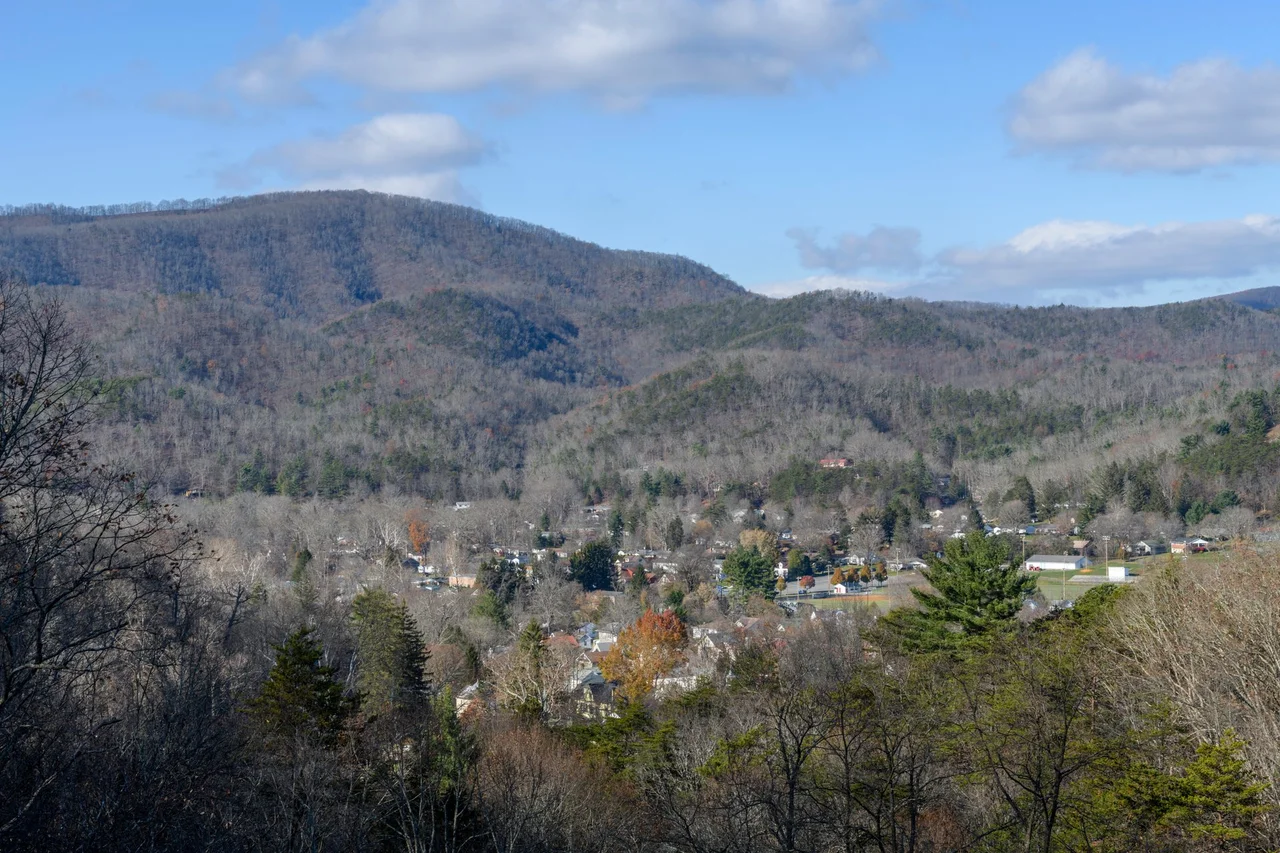
The battle was fought at approximately 37.80 N, 80.29 W, near the village of White Sulphur Springs in Greenbrier County, West Virginia - about 9 miles east of Lewisburg along U.S. 60 and Interstate 64, near where modern Greenbrier State Forest meets the Virginia state line. Elevation is around 2,000 feet, rising sharply into the ridges immediately east. The nearest commercial airport is Greenbrier Valley Regional (KLWB) at Lewisburg, about 10 nautical miles west. From altitude, the Greenbrier Resort's white-columned hotel complex is the dominant visual landmark at White Sulphur Springs itself; the battlefield ground lies just east of the resort along the I-64 corridor.
From the Air
Located at approximately 37.80 N, 80.29 W near White Sulphur Springs, Greenbrier County, West Virginia, at ~2,000 feet elevation. Nearest airport: Greenbrier Valley Regional (KLWB) at Lewisburg, approximately 10 nm west. The Greenbrier Resort's white-columned hotel complex is the primary visual landmark; the battlefield lies just east along the I-64 corridor. Recommended viewing altitude 5,500-7,500 feet. Mountain weather brings winter icing and summer afternoon thunderstorms.
Nearby Stories
- Bath County Pumped Storage Station 7.2 km away
- Botetourt County, Virginia 7.5 km away
- Paint Bank, Virginia 8.2 km away
- Gauley River National Recreation Area 8.8 km away
- Seebert Lane Colored School 12 km away
- Babcock State Park 16 km away
- Garth Newel Music Center 16 km away
- Concord University 25 km away