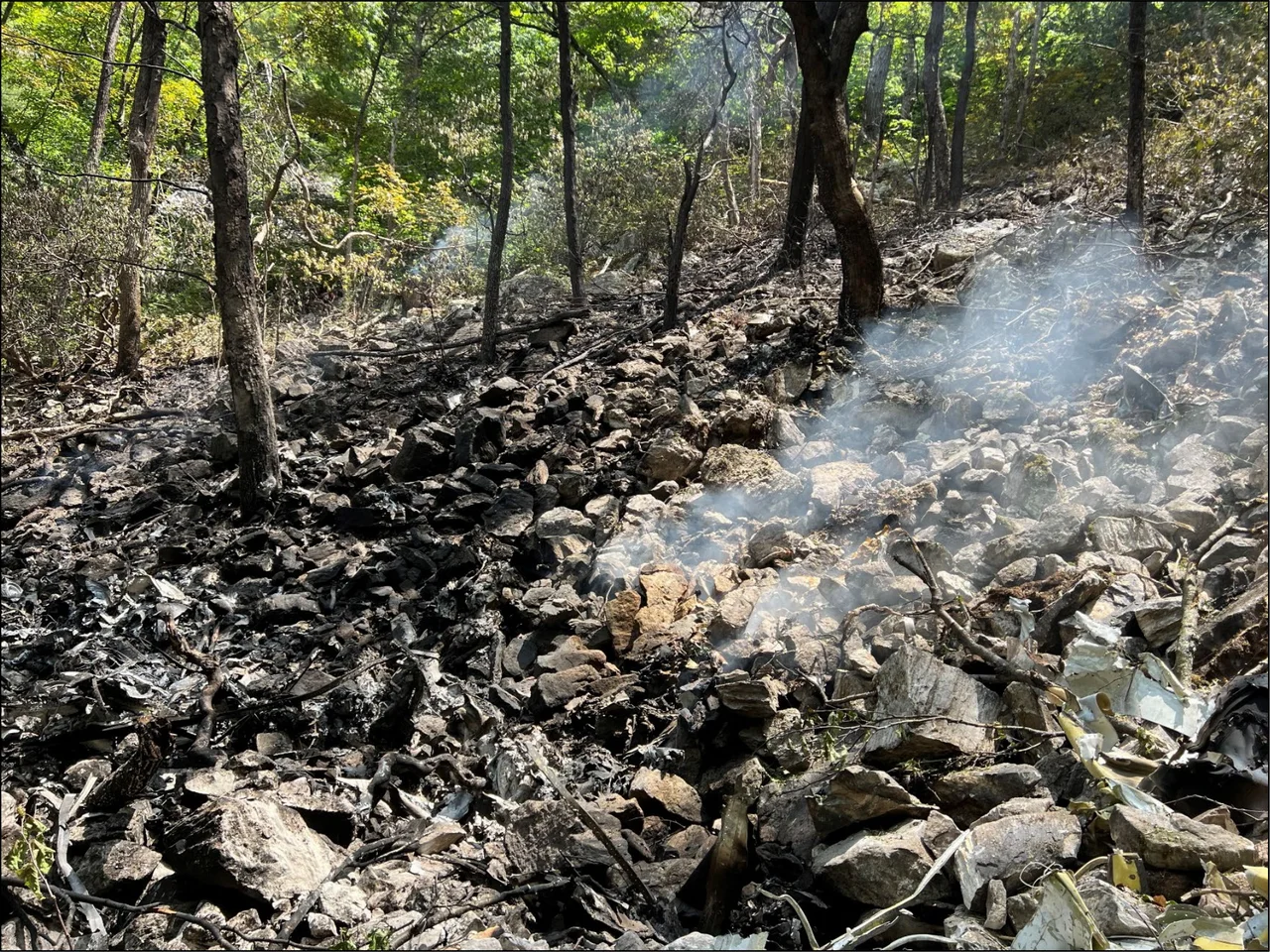

2023 Virginia Cessna Citation Crash
The sonic boom over the National Mall on June 4, 2023, was the first thing most people heard. It was a Sunday afternoon. The boom came from two F-16s out of Joint Base Andrews going supersonic to catch a small jet that wasn't answering its radio. They reached the Cessna over the capital and saw what the air traffic controllers had been afraid of: the pilot was slumped forward, unresponsive, the aircraft flying on autopilot toward Virginia at 34,000 feet.
The people aboard had been unconscious for some time. Four of them: a 69-year-old pilot named Jeff Hefner, a 49-year-old real estate broker named Adina Azarian, her two-year-old daughter Aria, and the family's 56-year-old nanny Evadnie Smith. The autopilot held its course south. Two minutes after the F-16s reached the cabin, the aircraft entered a right spiral and went into Mine Bank Mountain at something close to terminal velocity. The crater was so deep and the debris so fragmented that first responders described few recognizable pieces.
The Family on Board
Adina Azarian had been adopted at age 40. Her adoptive father, John Rumpel, was the Florida businessman who owned Encore Motors of Melbourne and the Cessna 560 Citation V registered as N611VG. The plane was returning from East Tennessee, where the family had been at the Rumpels' farm, and was on its way to East Hampton on Long Island when something went wrong with cabin pressurization. Aria was two years old. She had been adopted by Adina, who had spent her professional life as a real estate broker in Manhattan and on Long Island. Evadnie Smith, who had been Aria's nanny, was on board to help mind her on the flight. Jeff Hefner was a veteran corporate pilot who had flown for major airlines and had thousands of hours in the Citation series. He was, by every account the NTSB later collected, an experienced and capable aviator. In the moments that the aircraft depressurized, none of his experience could help him. None of them was conscious long enough to know what had happened.
The Intercept
NORAD scrambled six F-16s when the aircraft entered restricted airspace over Washington, D.C. without responding to repeated calls. Two of them, from the 113th Wing, were first to reach it. They flew alongside and saw the cabin. The pilot was passed out. They fired flares to try to wake anyone aboard. Nothing changed inside the Cessna. The supersonic dash that brought them to the intercept was what shook Washington with the boom that residents heard from the Potomac to the Beltway. The fighters followed the Citation as it flew past the capital and into Virginia airspace, passed over Mine Bank Mountain, and at approximately 3:22 p.m. Eastern Daylight Time entered a right spiral. The descent rate, John Rumpel told reporters afterward, was about 20,000 feet per minute. The intercept pilots watched the aircraft go in.
Mine Bank Mountain
The Cessna struck the north face of Mine Bank Mountain at an elevation of 2,760 feet, near the Mine Bank Creek Trail in the George Washington National Forest. The location is wild country east of the Blue Ridge Parkway, near Montebello, Virginia. Vegetation damage and the crater confirmed what the F-16 crews had reported: a fast, near-vertical descent. First responders hiked in over difficult terrain. There were no survivors. There was little to recover. The aircraft had carried a cockpit voice recorder. The NTSB later concluded that the recorder, like much of the aircraft, was not recoverable in any usable form from the impact crater.
What the NTSB Found
The National Transportation Safety Board released its final report on May 13, 2025, almost two years after the accident. The probable cause was hypoxia from a loss of cabin pressurization. The board could not corroborate this conclusion through medical forensics of the deceased and could not determine what caused the aircraft to depressurize in the first place. The report cited incomplete maintenance as a contributing factor. The owner of the aircraft, John Rumpel, had declined to fix a number of issues identified in pre-flight inspections, including problems with the emergency oxygen system that would have prevented the masks from deploying in the kind of low-pressure scenario the crew and passengers experienced. At 34,000 feet without supplemental oxygen, time of useful consciousness is measured in seconds. The crew almost certainly understood that something was wrong. They had no way to act on the understanding before the cabin air ran out of usable oxygen.
The Father Who Wasn't There
John Rumpel was not aboard. He has spoken publicly about the loss of his adopted daughter and granddaughter, and about his decision to forgo the maintenance items the NTSB later cited. He has expressed grief for Aria, whom Adina had recently adopted, and for Adina herself, whom he had adopted decades earlier. Two adoptions, two short generations, gone in two minutes of unconsciousness at altitude over a country that has built remarkable systems for preventing exactly this kind of accident. The systems work when they are maintained. The crash site, on the wooded slope of Mine Bank Mountain, is now part of the long quiet list of places in American aviation where a known and preventable failure was, for reasons that will not now be fully knowable, not prevented.
From the Air
The crash site is near Montebello, Virginia at approximately 37.93 degrees north, 79.10 degrees west, on the north face of Mine Bank Mountain at 2,760 feet elevation in the George Washington National Forest. Shenandoah Valley Regional Airport (KSHD) lies 30 nm northwest and Lynchburg Regional (KLYH) is 35 nm south. The surrounding wilderness is best viewed at 4,000 to 7,000 feet AGL. The site itself is unmarked from the air; the Blue Ridge ridgeline runs to the east, and the Mine Bank Creek drainage is visible as a wooded gorge.
Nearby Stories
- Amherst, Virginia 12 km away
- Virginia School for the Deaf and the Blind 12 km away
- Fork Union Military Academy 18 km away
- Montpelier 22 km away
- Peaks of Otter 22 km away
- Highland County, Virginia 25 km away
- Battle of Cumberland Church 30 km away
- Bath County, Virginia 32 km away