
Sweet Briar College
On March 3, 2015, the board of directors of Sweet Briar College announced that the school would close at the end of the academic year. Insurmountable financial challenges, they said. Declining enrollment. The end of an era. Within seventy-two hours, alumnae who had not spoken since graduation were calling each other. By the end of the week, a fundraising campaign called Saving Sweet Briar had raised over a million dollars and hired a lawyer. By June, the president had resigned, thirteen of the directors were gone, the courts had blocked the closure, and a new board was unanimously voting to keep the doors open. The college that almost ended in 2015 is the same college whose first 51 students arrived in 1906. The throughline is a grief that no parent ever fully recovers from.
Daisy
Maria Georgiana Williams was born in 1867. Her parents called her Daisy. She grew up at Sweet Briar plantation in Amherst County, the only child of Indiana Fletcher Williams and James Henry Williams. She died at sixteen, in 1884, of an illness that letters from the period describe but never quite name. Her mother never recovered. Indiana Fletcher Williams had inherited the plantation from her father, the Lynchburg mayor Elijah Fletcher, who at his 1858 death had enslaved more than 110 people. When Indiana wrote her own will in 1900, she bequeathed the entire 3,250-acre property to become a school for young women - a memorial, in stone and red brick and curriculum, to a daughter who had not lived to attend college herself.
The Plantation Before the College
The land Sweet Briar sits on was the working plantation of the Fletcher family for more than fifty years before it became a campus. Elijah Fletcher and his descendants used enslaved labor to run the property. After emancipation in 1865, several formerly enslaved people and their descendants continued to work and live at Sweet Briar, including Martha Penn Taylor, who worked for three generations of the Fletcher-Williams family, and Signora Hollins, who had been Indiana Fletcher's childhood playmate. Some descendants of the people enslaved by the family still work at the college today. Others hold annual family reunions on campus. The Sweet Briar plantation burial ground, where upwards of 60 enslaved people are buried, remains on the property. A slave cabin from the 1840s still stands behind Sweet Briar House. The college does not hide this history - the names, the cabin, the cemetery are part of the campus tour.
Ralph Adams Cram's Quad
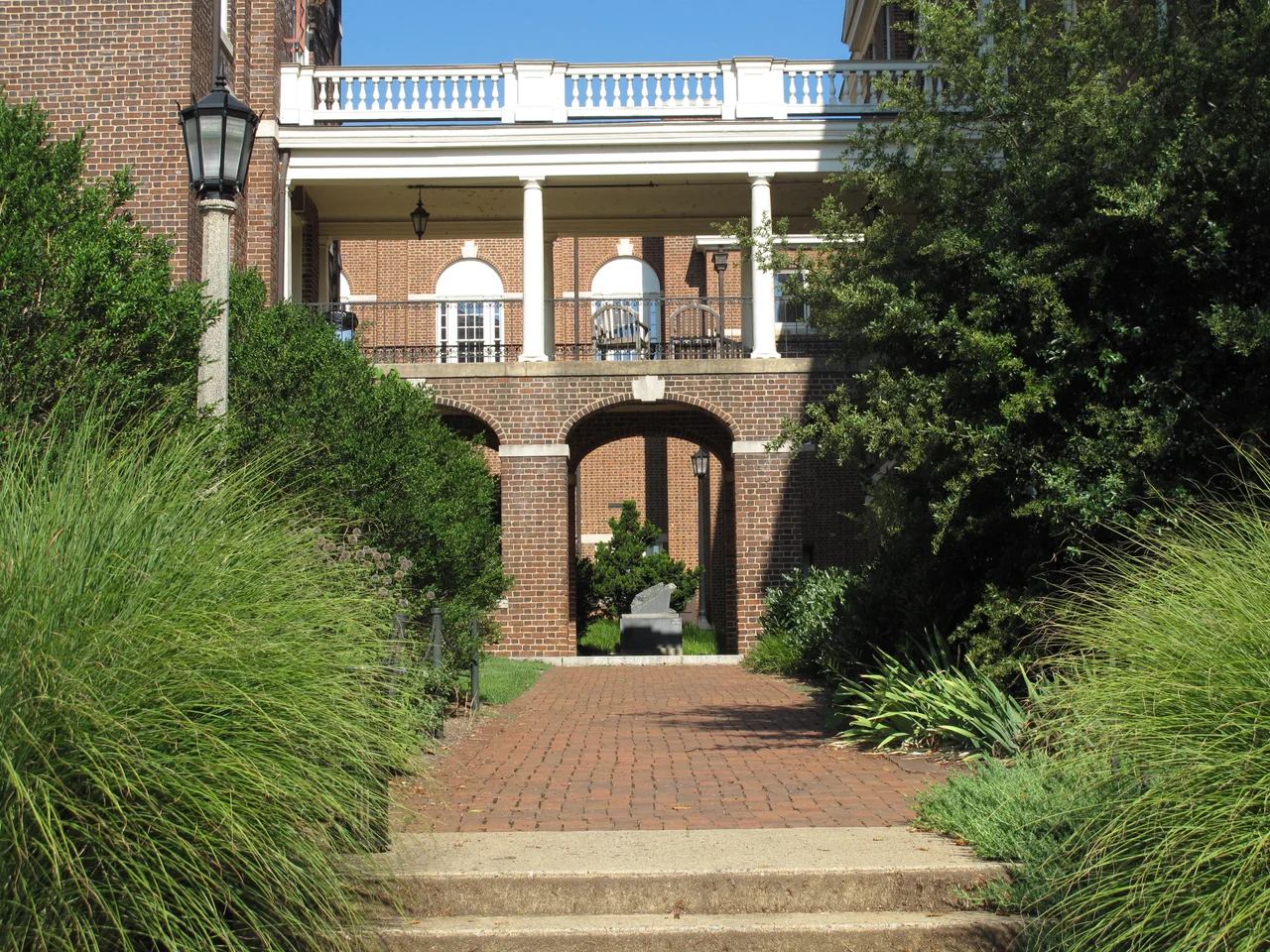
When the college formally opened in 1906, the architecture was the work of Ralph Adams Cram, whose name appears on the campuses of Princeton and West Point. Cram's signature style was Gothic Revival, but at Sweet Briar he chose Colonial Revival - red brick buildings with white balustrades, columned arcades, and the Georgian symmetry of a Virginia plantation reimagined for liberal arts education. Twenty-one of the thirty original campus buildings are now designated as the Sweet Briar College Historic District on the National Register. The first AB degrees were granted in 1910. By 1932 the college had a study-abroad exchange with the University of St. Andrews in Scotland; the Junior Year in France program launched in 1948. The curriculum was the academic equivalent of Smith or Wellesley, with one distinctive twist: Indiana Fletcher Williams' will required hands-on, practical education for women, and the college took the directive literally.
The Fight to Stay Open
By 2015 the endowment had slipped from $96 million to $84 million. Enrollment was down. The board, citing $25 million in bond debt and an inevitable insolvency, voted unanimously to close. The response was almost immediate: faculty passed a vote of no confidence in the board, alumnae organized through social media, and a fundraising group called Saving Sweet Briar pledged $12 million within months. The Amherst County Attorney filed suit on behalf of the Commonwealth of Virginia. A Bedford County judge issued injunctions to stop asset transfers. On June 20, 2015, the Virginia Attorney General announced a mediated settlement: the president and at least thirteen directors would resign, Saving Sweet Briar would deliver $12 million by September, and the college would open in the fall. By September 2, the group had delivered $12.143 million. The doors stayed open. The story made national news as the rare case of an alumni community successfully refusing to let their college die.
After the Save
Sweet Briar reorganized its curriculum in 2018 into three centers - Engineering, Science and Technology in Society; Human and Environmental Sustainability; and Creativity, Design and the Arts. It became the second women's college in the country to offer an ABET-accredited engineering degree. Its riding program, focused on show hunters and equitation, remains among the most decorated in the country - four ODAC titles and nine ANRC national championships across the program's history. Notable alumnae include Janet Lee Bouvier (Jackie Kennedy's mother), the entrepreneur Leah Busque who founded TaskRabbit, and Marshalyn Yeargin-Allsopp, the college's first African-American student, who later served as associate director in the Division of Congenital and Developmental Disorders at the CDC. The Pulitzer Prize-winning poet Mary Oliver spent four years at Sweet Briar as Margaret Banister Writer-in-Residence (1991–1995), teaching workshops and receiving the National Book Award during her time on campus. The annual Founder's Day still walks to Monument Hill, where students lay daisies at Daisy Williams' grave - a mourning that, more than 140 years on, the college has turned into a yearly act of remembrance and renewal.
From the Air
Located at 37.55 degrees N, 79.08 degrees W in Amherst County, Virginia, just south of the town of Amherst on US Route 29. The campus covers 3,250 acres of fields, forest, and the historic Georgian-Revival red-brick quad designed by Ralph Adams Cram - a visible landmark from above. The Blue Ridge rises to the west. Nearest airport is Lynchburg Regional (KLYH) about 12 miles south. Best viewed at 2,500 to 4,000 feet AGL in clear conditions, ideally in spring when the daisies for which Daisy Williams was named bloom across campus.
Nearby Stories
- Peaks of Otter 15 km away
- Battle of Cumberland Church 20 km away
- 2023 Virginia Cessna Citation Crash 22 km away
- Murders of Alison Parker and Adam Ward 24 km away
- Red Hill Patrick Henry National Memorial 26 km away
- Francisco's Fight 34 km away
- Bath County, Virginia 39 km away