
2014 Dan River Coal Ash Spill
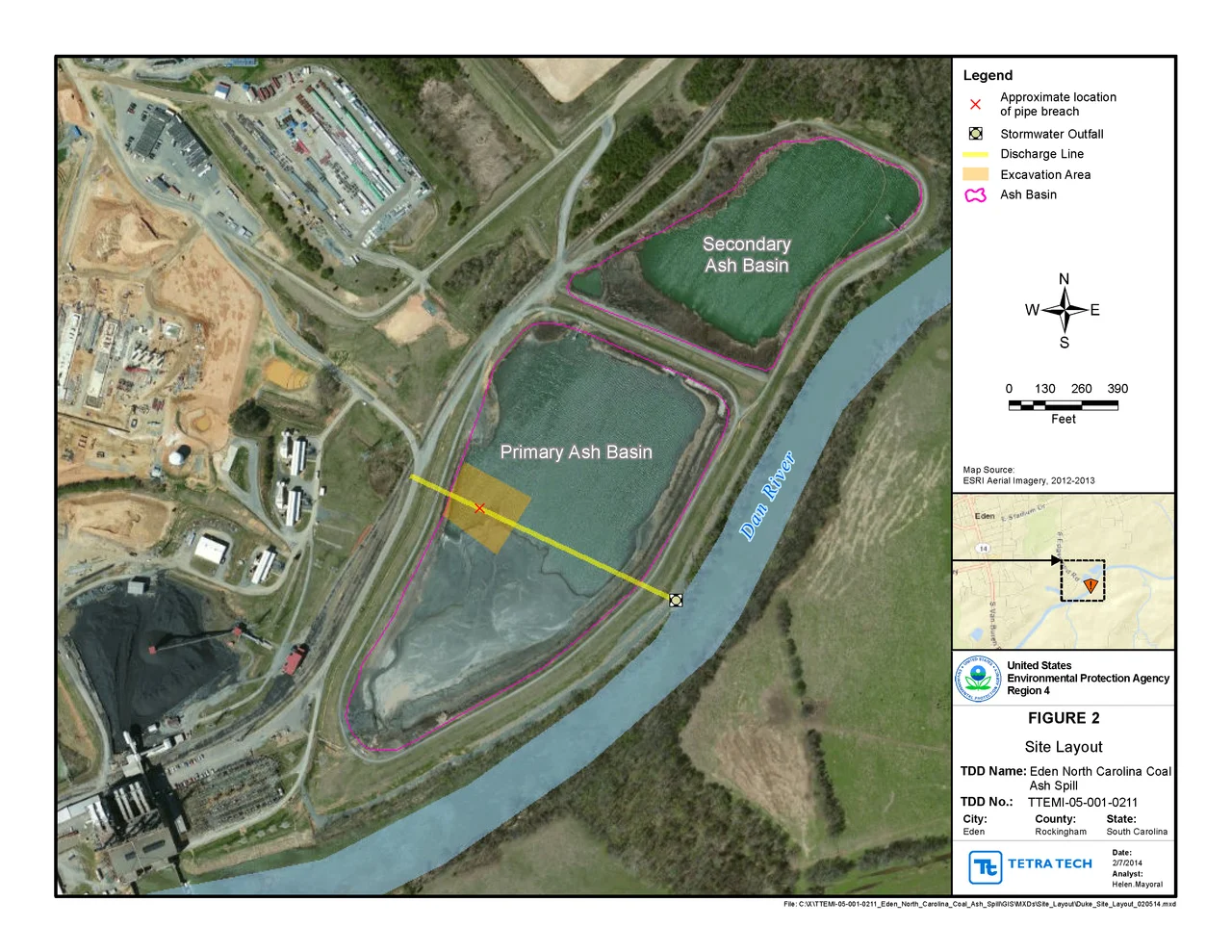
The pipe was forty-eight inches across, made of corrugated metal, and had been buried for decades under a coal-ash pond at the Dan River Steam Station in Eden, North Carolina. On the afternoon of February 2, 2014, a security guard at the retired coal plant noticed the water level in the pond was dropping. By the time crews understood what was happening - that the storm pipe had ruptured at the bottom of an unlined impoundment and was now venting the pond's contents directly into the river - the Dan was already turning gray for twenty miles downstream. The pipe stayed broken and draining for almost a week before it was finally plugged.
Thirty-Nine Thousand Tons
Coal ash is the gritty residue left when a power plant burns coal. It is laced with arsenic, selenium, copper, iron, zinc, and lead. The cheap way to store it is to mix it with water and let it settle in a clay-lined or unlined pond. The Dan River Steam Station had ceased operating in 2012, but the ash pond was still there and still toxic. The collapse sent an estimated 39,000 tons of coal ash and 27 million gallons of wastewater into the Dan River - the third-largest coal ash spill in United States history at the time. Workers eventually recovered about ten percent of the spilled ash. The rest settled across about 25 miles of riverbed downstream, into Virginia and beyond. Tests near the spill showed arsenic and selenium spikes. Sediment samples showed pollutants well above the levels considered safe for aquatic life, with lead repeatedly exceeding ecological screening thresholds.
A Regulator Stripped to the Bones
The New York Times reported that Governor Pat McCrory's administration had directed the state's environmental agency to minimize its regulatory role in the years before the spill. McCrory had worked for Duke Energy for nearly three decades before he became governor. Environmental groups had tried three separate times in 2013 to sue Duke under the Clean Water Act, demanding that the company fix the leaks documented at its coal ash dumps. Each time the state agency intervened, blocked the citizen suits, and pre-empted them with a state enforcement action of its own. The fine the state eventually levied was 99,111 dollars. Federal prosecutors looked at that number and started asking questions. The federal investigation would target both the company and the regulators.
Criminal Negligence
Internal documents pulled in the federal probe showed that company officials had known for years about leaks at multiple coal ash impoundments, including Eden, and had declined to give plant administrators the money they were requesting to monitor and mitigate. The U.S. Department of Justice's Environment and Natural Resources Division charged the company. In 2015, Duke Energy pleaded guilty to nine misdemeanor counts of criminal negligence under the Clean Water Act and agreed to pay 102 million dollars in fines and restitution - the largest federal criminal fine in North Carolina history. The company also paid 2.5 million dollars in fines to North Carolina and Virginia. The EPA and Duke signed an administrative consent order for cleanup, and the company has been billed periodically for federal oversight costs since.
Thirty-Two Ponds, Five Billion Dollars
The Dan River spill changed the political math in Raleigh. The state legislature ordered Duke Energy to close all 32 of its remaining coal ash ponds in North Carolina by 2029. In April 2019 the state ordered Duke to dig up millions of tons of ash at six of its power plants - the kind of full excavation and lined-landfill solution that environmental groups had been demanding for years. Estimates for the total cleanup have climbed past 5.6 billion dollars, with another 5 billion possible if all 32 active ponds must be drained. Most of that cost will be passed through to ratepayers. The river still carries the rest of the ash. Most of it settled into sediment in the first 25 miles below the spill site, layered into the Dan's bed where it will leach metals into the water for the rest of any human lifetime.
Flight Context
The spill site sits at 36.49N, 79.72W, on the south bank of the Dan River in Eden, North Carolina, near the confluence with Town Creek. From cruise the retired steam station is visible as a small industrial footprint - the coal pile gone but the stack still standing - on the inside of a sweeping river bend, with the impoundment pond a flat brown rectangle northeast of the plant. The river flows east-northeast into Virginia toward Danville. Smith Reynolds (KINT) at Winston-Salem lies about 36 nm WSW, Piedmont Triad International (KGSO) about 33 nm SW.
From the Air
Coordinates 36.49N, 79.72W; recommended viewing altitude 3,000-5,000 feet AGL. Visual landmarks include the retired Dan River Steam Station industrial footprint on the south bank, the flat brown rectangle of the closed ash impoundment, and the river bending east-northeast toward Danville, Virginia. Nearest airports: Smith Reynolds (KINT) ~36 nm WSW; Piedmont Triad International (KGSO) ~33 nm SW; Danville Regional (KDAN) ~15 nm ENE; Raleigh-Durham (KRDU) ~80 nm ESE.
Nearby Stories
- Smith Reynolds Airport 10 km away
- Hanging Rock State Park 14 km away
- Occoneechee Speedway 16 km away
- World War Memorial Stadium 20 km away
- Pittsylvania County, Virginia 22 km away
- Floyd County, Virginia 29 km away
- Orange County Speedway 30 km away
- Red Hill Patrick Henry National Memorial 37 km away