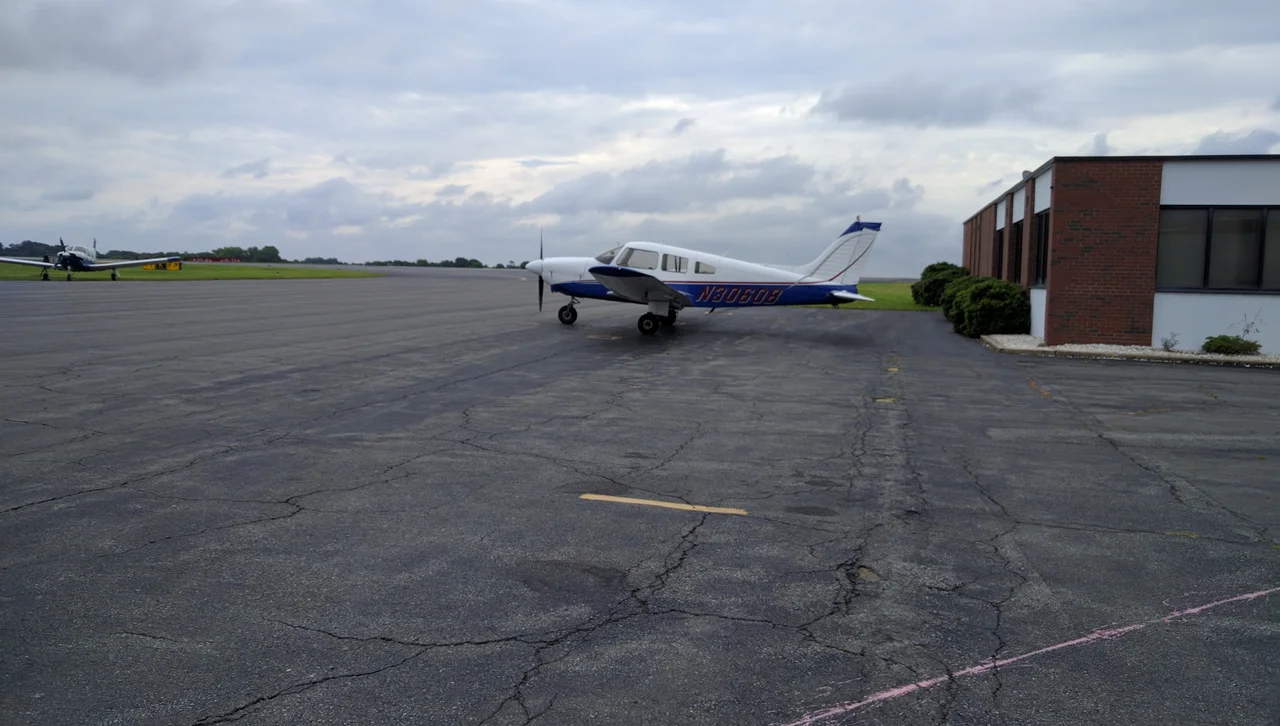

Smith Reynolds Airport
The airport is named for a man who never lived to see thirty. Zachary Smith Reynolds, son of the R.J. Reynolds tobacco fortune, was twenty years old when he died of a gunshot wound at the family's Reynolda estate in 1932. Suicide or murder? Winston-Salem still argues about it. What is not disputed is that Smith Reynolds loved flying - and that, ten years after his death, his family poured money into a struggling municipal airfield three miles northeast of downtown, asked the city to put his name on the gate, and built a memorial that breathes with the engines of working aircraft instead of carving his name into stone.
The Reynolds Name on the Hangar
Before it carried Smith Reynolds's name, the field was called Miller Municipal, after Clint Miller, who pledged $17,000 toward its first hangars in the 1920s. Reynolds Aviation - run by Dick Reynolds, Smith's older brother - was the field's anchor tenant through its first five years. When Dick disbanded that company in 1932, the year Smith died, a group of locals stepped in to start Camel City Flying Service, named for the cigarette that paid for nearly everything in Winston-Salem. The Civil Works Administration extended the runways in 1933. By 1938 the field had four runways and 170 acres. Then in 1940 the airport commission persuaded Eastern Air Lines to add the field to its north-south route, the Reynolds family rerouted money from the Z. Smith Reynolds Foundation to modernize the place, and in 1942 the field was rededicated as Smith Reynolds Airport - a memorial to a young man who had loved airplanes.
Camel City Becomes Piedmont
Camel City Flying Service did not stay Camel City for long. In 1940 it became Piedmont Aviation, and by 1948 Piedmont Airlines - one of the great American regional carriers - flew its first scheduled service out of Wilmington with a Douglas DC-3 nicknamed a Pacemaker. From this little Winston-Salem field, Piedmont built a network that reached from Bristol, Tennessee to Cincinnati to the North Carolina coast. The route between Winston-Salem and Greensboro-High Point, all of sixteen miles long, was for years the shortest commercial flight in the United States. By 1968 Piedmont was flying Boeing 727s out of INT. By 1983 it was four 737 departures a day with nonstops to Atlanta and Washington. Then in 1987 USAir acquired Piedmont, with the merger completing in August 1989, and the heavy maintenance work slowly drained away. The crew base closed in 1991. The big maintenance base closed in 1998. In January 2000 the last commuter flight to Charlotte took off, and that was the end of major airline service in Winston-Salem.
May 5, 1989
Late in the afternoon of May 5, 1989, an F2 tornado came out of the sky and walked right across the airfield. Thirty aircraft were tossed like grocery bags. Hangars were torn open. The Winston-Salem Journal would later call it the most destructive tornado in Forsyth County history. Smith Reynolds Airport survived. The hangars were rebuilt, the tower kept its hours, and within a few years general aviation traffic was as busy as ever. The airshow that drew 20,000 spectators each September continued through 2015. The field still hums - flight schools turning Cessnas in the pattern, North State Aviation parking 737s in the heavy maintenance bays, Signature Flight Support fueling Gulfstreams for the corporate jet crowd. The control tower works from 6 a.m. to 9:30 p.m., 365 days a year.
A Memorial That Flies
Most twenty-year-olds who die famously become statues, or scholarships, or sentences in old newspapers. Smith Reynolds got an airport - one that has launched a regional airline, weathered a tornado, trained Air Corps pilots in World War II, and still pushes private aircraft into the Piedmont sky every clear morning. The Z. Smith Reynolds Foundation his family established in his memory has grown into one of North Carolina's largest charitable foundations. The airport (ICAO: KINT) keeps the family name visible from the air. Whether his death in July 1932 was suicide, accident, or something darker is a question Winston-Salem has never quite let go of. The airport answers it differently. It simply keeps flying.
From the Air
Smith Reynolds Airport (KINT) sits at 36.13 degrees N, 80.22 degrees W, about 3 miles northeast of downtown Winston-Salem at 970 feet field elevation. Two paved runways: 4/22 (6,655 feet) and 15/33 (3,810 feet). Class D airspace when the tower is open (6:00 AM to 9:30 PM local). Nearby airports: Piedmont Triad International (KGSO) 17 nm east in Greensboro; Statesville Regional (KSVH) 30 nm southwest; Asheboro (KHBI) 26 nm southeast. Recommended viewing altitude 2,500-3,500 feet AGL for the Reynolda estate and the city skyline two miles south. Watch for transient corporate jets and student traffic in the pattern.
Nearby Stories
- Battle of Wetzell's Mill 5 km away
- Hanging Rock State Park 5.9 km away
- Mebane's Bridge 11 km away
- 2025 North Carolina Cessna Citation II Crash 13 km away
- Wil-Cox Bridge 16 km away
- North Wilkesboro Speedway 19 km away
- Galax, Virginia 31 km away
- Deep River Camelback Truss Bridge 60 km away