
Martinsville Speedway
Henry Clay Earles called the dust unbelievable. On September 7, 1947, the day he opened his new race track on thirty acres of Virginia red clay, the modified stock cars churned the surface into a brown fog so dense that after the race, in his words from a 1967 interview, you couldn't recognize the people leaving. He compared the cloud to the aftermath of an H-bomb. The crowd of 6,013 went home filthy. The race had been won, in the dust and confusion, by a former Air Force tail gunner named Red Byron, the man who had won the war's wreckage and would shortly win NASCAR's first championship as well. Earles had budgeted ten thousand dollars for his three partners. He had spent twice that. Almost no one in 1947 would have predicted that this tiny, half-mile dirt track in Ridgeway, Virginia, would still be on the NASCAR schedule almost eighty years later - still hosting two Cup Series weekends a year, still the shortest oval in the series, still producing the most physical racing on the calendar.
The Paperclip
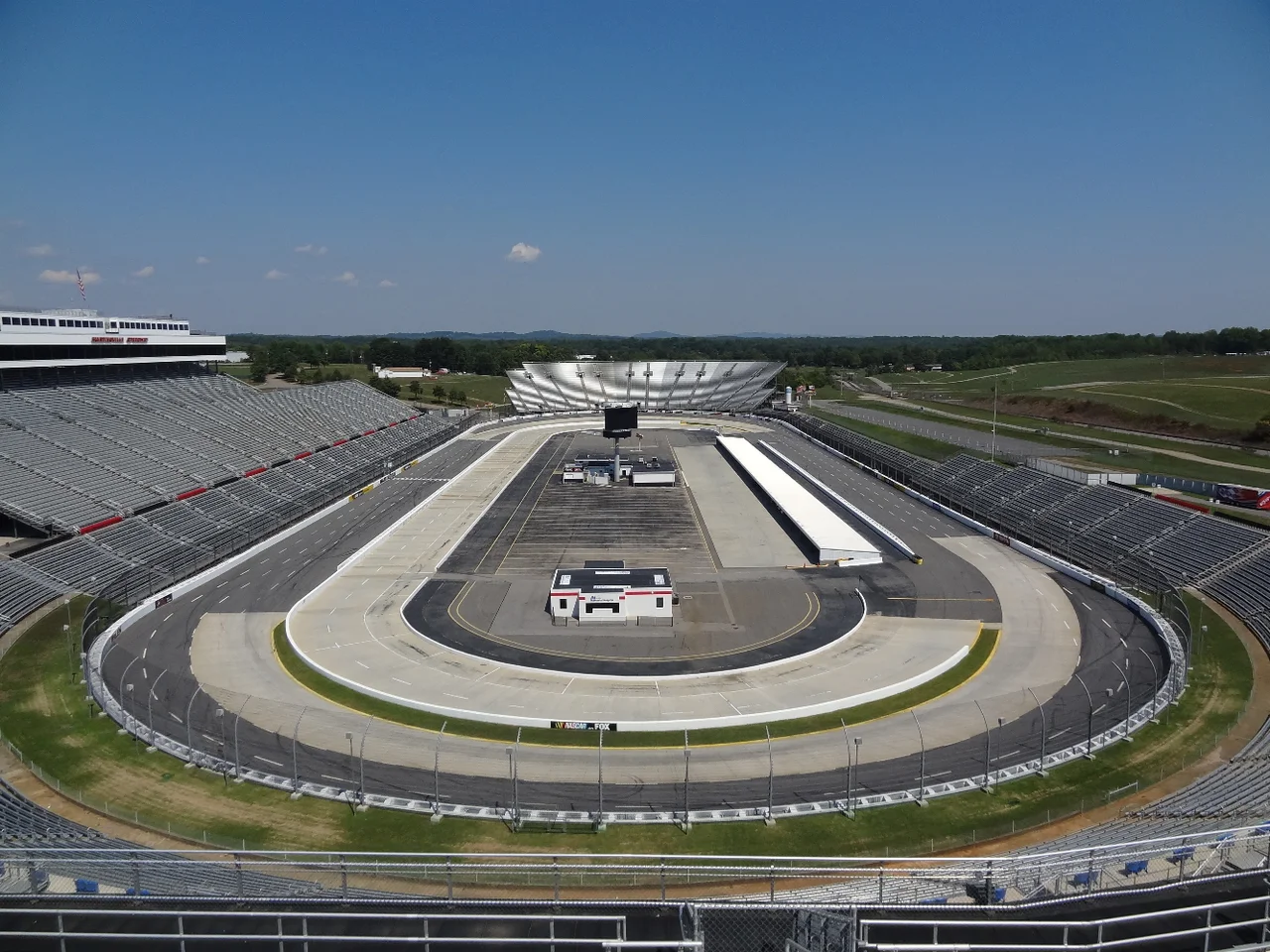
Look at Martinsville Speedway from directly above and the shape is instantly recognizable: a paperclip. Two long, perfectly flat straightaways connected by tight 180-degree turns. The corners are banked twelve degrees - shallow by NASCAR standards. The straights have no banking at all. That geometry forces a particular kind of racing. Cars cannot turn off speed in the corners the way they can at Bristol or Daytona; they have to brake hard, drop deep into the turn, and then accelerate out. With forty cars trying to do that at once on a 0.526-mile circuit, contact is not just possible. It is the medium. The lower lanes of the corners are paved with concrete, the rest of the track with asphalt - a hybrid surface put in starting in 1976 because Earles thought concrete would survive the constant scrubbing better. Half a century later he was right.
From Dirt to NASCAR
Earles paved the track in 1955. By then the inaugural NASCAR Cup race had already run here in September 1949, Red Byron winning again, and Bill France Sr. had bought out Earles's partners Sam Rice and Henry Lawrence the year before to lock in the relationship. Through the 1960s the speedway kept adding seats. A new East Grandstand brought capacity to 16,000 by 1956. The 1969 reclassification of NASCAR track lengths pushed Martinsville from a billed half-mile to the official 0.526 miles. By 1974 capacity was just over 30,000. The track grew so fast that the maps published by NASCAR could not quite keep up. The wood-and-concrete grandstands of the early postwar years gave way to steel towers and corporate suites. The dust gave way to the smell of brake rotors burning.
Mass Expansion and Modern Tragedy
The 1990s rebuilt the speedway almost from scratch. Every year for five consecutive years - 1989, 1990, 1991, 1992, 1993 - the track added a new tower, totaling more than 14,000 new seats. In 1996 the 7,000-seat Bill France Sr. Tower went up over turns three and four. A second tower joined it on the frontstretch in 1998. Capacity peaked above 70,000 in the early 2000s before sliding back down. The track has also seen tragedy: on October 24, 1985, modified driver Richie Evans, a nine-time NASCAR Modified champion, crashed in turns three and four and died of multiple trauma - the speedway's first fatality. On March 22, 1987, modified driver Charlie Jarzombek died after a stuck throttle sent him into the turn-one wall. SAFER barriers, the energy-absorbing soft walls that have saved many lives since their 2002 introduction, were added at Martinsville in 2004.
The Hot Dogs and the Grandfather Clock
Two things at Martinsville matter beyond the racing. The first is the trophy. Cup Series winners at Martinsville receive a six-foot grandfather clock - an actual functional pendulum clock, presented in victory lane, an oddity older than most of the drivers who win it. Drivers display the clocks proudly in their homes; Tony Stewart has several. The second is the hot dog. Martinsville has sold the same brand of hot dog, by Jesse Jones, since the track started selling concessions in the 1940s - with one brief interruption from 2015 to 2018, when Valleydale Foods replaced Jesse Jones, and the resulting outrage forced NASCAR and the speedway to bring Jesse Jones back. A short orange-tinted dog on a steamed bun with chili, slaw, mustard, and onions. Fans calculate their consumption in dozens. The hot dog, like the clock, is a fixture - an heirloom of an older racing culture that the rest of NASCAR has not quite managed to replace.
Owned by NASCAR, Beloved by Drivers
In May 2004 the France-family-owned International Speedway Corporation announced their $192 million purchase of Martinsville from Earles's family and the remaining minority partners. Earles himself had died in 1999; his grandson Clay Campbell continued running the track, and continues today. In 2019 NASCAR bought ISC outright, taking direct control of Martinsville for the first time. Permanent lighting installed in 2017 made night racing possible. Capacity, after multiple reductions, sits around 44,000 - intimate compared to the giant superspeedways. Drivers consistently rank Martinsville among their favorite tracks, even when they hate it. The 500-lap races take more than three hours of relentless braking. Brake pads glow red. Tempers fray. Cars carry the marks of contact from front bumper to rear, the paint streaked and gouged from constant traffic. It is the closest thing in modern NASCAR to the dust-and-clay racing Earles started on this same patch of Henry County dirt in 1947.
From the Air
Martinsville Speedway sits at 36.634 north, 79.852 west, near Ridgeway in southern Virginia. The distinctive paperclip shape is one of the easiest landmarks to spot from cruising altitude. Blue Ridge Airport (KMTV) is nine miles northwest at Martinsville. Larger airports are Piedmont Triad International (KGSO) in Greensboro NC, about 35 miles south, and Roanoke (KROA) about 50 miles north. The Virginia-North Carolina state line lies just to the south. US-58 and US-220 cross near the track.
Nearby Stories
- Ferrum College 4.1 km away
- Wreck of the Old 97 8 km away
- Pulaski County, Virginia 24 km away
- Chang and Eng Bunker 24 km away
- Chinqua Penn Plantation 25 km away
- Battle of Shallow Ford 34 km away
- Pyle's Massacre 37 km away
- Red Hill Patrick Henry National Memorial 51 km away