
North Carolina Aviation Museum
Jim Peddycord did not live to see what his museum became. In 1994 the Asheboro businessman started the Foundation for Aircraft Conservation with a couple of his warbirds in an empty hangar at Asheboro Regional Airport. In 1996 he organized the first air show as a fundraiser. The second air show was scheduled for June 5, 1997. The day before the event, June 4, Peddycord and his son Rick took two aircraft up for practice and collided in mid-air. Both died. The foundation took Peddycord's name in his honor. Another local businessman, Craig Branson, picked up the work. The hangars kept filling with airplanes. The fly-in kept happening on the second Saturday in June. The museum kept going - because in aviation, that is what you do.
Two Hangars Worth of Stories
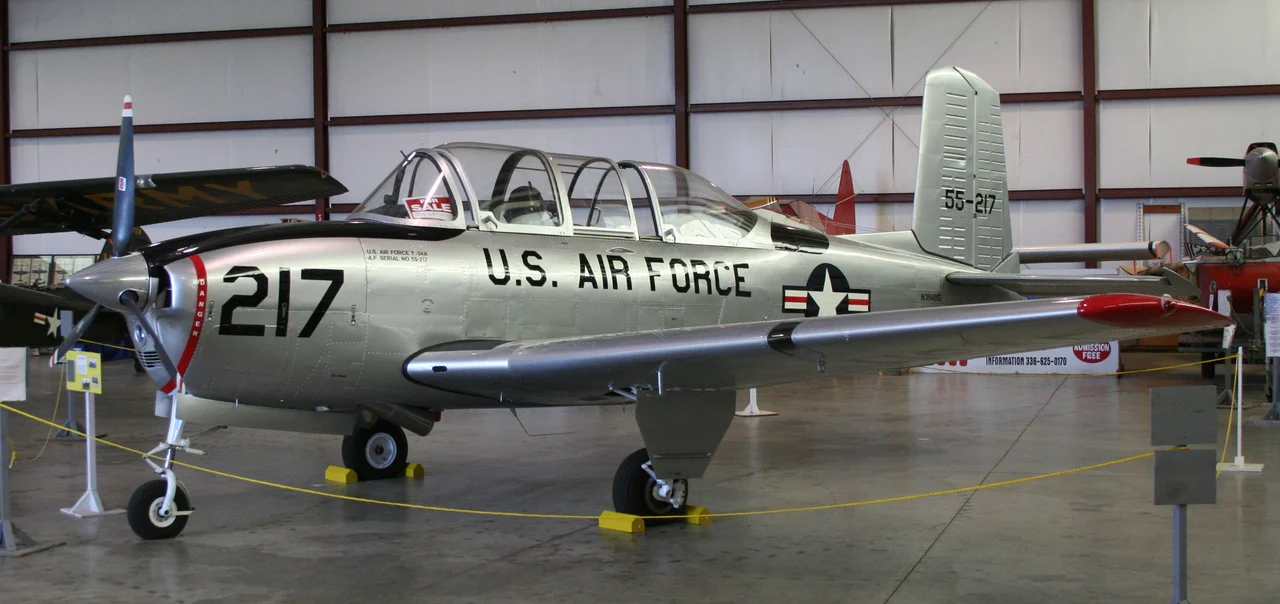
Almost every aircraft in the museum is privately owned and on loan, and almost every one is kept in flight-worthy condition. The collection turns over - planes come, planes go. But the standouts have included a Piper J-3 Flitfire (NC1776) that Orville Wright flew on a 1943 War Bond tour — the aircraft carried RAF Benevolent Fund markings from its 1941 origins. A 1930 Savoia-Marchetti S.56, one of only two left in the world, on three-year loan from the Reynolda House Museum in Winston-Salem. A Cessna L-19 Bird Dog from the Korean War. A Stearman PT-13D Kaydet that trained American and Allied pilots through the Second World War. A Beechcraft T-34 Mentor and a Swiss Pilatus P-3 - Switzerland's answer to the T-34. One-of-a-kind experimentals: a Shehane Aerosport Quail built in 1978 around a Volkswagen engine; the Purcell Sea Sprite (1975) and Purcell Flightsail Pelican (1990s); the Rutan VariEze, the first ever sold in North Carolina, third sold in the country.
The B-25 Project
In 1998 Craig Branson - the businessman who took over the foundation after the Peddycords' deaths - bought a B-25 Mitchell bomber for restoration and got the community behind building a second hangar to hold it. The Mitchell was the World War II twin-engine medium bomber Jimmy Doolittle's raiders flew off the deck of the USS Hornet to bomb Tokyo in April 1942. The aircraft was completely restored in 2004 and made limited flights in 2004 and 2005. Branson died in 2006. The B-25 is no longer at the museum, but the hangar remains, and over the years it has held an F4U-4 Corsair courtesy of Classic Fighters of America pilot Doug Matthews - one of an estimated forty airworthy Corsairs left in the world - and a Beechcraft C-45A and the T-34 Mentor mentioned above. Outside the hangars sit a WWII Plymouth staff car, a 1942 Harley-Davidson motorcycle, a 1977 Army Jeep, and President Truman's presidential limousine.
The Fly-In
Since 1996 the museum has hosted a fly-in on the second Saturday in June. Visiting pilots fly in from across the Carolinas and Virginia. There are free small-plane rides for children, helicopter rides, a racing car exhibit, ham radio demonstrations, remote-control aircraft demonstrations. The Marines do face painting. In 2009 the fly-in drew 80 visiting aircraft and 1,500 patrons. By 2010 those figures jumped to 150 aircraft and 2,500 patrons. In 2012, 120 to 150 planes flew in - including the museum's old B-25, called the Korean War Hero, and a Beech 18. The fly-in is the museum's signature event. It is also the event that killed its founder, and it is held in the same month, almost on the same weekend. The volunteers and staff who run the place do not pretend the history isn't there. They just keep doing the work.
Not the Other One
The North Carolina Aviation Museum is in Asheboro - not to be confused with the Carolinas Aviation Museum, which is in Charlotte and which most North Carolinians know as the home of the Airbus A320 that Captain Sullenberger landed in the Hudson River. The Asheboro museum is smaller, scrappier, more focused on actively flying privately-owned aircraft, and it doubles as the official site of the North Carolina Aviation Hall of Fame - a designation it picked up in 2001-2002 when the facility expanded its mission to include uniforms, weapons, artwork, and the 150-plus aircraft models that hang from the gift shop ceiling. Bob Moon, the museum's first manager, assembled most of those models and donated them before his death in October 2007. The gift shop is named for him. Inside it, miniature Wright Flyers, Messerschmitts, Mustangs and Thunderbolts hang from threads as quiet memorials to the people who built this place.
From the Air
The North Carolina Aviation Museum sits at Asheboro Regional Airport (KHBI) at 35.65 degrees N, 79.89 degrees W in Randolph County, North Carolina, at 671 feet field elevation. Two paved runways. Open Class G airspace below 700 feet AGL. Nearest larger airports: Piedmont Triad International (KGSO) 24 nm north; Raleigh Executive Jetport (KTTA) 32 nm east near Sanford; Smith Reynolds (KINT) 35 nm north. Recommended viewing altitude 2,000-3,000 feet AGL for the airfield. The fly-in is held the second Saturday in June each year - expect heavy traffic on that day. Pattern altitude is 1,700 feet MSL. The Sandhills lie roughly 25 miles south; the Uwharrie Mountains lie 15 miles west.
Nearby Stories
- Concord Speedway 2.9 km away
- Battle of Lindley's Mill 10 km away
- High Point, North Carolina 13 km away
- Thyatira Presbyterian Church, Cemetery, and Manse 13 km away
- Carolina Sandhills 18 km away
- Deep River Camelback Truss Bridge 19 km away
- Battle of Colson's Mill 22 km away
- Battle of Shallow Ford 25 km away