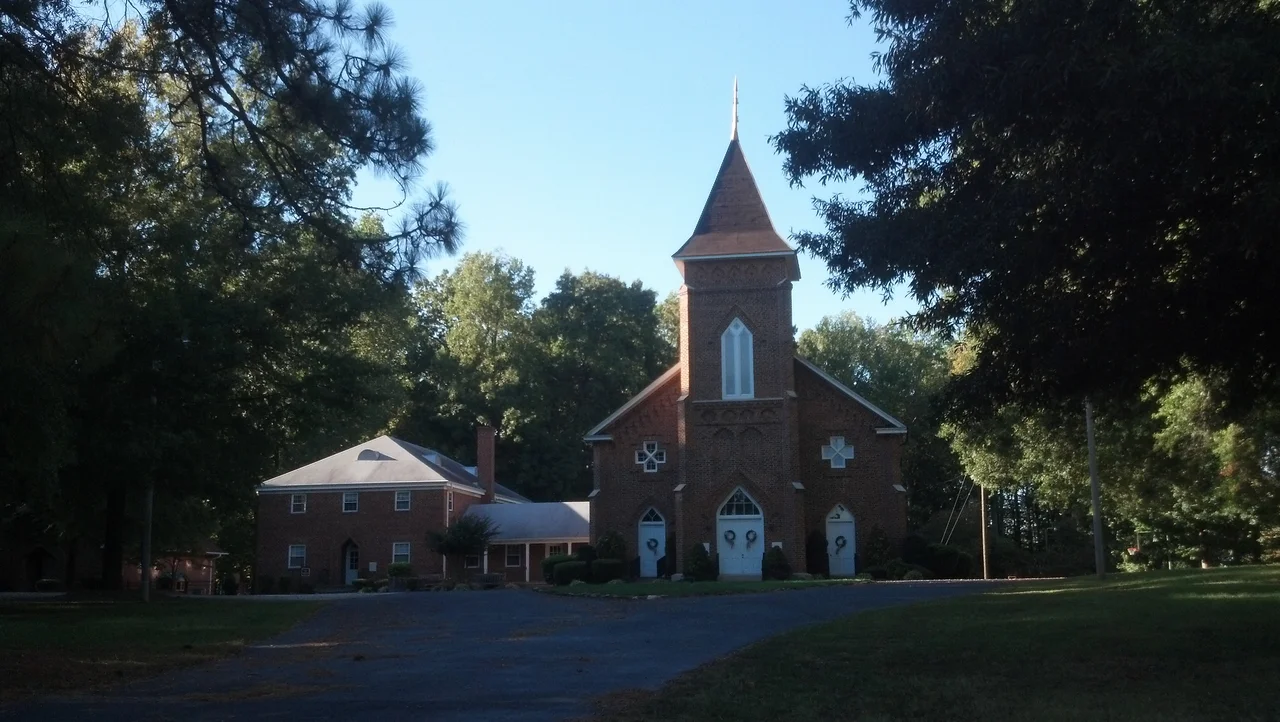

Thyatira Presbyterian Church, Cemetery, and Manse
The third Thyatira meeting house, built sometime before 1860, had three galleries running around the upper level. One of them, by custom of the time, was reserved for enslaved worshippers. The Gothic Revival brick sanctuary that replaced it in 1860 still stands on White Road, ten miles west of Salisbury, looking out over a cemetery full of Revolutionary headstones. Presbyterians have been gathering at this Rowan County crossroads since at least 1750, three years before Rowan County itself existed. Walk the burial ground and the ages stack up underfoot: gravestones from the 1750s, soldiers from Brandywine and King's Mountain, the great-grandparents of an American president, and four tombstones marked with crossbones for executed pirates.
From Cathy's Meeting House to Thyatira
The deed for the land was signed on January 17, 1753, when John and Naomi Lynn conveyed twelve acres to a congregation then called the Lower Meeting House. Twelve more acres followed the next day from James Cathey, whose name was so closely associated with the gathering that the church was soon known as Cathy's Meeting House. The current Thyatira name came later, drawn from one of the seven churches addressed in the Book of Revelation. At the time of the deed the land was still in Anson County; Rowan was carved out on March 27, 1753, two months later. The earliest gravestones in the cemetery predate the deed: John Nisbet, died November 19, 1755, age 50, is the oldest. The graveyard was already in use when the official paperwork caught up.
Four Buildings, One Site
Thyatira's congregation has worshipped in four successive buildings on the same ground. The first was a log meeting house on a small rise above the cemetery. Almost nothing is known about the second. The third was a large frame structure with galleries on three sides, a high pulpit reached by winding stairs, and an ornamental sounding board hung over the minister's head. One of those galleries was reserved for the enslaved members of the congregation, a fact preserved in church records and worth naming plainly: this was a place where the people who built much of the local economy worshipped on a separate floor. The fourth and current building, brick and Gothic Revival, was completed in 1860 and renovated in 1864 after the disruptions of the Civil War.
The Great-Grandparents of a President
Two memorial stones in the Thyatira churchyard mark the lineage of James Knox Polk, eleventh president of the United States. John and Jean Gracy Knox, who died in 1758 and 1772, were Polk's great-grandparents on his mother's side; their tombstone notes that seven of their sons fought in the Revolution. Thomas and Naomi Gillespie were his great-grandparents on his other maternal line; they died on the same day, December 13, 1796, after 51 years of marriage, and were laid in the same coffin by their six sons. President Polk was born in 1795, the year before the Gillespies died, in a log cabin near Pineville about 50 miles south. The Thyatira cemetery is the older chapter of a family story that would run all the way to the Pacific.
Revolutionary Patriots
Walk the older sections and the Revolutionary names come quickly. Captain William Armstrong was mortally wounded at the Battle of Ramseur's Mill on June 20, 1780, and died the next day at age 41. Captain Thomas Cowan fought at King's Mountain, Cowpens, and Ramseur's Mill, and lived until 1817. General Matthew Locke served three terms in the North Carolina Provincial Congress and six in the U.S. Congress before his death in 1801. Elizabeth Maxwell Steele, who died in 1790, is remembered for handing General Nathanael Greene two bags of gold and silver during the army's darkest days in 1781, telling him: 'Take these, General. You need them and I can do without them.' She had run an inn in Salisbury. Greene's morale and the Continental Army's southern campaign survived the night.
The Pirates of Thyatira
Four tombstones in the cemetery are marked with skulls and crossbones, or just crossbones, and a story is told about each of them. According to the tradition, four men who had pirated along the North Carolina coast made their way inland after their ships were finished, settled in Rowan County, took up farming, and lived quietly for years. They were eventually recognized, convicted, and executed for their old crimes. Their families wanted them buried in consecrated ground, and the church agreed on one condition: the gravestones would carry the pirate emblem so that no one would forget. The story may be apocryphal; the stones are real. The cemetery sits in a pastoral hollow under tall trees, and the older slate markers lean slightly with the weight of two and a half centuries. Sunday services still meet in the 1860 sanctuary; the Presbyterian Church (USA) congregation still calls itself Thyatira.
From the Air
Thyatira sits at 35.650 degrees N, 80.637 degrees W in southwestern Rowan County, at 220 White Road off NC 150 in the Mill Bridge area. Best viewed from 2,500 to 4,000 feet AGL. Mid-Carolina Regional (KRUQ, Salisbury) is about 10 miles east; Statesville Regional (KSVH) is about 20 miles north. The brick church and its cemetery clearing are visible in the surrounding hardwoods.
Nearby Stories
- University of North Carolina at Charlotte 5.3 km away
- Hickory Motor Speedway 12 km away
- Kings Mountain Mine 18 km away
- High Point, North Carolina 19 km away
- Battle of Colson's Mill 21 km away
- North Carolina Aviation Museum 25 km away
- Perciphull Campbell House 25 km away
- Blowing Rock 52 km away