
High Point, North Carolina
Twice a year, downtown High Point fills with 70,000 to 80,000 people who do not live there. They come in April and October for the High Point Market, the world's largest home furnishings industry trade show: roughly 11.5 million square feet of showroom space, around 2,000 exhibitors, 180 buildings, and buyers from more than a hundred countries. A 2018 Duke study put the economic impact at $6.7 billion a year. The rest of the year, the downtown is curiously quiet - more than half of it owned by International Market Centers, more than half of that left vacant between markets because that is how a city designed around two industry weeks works.
Why Furniture, Why Here
The English-descended settlers who moved into the Piedmont in the 17th century made functional furniture on a small scale. Reconstruction-era labor was cheap, and High Point sat squarely on top of the answer to the southern furniture market - hardwood. The vast oak, hickory, and walnut forests of central and western North Carolina stood within shipping range of the rail lines that crossed at High Point. The first factory, High Point Furniture Manufacturing Company, opened in 1889. From 1890 to 1900, 38 new furniture factories opened in North Carolina, 13 of them in High Point. Auxiliary plants followed: veneers, plate glass, mirrors, paint, locks. By 1905 the city's manufacturers had organized the first Southern Furniture Exposition. It became the High Point Market.
The World's Largest Bureau
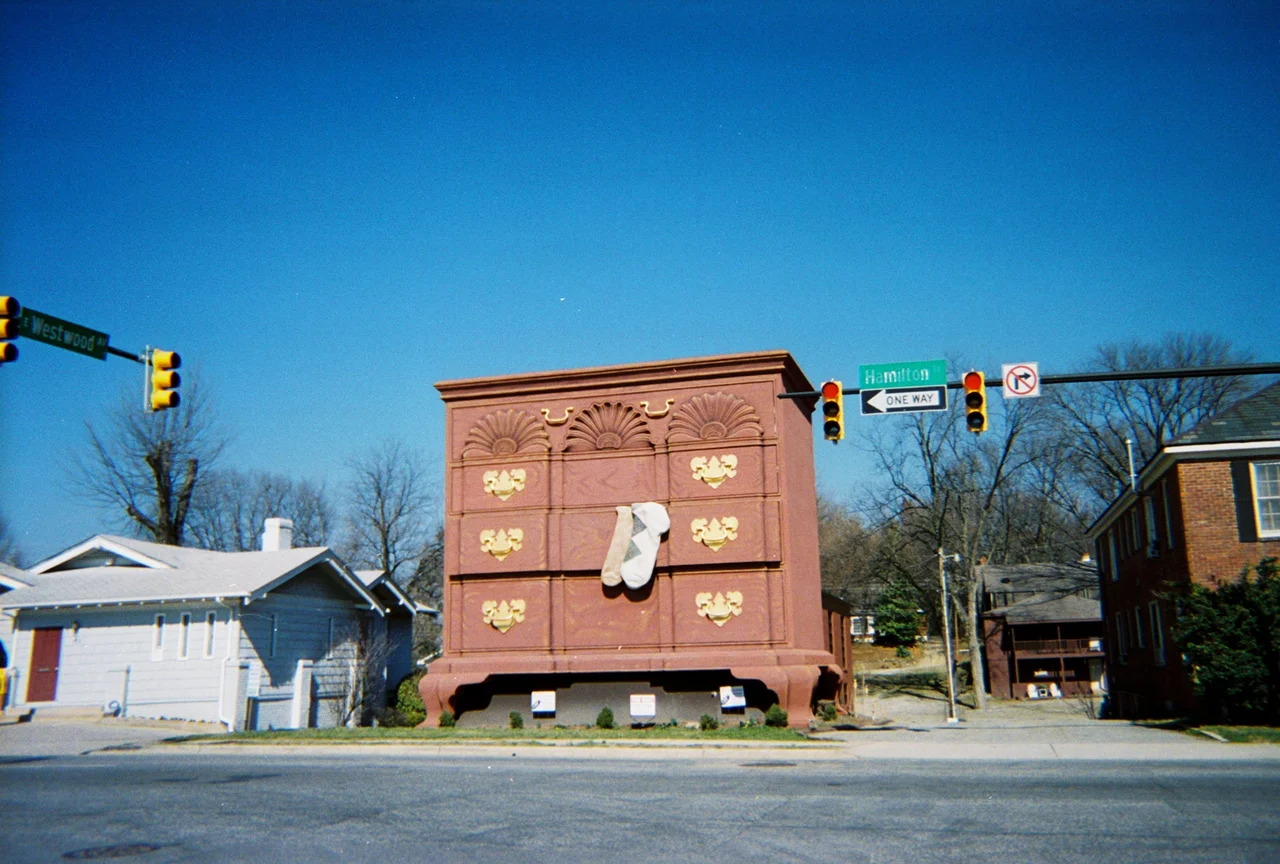
In 1926 the High Point Chamber of Commerce built a 38-foot-tall chest of drawers on North Hamilton Street - the World's Largest Bureau, a piece of automobile-oriented pop architecture meant to advertise the town's product. It still stands. So does the Tomlinson Chair Company's old plant. Tomlinson invented profit-sharing among furniture workers in the early 1900s, paid bonuses to anyone who exceeded quota, and helped pioneer period reproduction furniture at industrial scale. Buyers had to travel to the factory to choose orders because the pieces were too heavy and too expensive to ship on speculation. Sears Roebuck eventually figured out how to mass-market North Carolina furniture by catalogue. By the 1990s, China had figured out how to make the same furniture cheaper. The factories closed. The market - the showrooms, the buyers, the trade press - stayed.
John Coltrane's Saxophone
High Point's most important cultural export is John Coltrane. He was born in Hamlet, North Carolina, on September 23, 1926, but his family moved to High Point shortly after, and he grew up here, attended William Penn High School - the Quaker-founded school for Black students that the Society of Friends started in 1891 and that black educator Alfred J. Griffin led through its long expansion - and discovered the saxophone here. The school closed in 1968, but reopened in 2003 as the Penn-Griffin School for the Arts, a public arts magnet. Coltrane is far from the only musical name from High Point: Fantasia Barrino won American Idol season 3. Adam Lazzara fronts Taking Back Sunday. Opera tenor Anthony Dean Griffey, jazz legend Coltrane, blues guitarist Bob Margolin - the town's sound is wider than its furniture catalogues suggest.
Quakers, Cox, and the University
Quakers ran the city's early education long before the public schools existed. The High Point public system opened in 1897 with a $10,000 bond, partly to buy J. Elwood Cox's family home for the first schoolhouse. By 1921 the Chamber of Commerce went after a college, beating Greensboro and Burlington with 60 acres of land and $100,000 in citizen pledges. High Point College opened in 1924 with three buildings and a Methodist Protestant affiliation. It became High Point University in 1991. Under President Nido Qubein, the campus has become known for an extravagant student-experience emphasis - chandeliers in dorm lobbies, valet parking for visitors - and a steady upward climb in enrollment. The town's other living institution is Truist Point, downtown's multi-use stadium, home of the High Point Rockers in independent baseball and the Carolina Core FC in MLS Next Pro.
Quiet Industry, Hidden Wealth
Besides furniture, High Point has historically built hosiery and Hatteras Yachts, and in the diversified present makes a living off distribution, logistics, customer service, banking, manufacturing, and pharmaceuticals. The Bienenstock Furniture Library downtown is the largest furniture specialty library in the world, with more than 4,000 design volumes. Castle McCulloch Gold Mill - built 1832 to process ore from the central Carolina gold belt - now hosts weddings. The High Point Museum and Historical Park keeps the 1786 Haley House and a working blacksmith shop. The Piedmont Environmental Center offers 375 acres of hiking trails along High Point City Lake, the 540-acre reservoir that powers an old amusement park with the state's largest outdoor swimming pool. The furniture made the city famous. The rest is what keeps it standing between markets.
From the Air
High Point sits at 35.971N, 79.998W in the southwest corner of Guilford County, with smaller portions extending into Davidson, Randolph, and Forsyth counties. Elevation around 939 ft MSL on the Piedmont uplands. Piedmont Triad International (KGSO) is about 12 nm north and serves the whole Triad metro; smaller alternatives include Smith Reynolds (KINT) about 18 nm northwest in Winston-Salem and Asheboro Regional (KHBI) about 18 nm south. The downtown showroom district is visible at 2,000-3,500 ft AGL as a tight cluster of large blocks just east of US 311; City Lake's reservoir is unmistakable just west of US 311 at I-85 Business. Piedmont Triad's location at the center of the regional rail and interstate net makes the showroom logistics work.
Nearby Stories
- North Carolina Aviation Museum 8.6 km away
- Alamance County, North Carolina 11 km away
- Thyatira Presbyterian Church, Cemetery, and Manse 12 km away
- Battle of Shallow Ford 15 km away
- Caswell County, North Carolina 22 km away
- Deep River Camelback Truss Bridge 23 km away
- Chang and Eng Bunker 29 km away
- Chinqua Penn Plantation 32 km away